


Automated Packaging System Market
Automated Packaging System Market Insights, Competitive Landscape, and Market Forecast - 2033
Global Automated Packaging System Market Forecast
The Automated Packaging System Market is expected to grow from USD 86.6 Billion in 2026 to USD 140.9 Billion by 2033, reflecting strong industry expansion and registering a CAGR of 7.2% during the forecast period from 2026 to 2033.
Automated Packaging System Insights
- Box/carton machines are witnessing strong demand in food packaging due to the rise in ready-to-eat and processed food products, which require fast, hygienic, and efficient secondary packaging solutions.
- Filling machines are gaining popularity in beverage packaging as manufacturers seek high-speed, multi-product compatible systems that reduce downtime and improve production line efficiency.
- Wrapping and sealing systems are rapidly adopted in pharmaceutical packaging to comply with stringent regulations for tamper-evidence and ensure product safety during transportation and storage.
- Labelling systems are in high demand in e-commerce packaging as online retailers require fast, automated labelling solutions for real-time tracking, error reduction, and faster order fulfilment.
- Packing and palletising systems are being embraced in personal care and toiletries packaging to handle increasing product variety with flexible automation that reduces manual labor and improves throughput.
A Look Back and a Look Forward - Comparative Analysis
From 2019 to 2024, the global automated packaging system market grew steadily, driven by rising e-commerce, labor shortages, and demand for operational efficiency. Sectors like food, pharmaceuticals, and consumer goods led adoption. COVID-19 accelerated automation as companies sought contactless operations, while investments focused on speed, accuracy, and reducing workforce dependency in warehousing and manufacturing.
Between 2025 and 2032, automation in packaging is expected to expand further due to sustainability regulations, digital transformation, and AI integration. Demand will rise for smart systems with real-time data tracking, predictive maintenance, and eco-friendly packaging capabilities. Customization, robotics, and flexible machinery will shape future growth, especially in fast-moving consumer goods and pharmaceutical applications.
Key Growth Determinants
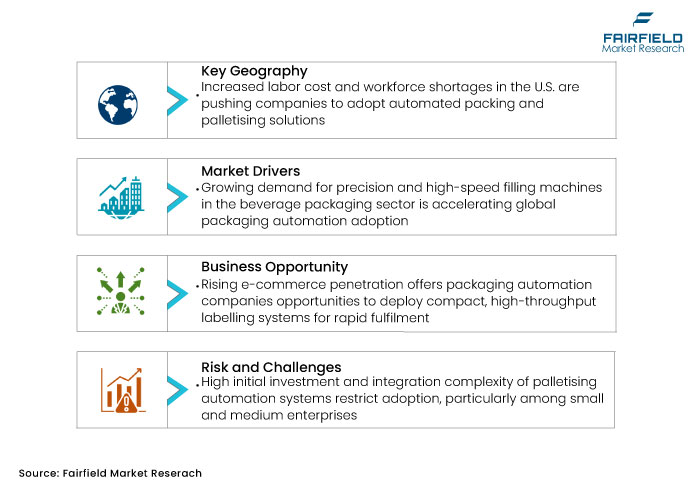
The growing demand for precision and high-speed filling machines in the beverage packaging sector is accelerating global packaging automation adoption
Automation in beverage filling is accelerating global packaging systems demand. The beverage packaging machine market is experiencing strong growth, with filling and capping machines leading the way. High-speed filling machines are widely adopted to improve production speed and consistency. These machines help manufacturers meet rising demand while reducing errors and minimizing product loss in bottling operations.
Manufacturers are focusing on precision and efficiency to meet growing consumer expectations. In 2023, filling machines accounted for nearly 30% of all packaging machinery demand, making it the largest equipment segment. Companies such as Accutek and Cozzoli have seen strong orders for automated liquid filling systems, especially in the beverage industry. The trend is supported by growing needs for hygienic, reliable, and high-throughput packaging processes.
Key Growth Barriers
High initial investment and integration complexity of palletising automation systems restrict adoption, particularly among small and medium enterprises
High initial investment for palletising automation is a major barrier. A standard industrial robotic palletising system can start at around €70,000, not including integration and customization costs. Many small and medium enterprises find this upfront expense too high. As a result, even when automation offers long-term savings, many smaller businesses delay or avoid adoption.
Integration of palletising systems into existing production lines adds more complexity. Companies often need extra hardware, software, and sometimes have to modify their facilities. Industry reviews have shown that high capital expenditure and system integration challenges are key reasons many businesses hesitate to invest. These issues make it difficult for small manufacturers to justify the cost and effort of full-scale automation.
Automated Packaging System Market Opportunities
Rising e-commerce penetration offers packaging automation companies opportunities to deploy compact, high-throughput labelling systems for rapid fulfilment
Rising e-commerce demand is boosting the need for packaging automation. Global e-commerce sales reached US$6 trillion in 2023 and are expected to keep growing as more consumers shop online. This surge is creating pressure on fulfilment centres to process and dispatch orders faster. As a result, businesses are adopting compact, high-speed labelling systems to keep up with daily order volumes and reduce human error.
As warehouses get busier, third-party logistics providers and online brands need compact, high-throughput labelling systems. For instance, some systems now fit in just 10 square metres but still support fast order flow in limited space. Advanced solutions are also reducing labour needs by 50% and lowering package volume by 30%, helping fulfilment centres cut costs and speed up delivery to meet growing customer expectations.
Segment-wise Overview
- Pharmaceutical packaging is witnessing rapid automation due to stringent regulatory demands for tamper-evident and traceable packaging solutions
Pharmaceutical packaging is leading automation growth due to high safety and compliance demands. Nearly 45% of pharmaceutical packaging processes are now automated, reflecting rapid adoption of labeling, sealing, and serialization systems to meet strict drug-traceability rules. Companies like Systech and Praxis are rolling out cloud-based track-and-trace platforms to support global regulations such as the Drug Supply Chain Security Act and the Falsified Medicines Directive.
Demand is also growing for tamper-evident and smart packaging. The global tamper-proof packaging market reached USD 13.4 billion in 2024, driven by rising needs for drug integrity during transit. New solutions, like SCHOTT’s polymer syringe with RFID chips and first-opening indicators, enable automation-ready packaging lines. These innovations highlight why pharmaceutical packaging is the leading equipment type in the automated packaging system market.
- Filling machines remain dominant as manufacturers upgrade to multi-product compatible systems with automated cleaning and reduced downtime
Filling machines remain the top equipment type in automated packaging as industries demand faster, cleaner, and more flexible systems. A recent industry report noted that over 65% of packaging lines in food and beverage sectors now use automated filling machines. Companies are also shifting to clean-in-place systems that reduce manual intervention, cut cleaning time by up to 40%, and improve production uptime.
New product developments support this trend. For example, SIG launched a high-speed aseptic filler capable of handling multiple product types with minimal changeover, reducing downtime by nearly 30%. Similarly, Bosch introduced a modular filling line with automated adjustment features, allowing manufacturers to switch between product formats quickly. These innovations show why filling machines continue to lead in the automated packaging system market.
Regional Analysis
- Increased labor cost and workforce shortages in the U.S. are pushing companies to adopt automated packing and palletising solutions
In North America, high labor costs and workforce shortages are pushing automation. U.S. manufacturing job openings are now double the pre-pandemic levels, with employee turnover reaching 36.6% in 2023. About 65% of packaging operations leaders have stated their intention to adopt automation and robotics, with labor shortages being the top reason behind this shift toward automated systems.
These pressures are driving strong investment in automated packing and palletising solutions. A recent study found that labor issues are the main factor behind the growing use of robotics in warehouses. In 2024, the U.S. saw a sharp rise in demand for robotic palletizers, particularly due to their flexibility, safety, and speed. Automation has become necessary for companies to maintain output despite rising wages and limited worker availability.
- Sustainability regulations in Europe are encouraging adoption of automated carton machines that minimize packaging waste and energy use
In Europe, strict sustainability regulations are pushing companies to adopt automated carton machines that cut packaging waste and reduce energy use. The EU Packaging and Packaging Waste Regulation (PPWR) is encouraging businesses to shift to more efficient packaging methods. Many European manufacturers now use automated systems that right-size each package, helping reduce space and save material with every order.
Leading companies are investing in eco-friendly automation. For example, several logistics centers in Germany and France have installed carton machines that use 20% less energy and reduce cardboard waste by nearly 30%. These systems also help businesses meet carbon reduction goals. As regulations tighten, more European firms are adopting automated packaging solutions that align with sustainability targets and improve operational efficiency.
- Rapid industrialisation and food processing expansion in China and India are fueling demand for advanced wrapping and sealing machines
In Asia Pacific, rapid industrialisation and strong growth in food processing especially in China and India are increasing demand for advanced wrapping and sealing machines. In 2024, China held over 29% share of the global wrapping machine market, showing the country’s growing shift toward automation. In India, rising demand for frozen and ready-to-eat foods is driving the adoption of modern food packaging systems.
Manufacturers across the region are investing in smart and efficient packaging technologies. In India, companies expect packaging automation to grow by more than 10% annually due to the increasing use of smart factories. Throughout Asia Pacific, wrapping machines generated significant revenue in 2024, as businesses focus on reducing manual labor and improving packaging speed and hygiene. These trends highlight the region's leading role in automated packaging system growth.
Competitive Landscape
Competition is intense, with market leaders forming partnerships and acquiring firms to strengthen their product range. Sealed Air’s acquisition of Automated Packaging Systems helped expand its automated bagging solutions. Packsize is acquiring Sparck Technologies to add automated lidding and height-reduction features. These strategic moves show how companies are investing in technology and integration to stay ahead in the market.
Innovation, service, and sustainability are key strategies among leading players. Mondi partnered with CMC to offer automated solutions using sustainable kraft paper for e-commerce packaging. Domino chose Viking Masek’s servo-driven machines to ensure high speed and low maintenance. Domino Printing Sciences also launched automated label printing and inspection systems to reduce human error. These actions show how firms are competing through smart technology, green solutions, and customer-centric services.
Key Companies
- ABB Ltd.
- Rockwell Automation, Inc.
- Schneider Electric SE
- Mitsubishi Electric Corporation
- Siemens AG
- Emerson Electric Co.
- FANUC Corporation
- Bosch Packaging Technology (Syntegon Technology GmbH)
- Kollmorgen Corporation
- Swisslog Holding AG
Global Automated Packaging System Market Segmentation
By Product Type
- Filling Systems
- Cartoning Systems
- Palletizing Systems
- Labeling Systems
- Wrapping Systems
By Automation Type
- Fully Automatic Packaging Systems
- Semi-Automatic Packaging Systems
By End-use Industry
- Food & Beverage
- Pharmaceuticals
- Consumer Goods
- Logistics & E-commerce
- Chemicals
By Function
- Packaging
- Sorting
- Picking & Placing
- Case Packing
- Material Handling
By Region
- North America
- Europe
- Asia Pacific
- Latin America
- Middle East & Africa
- Executive Summary
- Global Automated Packaging System Market Snapshot
- Future Projections
- Key Market Trends
- Regional Snapshot, by Value, 2026
- Analyst Recommendations
- Market Overview
- Market Definitions and Segmentations
- Market Dynamics
- Drivers
- Restraints
- Market Opportunities
- Value Chain Analysis
- COVID-19 Impact Analysis
- Porter's Five Forces Analysis
- Impact of Russia-Ukraine Conflict
- PESTLE Analysis
- Regulatory Analysis
- Price Trend Analysis
- Current Prices and Future Projections, 2025-2033
- Price Impact Factors
- Global Automated Packaging System Market Outlook, 2020 - 2033
- Global Automated Packaging System Market Outlook, by Product Type, Value (US$ Bn), 2020-2033
- Filling Systems
- Cartoning Systems
- Palletizing Systems
- Labeling Systems
- Wrapping Systems
- Global Automated Packaging System Market Outlook, by Automation Type, Value (US$ Bn), 2020-2033
- Fully Automatic Packaging Systems
- Semi-Automatic Packaging Systems
- Global Automated Packaging System Market Outlook, by End-use Industry, Value (US$ Bn), 2020-2033
- Food & Beverage
- Pharmaceuticals
- Consumer Goods
- Logistics & E-commerce
- Chemicals
- Global Automated Packaging System Market Outlook, by Function, Value (US$ Bn), 2020-2033
- Packaging
- Sorting
- Picking & Placing
- Case Packing
- Material Handling
- Global Automated Packaging System Market Outlook, by Region, Value (US$ Bn), 2020-2033
- North America
- Europe
- Asia Pacific
- Latin America
- Middle East & Africa
- Global Automated Packaging System Market Outlook, by Product Type, Value (US$ Bn), 2020-2033
- North America Automated Packaging System Market Outlook, 2020 - 2033
- North America Automated Packaging System Market Outlook, by Product Type, Value (US$ Bn), 2020-2033
- Filling Systems
- Cartoning Systems
- Palletizing Systems
- Labeling Systems
- Wrapping Systems
- North America Automated Packaging System Market Outlook, by Automation Type, Value (US$ Bn), 2020-2033
- Fully Automatic Packaging Systems
- Semi-Automatic Packaging Systems
- North America Automated Packaging System Market Outlook, by End-use Industry, Value (US$ Bn), 2020-2033
- Food & Beverage
- Pharmaceuticals
- Consumer Goods
- Logistics & E-commerce
- Chemicals
- North America Automated Packaging System Market Outlook, by Function, Value (US$ Bn), 2020-2033
- Packaging
- Sorting
- Picking & Placing
- Case Packing
- Material Handling
- North America Automated Packaging System Market Outlook, by Country, Value (US$ Bn), 2020-2033
- U.S. Automated Packaging System Market Outlook, by Product Type, 2020-2033
- U.S. Automated Packaging System Market Outlook, by Automation Type, 2020-2033
- U.S. Automated Packaging System Market Outlook, by End-use Industry, 2020-2033
- U.S. Automated Packaging System Market Outlook, by Function, 2020-2033
- Canada Automated Packaging System Market Outlook, by Product Type, 2020-2033
- Canada Automated Packaging System Market Outlook, by Automation Type, 2020-2033
- Canada Automated Packaging System Market Outlook, by End-use Industry, 2020-2033
- Canada Automated Packaging System Market Outlook, by Function, 2020-2033
- BPS Analysis/Market Attractiveness Analysis
- North America Automated Packaging System Market Outlook, by Product Type, Value (US$ Bn), 2020-2033
- Europe Automated Packaging System Market Outlook, 2020 - 2033
- Europe Automated Packaging System Market Outlook, by Product Type, Value (US$ Bn), 2020-2033
- Filling Systems
- Cartoning Systems
- Palletizing Systems
- Labeling Systems
- Wrapping Systems
- Europe Automated Packaging System Market Outlook, by Automation Type, Value (US$ Bn), 2020-2033
- Fully Automatic Packaging Systems
- Semi-Automatic Packaging Systems
- Europe Automated Packaging System Market Outlook, by End-use Industry, Value (US$ Bn), 2020-2033
- Food & Beverage
- Pharmaceuticals
- Consumer Goods
- Logistics & E-commerce
- Chemicals
- Europe Automated Packaging System Market Outlook, by Function, Value (US$ Bn), 2020-2033
- Packaging
- Sorting
- Picking & Placing
- Case Packing
- Material Handling
- Europe Automated Packaging System Market Outlook, by Country, Value (US$ Bn), 2020-2033
- Germany Automated Packaging System Market Outlook, by Product Type, 2020-2033
- Germany Automated Packaging System Market Outlook, by Automation Type, 2020-2033
- Germany Automated Packaging System Market Outlook, by End-use Industry, 2020-2033
- Germany Automated Packaging System Market Outlook, by Function, 2020-2033
- Italy Automated Packaging System Market Outlook, by Product Type, 2020-2033
- Italy Automated Packaging System Market Outlook, by Automation Type, 2020-2033
- Italy Automated Packaging System Market Outlook, by End-use Industry, 2020-2033
- Italy Automated Packaging System Market Outlook, by Function, 2020-2033
- France Automated Packaging System Market Outlook, by Product Type, 2020-2033
- France Automated Packaging System Market Outlook, by Automation Type, 2020-2033
- France Automated Packaging System Market Outlook, by End-use Industry, 2020-2033
- France Automated Packaging System Market Outlook, by Function, 2020-2033
- U.K. Automated Packaging System Market Outlook, by Product Type, 2020-2033
- U.K. Automated Packaging System Market Outlook, by Automation Type, 2020-2033
- U.K. Automated Packaging System Market Outlook, by End-use Industry, 2020-2033
- U.K. Automated Packaging System Market Outlook, by Function, 2020-2033
- Spain Automated Packaging System Market Outlook, by Product Type, 2020-2033
- Spain Automated Packaging System Market Outlook, by Automation Type, 2020-2033
- Spain Automated Packaging System Market Outlook, by End-use Industry, 2020-2033
- Spain Automated Packaging System Market Outlook, by Function, 2020-2033
- Russia Automated Packaging System Market Outlook, by Product Type, 2020-2033
- Russia Automated Packaging System Market Outlook, by Automation Type, 2020-2033
- Russia Automated Packaging System Market Outlook, by End-use Industry, 2020-2033
- Russia Automated Packaging System Market Outlook, by Function, 2020-2033
- Rest of Europe Automated Packaging System Market Outlook, by Product Type, 2020-2033
- Rest of Europe Automated Packaging System Market Outlook, by Automation Type, 2020-2033
- Rest of Europe Automated Packaging System Market Outlook, by End-use Industry, 2020-2033
- Rest of Europe Automated Packaging System Market Outlook, by Function, 2020-2033
- BPS Analysis/Market Attractiveness Analysis
- Europe Automated Packaging System Market Outlook, by Product Type, Value (US$ Bn), 2020-2033
- Asia Pacific Automated Packaging System Market Outlook, 2020 - 2033
- Asia Pacific Automated Packaging System Market Outlook, by Product Type, Value (US$ Bn), 2020-2033
- Filling Systems
- Cartoning Systems
- Palletizing Systems
- Labeling Systems
- Wrapping Systems
- Asia Pacific Automated Packaging System Market Outlook, by Automation Type, Value (US$ Bn), 2020-2033
- Fully Automatic Packaging Systems
- Semi-Automatic Packaging Systems
- Asia Pacific Automated Packaging System Market Outlook, by End-use Industry, Value (US$ Bn), 2020-2033
- Food & Beverage
- Pharmaceuticals
- Consumer Goods
- Logistics & E-commerce
- Chemicals
- Asia Pacific Automated Packaging System Market Outlook, by Function, Value (US$ Bn), 2020-2033
- Packaging
- Sorting
- Picking & Placing
- Case Packing
- Material Handling
- Asia Pacific Automated Packaging System Market Outlook, by Country, Value (US$ Bn), 2020-2033
- China Automated Packaging System Market Outlook, by Product Type, 2020-2033
- China Automated Packaging System Market Outlook, by Automation Type, 2020-2033
- China Automated Packaging System Market Outlook, by End-use Industry, 2020-2033
- China Automated Packaging System Market Outlook, by Function, 2020-2033
- Japan Automated Packaging System Market Outlook, by Product Type, 2020-2033
- Japan Automated Packaging System Market Outlook, by Automation Type, 2020-2033
- Japan Automated Packaging System Market Outlook, by End-use Industry, 2020-2033
- Japan Automated Packaging System Market Outlook, by Function, 2020-2033
- South Korea Automated Packaging System Market Outlook, by Product Type, 2020-2033
- South Korea Automated Packaging System Market Outlook, by Automation Type, 2020-2033
- South Korea Automated Packaging System Market Outlook, by End-use Industry, 2020-2033
- South Korea Automated Packaging System Market Outlook, by Function, 2020-2033
- India Automated Packaging System Market Outlook, by Product Type, 2020-2033
- India Automated Packaging System Market Outlook, by Automation Type, 2020-2033
- India Automated Packaging System Market Outlook, by End-use Industry, 2020-2033
- India Automated Packaging System Market Outlook, by Function, 2020-2033
- Southeast Asia Automated Packaging System Market Outlook, by Product Type, 2020-2033
- Southeast Asia Automated Packaging System Market Outlook, by Automation Type, 2020-2033
- Southeast Asia Automated Packaging System Market Outlook, by End-use Industry, 2020-2033
- Southeast Asia Automated Packaging System Market Outlook, by Function, 2020-2033
- Rest of SAO Automated Packaging System Market Outlook, by Product Type, 2020-2033
- Rest of SAO Automated Packaging System Market Outlook, by Automation Type, 2020-2033
- Rest of SAO Automated Packaging System Market Outlook, by End-use Industry, 2020-2033
- Rest of SAO Automated Packaging System Market Outlook, by Function, 2020-2033
- BPS Analysis/Market Attractiveness Analysis
- Asia Pacific Automated Packaging System Market Outlook, by Product Type, Value (US$ Bn), 2020-2033
- Latin America Automated Packaging System Market Outlook, 2020 - 2033
- Latin America Automated Packaging System Market Outlook, by Product Type, Value (US$ Bn), 2020-2033
- Filling Systems
- Cartoning Systems
- Palletizing Systems
- Labeling Systems
- Wrapping Systems
- Latin America Automated Packaging System Market Outlook, by Automation Type, Value (US$ Bn), 2020-2033
- Fully Automatic Packaging Systems
- Semi-Automatic Packaging Systems
- Latin America Automated Packaging System Market Outlook, by End-use Industry, Value (US$ Bn), 2020-2033
- Food & Beverage
- Pharmaceuticals
- Consumer Goods
- Logistics & E-commerce
- Chemicals
- Latin America Automated Packaging System Market Outlook, by Function, Value (US$ Bn), 2020-2033
- Packaging
- Sorting
- Picking & Placing
- Case Packing
- Material Handling
- Latin America Automated Packaging System Market Outlook, by Country, Value (US$ Bn), 2020-2033
- Brazil Automated Packaging System Market Outlook, by Product Type, 2020-2033
- Brazil Automated Packaging System Market Outlook, by Automation Type, 2020-2033
- Brazil Automated Packaging System Market Outlook, by End-use Industry, 2020-2033
- Brazil Automated Packaging System Market Outlook, by Function, 2020-2033
- Mexico Automated Packaging System Market Outlook, by Product Type, 2020-2033
- Mexico Automated Packaging System Market Outlook, by Automation Type, 2020-2033
- Mexico Automated Packaging System Market Outlook, by End-use Industry, 2020-2033
- Mexico Automated Packaging System Market Outlook, by Function, 2020-2033
- Argentina Automated Packaging System Market Outlook, by Product Type, 2020-2033
- Argentina Automated Packaging System Market Outlook, by Automation Type, 2020-2033
- Argentina Automated Packaging System Market Outlook, by End-use Industry, 2020-2033
- Argentina Automated Packaging System Market Outlook, by Function, 2020-2033
- Rest of LATAM Automated Packaging System Market Outlook, by Product Type, 2020-2033
- Rest of LATAM Automated Packaging System Market Outlook, by Automation Type, 2020-2033
- Rest of LATAM Automated Packaging System Market Outlook, by End-use Industry, 2020-2033
- Rest of LATAM Automated Packaging System Market Outlook, by Function, 2020-2033
- BPS Analysis/Market Attractiveness Analysis
- Latin America Automated Packaging System Market Outlook, by Product Type, Value (US$ Bn), 2020-2033
- Middle East & Africa Automated Packaging System Market Outlook, 2020 - 2033
- Middle East & Africa Automated Packaging System Market Outlook, by Product Type, Value (US$ Bn), 2020-2033
- Filling Systems
- Cartoning Systems
- Palletizing Systems
- Labeling Systems
- Wrapping Systems
- Middle East & Africa Automated Packaging System Market Outlook, by Automation Type, Value (US$ Bn), 2020-2033
- Fully Automatic Packaging Systems
- Semi-Automatic Packaging Systems
- Middle East & Africa Automated Packaging System Market Outlook, by End-use Industry, Value (US$ Bn), 2020-2033
- Food & Beverage
- Pharmaceuticals
- Consumer Goods
- Logistics & E-commerce
- Chemicals
- Middle East & Africa Automated Packaging System Market Outlook, by Function, Value (US$ Bn), 2020-2033
- Packaging
- Sorting
- Picking & Placing
- Case Packing
- Material Handling
- Middle East & Africa Automated Packaging System Market Outlook, by Country, Value (US$ Bn), 2020-2033
- GCC Automated Packaging System Market Outlook, by Product Type, 2020-2033
- GCC Automated Packaging System Market Outlook, by Automation Type, 2020-2033
- GCC Automated Packaging System Market Outlook, by End-use Industry, 2020-2033
- GCC Automated Packaging System Market Outlook, by Function, 2020-2033
- South Africa Automated Packaging System Market Outlook, by Product Type, 2020-2033
- South Africa Automated Packaging System Market Outlook, by Automation Type, 2020-2033
- South Africa Automated Packaging System Market Outlook, by End-use Industry, 2020-2033
- South Africa Automated Packaging System Market Outlook, by Function, 2020-2033
- Egypt Automated Packaging System Market Outlook, by Product Type, 2020-2033
- Egypt Automated Packaging System Market Outlook, by Automation Type, 2020-2033
- Egypt Automated Packaging System Market Outlook, by End-use Industry, 2020-2033
- Egypt Automated Packaging System Market Outlook, by Function, 2020-2033
- Nigeria Automated Packaging System Market Outlook, by Product Type, 2020-2033
- Nigeria Automated Packaging System Market Outlook, by Automation Type, 2020-2033
- Nigeria Automated Packaging System Market Outlook, by End-use Industry, 2020-2033
- Nigeria Automated Packaging System Market Outlook, by Function, 2020-2033
- Rest of Middle East Automated Packaging System Market Outlook, by Product Type, 2020-2033
- Rest of Middle East Automated Packaging System Market Outlook, by Automation Type, 2020-2033
- Rest of Middle East Automated Packaging System Market Outlook, by End-use Industry, 2020-2033
- Rest of Middle East Automated Packaging System Market Outlook, by Function, 2020-2033
- BPS Analysis/Market Attractiveness Analysis
- Middle East & Africa Automated Packaging System Market Outlook, by Product Type, Value (US$ Bn), 2020-2033
- Competitive Landscape
- Company Vs Segment Heatmap
- Company Market Share Analysis, 2025
- Competitive Dashboard
- Company Profiles
- ABB Ltd.
- Company Overview
- Product Portfolio
- Financial Overview
- Business Strategies and Developments
- Rockwell Automation, Inc.
- Schneider Electric SE
- Mitsubishi Electric Corporation
- Siemens AG
- Emerson Electric Co.
- FANUC Corporation
- Bosch Packaging Technology (Syntegon Technology GmbH)
- Kollmorgen Corporation
- Swisslog Holding AG
- ABB Ltd.
- Appendix
- Research Methodology
- Report Assumptions
- Acronyms and Abbreviations
|
BASE YEAR |
HISTORICAL DATA |
FORECAST PERIOD |
UNITS |
|||
 |
2025 |
 |
2020 - 2025 |
 |
2026 - 2033 |
Value: US$ Billion |
|
REPORT FEATURES |
DETAILS |
|
Equipment Type Coverage |
|
|
End Use Coverage |
|
|
Geographical Coverage |
|
|
Leading Companies |
|
|
Report Highlights |
Key Market Indicators, Macro-micro economic impact analysis, Technological Roadmap, Key Trends, Driver, Restraints, and Future Opportunities & Revenue Pockets, Porter’s 5 Forces Analysis, Historical Trend (2019-2024), Market Estimates and Forecast, Market Dynamics, Industry Trends, Competition Landscape, Category, Region, Country-wise Trends & Analysis, COVID-19 Impact Analysis (Demand and Supply Chain) |
Our Research Methodology
Considering the volatility of business today, traditional approaches to strategizing a game plan can be unfruitful if not detrimental. True ambiguity is no way to determine a forecast. A myriad of predetermined factors must be accounted for such as the degree of risk involved, the magnitude of circumstances, as well as conditions or consequences that are not known or unpredictable. To circumvent binary views that cast uncertainty, the application of market research intelligence to strategically posture, move, and enable actionable outcomes is necessary.
View Methodology
Quality Assured
Rigorous Validation Process

Confidentiality Assured
End-to-end Data Security

Custom Research Services
Tailored To Your Objectives
FAQs
The Automated Packaging System market size is expected to reach USD 86.6 billion in 2026.
The Automated Packaging System market is projected to grow at a CAGR of 7.2% through 2033.
The Automated Packaging System market growth is driven by rising e-commerce demand, increasing industrial automation, and the adoption of AI-powered smart packaging solutions.
North America is the dominant regional market for the Automated Packaging System market.
ABB Ltd., Rockwell Automation, Inc., Siemens AG, Schneider Electric SE, and FANUC Corporation are some leading industry players in the Automated Packaging System market.
Related Reports
Aircraft Ground Support Equipment Market Insights, Competitive Landscape, and Market Forecast - 2033
Aircraft Ground Support Equipment Market to reach US$2.28B by 2033 at 4.3% CAGR, driven by airport expansion, electric GSE, and fleet growth.
Condition Monitoring System Market Insights, Competitive Landscape, and Market Forecast 2033
The condition monitoring system market is projected to grow from US$ 6.90 billion in 2026 to US$ 12.53 billion by 2033, growing at an 8.9% CAGR.
Automotive Performance Parts Market Insights, Competitive Landscape, and Market Forecast 2033
Automotive Performance Parts Market is projected to reach US$579.72 billion by 2033, driven by motorsports, vehicle customization, and OEM demand.
Automotive Load Floor Market Insights, Competitive Landscape, and Market Forecast 2033
Automotive Load Floor Market is projected to reach US$452.03 million by 2033, driven by EV adoption, lightweight materials, and SUV demand.
Hand Tools Market Insights, Competitive Landscape, and Market Forecast - 2033
Hand Tools Market to reach US$37.54 billion by 2033 at 5.8% CAGR, driven by construction, infrastructure projects, and industrial demand.
Gaskets and Seals Market Insights, Competitive Landscape, and Market Forecast - 2033
Gaskets and Seals Market to reach US$97.27 billion by 2033 at 4.6% CAGR, driven by EVs, renewable energy, and industrial demand