



Baby Feeding Accessories Market
Baby Feeding Accessories Market Insights, Competitive Landscape, and Market Forecast - 2033
Global Baby Feeding Accessories Market Forecast
The Baby Feeding Accessories Market is expected to grow from USD 2.7 Billion in 2026 to USD 4.3 Billion by 2033, reflecting strong industry expansion and registering a CAGR of 6.7% during the forecast period from 2026 to 2033.
Executive Summary & Key Highlights
- Bottles and Nipples lead the global market with over 40% share, driven by universal usage and high replacement frequency.
- Non-metallic accessories dominate material demand with over 70% share due to strong preference for plastic, silicone, and glass safety-certified products.
- The 6 Months to 12 Months segment is the fastest-growing age category, boosted by earlier complementary feeding and baby-led weaning practices.
- Offline Sales Channels dominate distribution with over 65% share as parents prefer in-store product inspection and immediate availability.
- Asia-Pacific leads regionally with around 45% share, driven by strong demand in China and India and rising adoption of premium feeding accessories.
- Niger has the highest birth rate in the world at 44.5 births per 1,000 people (CIA World).
- Angola’s birth rate declined sharply from 46.89 (2000) to 37.1 (2024).
- Central Africa consistently ranks as the fastest-growing region globally, even when UN or World Bank data slightly reshuffle country rankings.
- Vatican City records the lowest global birth rate, at 4.63 births per 1,000 people.
Market Dynamics: Drivers, Restraints, and Opportunities Analysis
Market Drivers
- Rising Female Workforce Participation and Dual-Income Household Prevalence
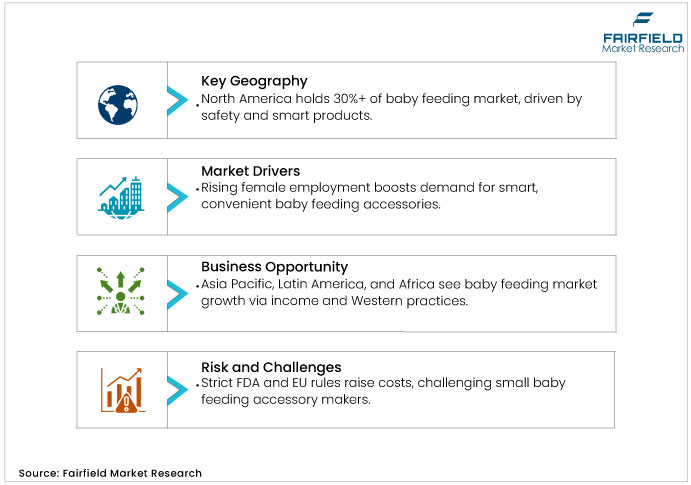
The rise in women’s formal employment, now above 60% in regions such as the U.S. and Western Europe and growing across India and Southeast Asia is reshaping demand for baby feeding accessories. Working mothers increasingly adopt electric breast pumps with portable batteries, insulated bottle carriers, and rapid-sterilization systems to balance career and infant nutrition needs.
Delayed parenthood among career-driven demographics further strengthens demand for premium, tech-enhanced solutions, with working mothers showing 40–50% higher transaction values than non-working parents. Companies offering workplace lactation support and time-efficient feeding systems are positioned to gain, while traditional portfolios risk share losses amid evolving workforce and policy trends.
- Heightened Safety and Material Composition Standards:
Growing consumer awareness around feeding accessory safety driven by recalls and stricter regulations has led parents to prioritize BPA-free, phthalate-free, food-grade materials such as medical-grade silicone and borosilicate glass. Safety-related search queries have risen by 60% in the past five years, increasing scrutiny and boosting demand for certified products.
Premium safety-focused accessories now command 30–50% higher prices, while FDA and EN 14350 standards create barriers for smaller manufacturers and strengthen baby feeding accessories market consolidation. Asia-Pacific shows strong momentum as countries such as China adopt stricter standards, favoring brands with transparent supply chains and multi-certification capabilities in an environment shaped by rising parental risk sensitivity.
Market Restraints
- Stringent Regulatory Compliance and Certification Requirements
The baby feeding accessories market faces significant regulatory pressure, with the FDA enforcing strict requirements under the Federal Food, Drug, and Cosmetic Act and the EU applying EN 14350 and Regulation (EC) 1935/2004. These frameworks demand extensive pre-market testing, facility inspections, and documentation, often requiring several hundred thousand dollars in initial and ongoing compliance investments, which disproportionately burden smaller manufacturers.
Global expansion adds complexity as companies must navigate multiple certification processes, and scrutiny has intensified since the 2022 U.S. infant formula contamination incident, increasing inspection frequency. While challenging, strong compliance systems can become a competitive advantage, supported by strategies such as enhanced quality management, regulatory affairs expertise, and proactive engagement with authorities to anticipate evolving standards.
- Raw Material Price Volatility and Supply Chain Constraints
Volatility in key materials such as medical-grade silicone, borosilicate glass, stainless steel, and BPA-free plastics poses a major restraint for the baby feeding accessories market, with silicone prices fluctuating 15–25% annually due to crude oil trends and capacity shifts. These swings compress manufacturer margins unless mitigated through pricing adjustments or efficiency gains, as seen during COVID-19 when supply shortages and extended lead times exposed global vulnerabilities.
Exposure varies by product type, with glass bottle makers impacted by energy-intensive processes and silicone nipple producers reliant on specialized chemical supply chains. Companies strengthening resilience through multi-region supplier diversification, long-term contracts with price-stabilization clauses, vertical integration, and flexible product designs capable of material substitution are better positioned to maintain competitiveness during commodity price cycles.
Market Opportunities
- Expansion into Emerging Market Geographies with Rising Middle-Class Populations
Emerging economies in Asia-Pacific, Latin America, and parts of Africa offer strong growth potential, driven by expanding populations, rising disposable incomes, and greater adoption of Western feeding practices. India stands out with the baby feeding accessories market projected to grow at a sustainable CAGR through 2034, supported by a rapidly expanding middle class earning over US$ 10,000 annually.
Southeast Asian countries such as Indonesia, Vietnam, and the Philippines also show promise with birth rates above replacement levels and accelerating urbanization. Opportunities include first-mover advantages in branding and distribution, supported by tiered product strategies that balance premium imports for affluent consumers with value-oriented local products, while accounting for regulatory diversity, cultural feeding norms, and the need for long-term market development investments.
- Technology Integration for Connected Feeding Ecosystems
The integration of the baby feeding accessories market with digital health platforms is expanding rapidly, driven by smart products such as connected breast pumps that track milk volumes, session duration, and feeding schedules while offering AI-powered lactation coaching. This opportunity extends to smart warmers, automated formula dispensers, and sensor-enabled utensils, supported by rising adoption rates that now exceed 30% among tech-oriented parents in the United States.
To capitalize on this growth, companies need capabilities in hardware design, mobile app development, data security, and digital service delivery to create seamless, premium user experiences. The long-term opportunity depends on continued consumer acceptance of connected infant-care devices and careful navigation of data privacy risks that could otherwise limit adoption.
Regional Market Assessment: Strategic Geography Analysis
- North America: Regulatory Leadership and Market Maturity
North America holds over 30% of the global baby feeding accessories market, with the U.S. valued at US$ 810 million in 2025, driven by high female workforce participation above 60%, strong safety awareness, and rapid adoption of smart feeding accessories. The region shows premium product growth and intense competition between multinational brands and emerging direct-to-consumer players.
Strict FDA regulations heightened after the 2022 infant formula contamination incident create advantages for established manufacturers with strong quality systems while raising entry barriers for smaller firms. Innovation hubs such as Boston, San Francisco, and New York continue advancing smart pumps, sterilization systems, and sustainable materials, requiring brands to balance premium pricing, omnichannel presence, and clinical validation to stay competitive.
- Europe: Regulatory Harmonization and Differentiated Market Dynamics
Germany accounts for 30–35% of Europe’s baby feeding accessories demand, followed by the U.K. with 25–30%, supported by premium product preference, strong retail networks, and high online penetration. The baby feeding accessories market in Europe is projected to exceed US$ 1.13 billion by 2032, with growth driven by immigration-supported birth rates and expanding premium categories despite slower momentum than emerging markets.
EU regulations, including EN 14350 and Regulation (EC) 1935/2004, create harmonized safety standards that benefit manufacturers able to meet stringent national requirements, while sustainability expectations reshape competition through recyclable materials and circular business models. Successful expansion requires aligning with country-specific norms, partnering with major European retailers, and emphasizing sustainability credentials that align with evolving consumer values.
- Asia-Pacific: Demographic Expansion and Competitive Intensity
The Asia-Pacific region leads the global baby feeding accessories market with around 45% share, projected to exceed US$ 1.95 billion by 2032, driven by rising incomes, urbanization, and strong demographic demand. China contributes 35–40% of regional value, supported by more than 10 million annual births and a growing preference for premium, safety-certified imported brands.
India is the fastest-growing baby feeding accessories market with a sustainable CAGR through 2032, fueled by 25 million+ annual births, expanding middle-class spending, and increasing female workforce participation. Regional competition spans mature markets such as Japan to high-growth Southeast Asia, with global and local manufacturers benefiting from strong production hubs in China and Taiwan and digital engagement via platforms such as WeChat and LINE.
Competitive Landscape: Market Structure and Strategic Positioning
The baby feeding accessories market shows moderate global concentration, with major players such as Philips Avent, Medela, Dr. Brown’s, Tommee Tippee, Munchkin, Pigeon, and Chicco holding 35–45% of total market value while regional brands and private labels create significant fragmentation. Differentiation ranges from innovation-focused leaders integrating smart technology and clinical validation to cost-focused mass-market competitors and premium specialists such as Comotomo and Hegen using unique materials and high-end design.
Entry barriers include regulatory compliance costs requiring hundreds of thousands of dollars, strong incumbent brand trust, and limited retail shelf access, although e-commerce has lowered distribution hurdles for direct-to-consumer brands. Competitive trends feature portfolio expansion through acquisitions, private equity interest in regional growth brands, and vertical integration, especially in silicone nipple production to enhance supply chain control and quality assurance.
Key Players
• Philips Avent
• Tommee Tippee
• Medela
• Nuk (Newell Brands)
• Dr. Brown's
• Mayborn USA Inc. (Tommee Tippee)
• Pigeon Corporation
• Lässig GmbH
• NOVATEX GmbH
• Carter's, Inc. (Skip Hop)
Global Baby Feeding Accessories Market Segmentation-
By Product Type:
• Bottles and Nipples
• Breastfeeding Accessories
• Baby Feeding Utensils
• Baby Formula Dispensers
• Other Product Types
By Material Type:
• Metallic Accessories
• Non-Metallic Accessories
By Age Group:
• Less than 6 Months
• 6 months to 12 Months
• 12 Months to 3 Years
• More than 3 Years
By Price Range:
• Low (Less than USD 50)
• Medium (USD 50 to USD 100)
• High or Premium (More than USD 100)
By End Use Verticals:
• Residential Use
• Commercial Use
By Sales or Distribution Channel:
• Online Retail Channels
• Offline Sales Channels
By Region:
• North America Market
• Latin America Market
• Europe Market
• East Asia Market
• South Asia and Pacific Market
• The Middle East and Africa (MEA) Market
- Executive Summary
- Global Baby Feeding Accessories Market Snapshot
- Future Projections
- Key Market Trends
- Regional Snapshot, by Value, 2026
- Analyst Recommendations
- Market Overview
- Market Definitions and Segmentations
- Market Dynamics
- Drivers
- Restraints
- Market Opportunities
- Value Chain Analysis
- COVID-19 Impact Analysis
- Porter's Five Forces Analysis
- Impact of Russia-Ukraine Conflict
- PESTLE Analysis
- Regulatory Analysis
- Price Trend Analysis
- Current Prices and Future Projections, 2025-2033
- Price Impact Factors
- Global Baby Feeding Accessories Market Outlook, 2020 - 2033
- Global Baby Feeding Accessories Market Outlook, by Product Type, Value (US$ Bn), 2020-2033
- Bottles and Nipples
- Breastfeeding Accessories
- Baby Feeding Utensils
- Baby Feeding Utensils
- Global Baby Feeding Accessories Market Outlook, by Material Type, Value (US$ Bn), 2020-2033
- Metallic Accessories
- Non-Metallic Accessories
- Global Baby Feeding Accessories Market Outlook, by Age Group, Value (US$ Bn), 2020-2033
- Less than 6 Months
- 6 months to 12 Months
- 12 Months to 3 Years
- More than 3 Years
- Global Baby Feeding Accessories Market Outlook, by Price Range, Value (US$ Bn), 2020-2033
- Low (Less than USD 50)
- Medium (USD 50 to USD 100)
- High or Premium (More than USD 100)
- Global Baby Feeding Accessories Market Outlook, by End Use Verticals, Value (US$ Bn), 2020-2033
- Residential Use
- Commercial Use
- Global Baby Feeding Accessories Market Outlook, by Region, Value (US$ Bn), 2020-2033
- North America
- Europe
- Asia Pacific
- Latin America
- Middle East & Africa
- Global Baby Feeding Accessories Market Outlook, by Product Type, Value (US$ Bn), 2020-2033
- North America Baby Feeding Accessories Market Outlook, 2020 - 2033
- North America Baby Feeding Accessories Market Outlook, by Product Type, Value (US$ Bn), 2020-2033
- Bottles and Nipples
- Breastfeeding Accessories
- Baby Feeding Utensils
- Baby Feeding Utensils
- North America Baby Feeding Accessories Market Outlook, by Material Type, Value (US$ Bn), 2020-2033
- Metallic Accessories
- Non-Metallic Accessories
- North America Baby Feeding Accessories Market Outlook, by Age Group, Value (US$ Bn), 2020-2033
- Less than 6 Months
- 6 months to 12 Months
- 12 Months to 3 Years
- More than 3 Years
- North America Baby Feeding Accessories Market Outlook, by Price Range, Value (US$ Bn), 2020-2033
- Low (Less than USD 50)
- Medium (USD 50 to USD 100)
- High or Premium (More than USD 100)
- North America Baby Feeding Accessories Market Outlook, by End Use Verticals, Value (US$ Bn), 2020-2033
- Residential Use
- Commercial Use
- North America Baby Feeding Accessories Market Outlook, by Country, Value (US$ Bn), 2020-2033
- U.S. Baby Feeding Accessories Market Outlook, by Product Type, 2020-2033
- U.S. Baby Feeding Accessories Market Outlook, by Material Type, 2020-2033
- U.S. Baby Feeding Accessories Market Outlook, by Age Group, 2020-2033
- U.S. Baby Feeding Accessories Market Outlook, by Price Range, 2020-2033
- U.S. Baby Feeding Accessories Market Outlook, by End Use Verticals, 2020-2033
- Canada Baby Feeding Accessories Market Outlook, by Product Type, 2020-2033
- Canada Baby Feeding Accessories Market Outlook, by Material Type, 2020-2033
- Canada Baby Feeding Accessories Market Outlook, by Age Group, 2020-2033
- Canada Baby Feeding Accessories Market Outlook, by Price Range, 2020-2033
- Canada Baby Feeding Accessories Market Outlook, by End Use Verticals, 2020-2033
- BPS Analysis/Market Attractiveness Analysis
- North America Baby Feeding Accessories Market Outlook, by Product Type, Value (US$ Bn), 2020-2033
- Europe Baby Feeding Accessories Market Outlook, 2020 - 2033
- Europe Baby Feeding Accessories Market Outlook, by Product Type, Value (US$ Bn), 2020-2033
- Bottles and Nipples
- Breastfeeding Accessories
- Baby Feeding Utensils
- Baby Feeding Utensils
- Europe Baby Feeding Accessories Market Outlook, by Material Type, Value (US$ Bn), 2020-2033
- Metallic Accessories
- Non-Metallic Accessories
- Europe Baby Feeding Accessories Market Outlook, by Age Group, Value (US$ Bn), 2020-2033
- Less than 6 Months
- 6 months to 12 Months
- 12 Months to 3 Years
- More than 3 Years
- Europe Baby Feeding Accessories Market Outlook, by Price Range, Value (US$ Bn), 2020-2033
- Low (Less than USD 50)
- Medium (USD 50 to USD 100)
- High or Premium (More than USD 100)
- Europe Baby Feeding Accessories Market Outlook, by End Use Verticals, Value (US$ Bn), 2020-2033
- Residential Use
- Commercial Use
- Europe Baby Feeding Accessories Market Outlook, by Country, Value (US$ Bn), 2020-2033
- Germany Baby Feeding Accessories Market Outlook, by Product Type, 2020-2033
- Germany Baby Feeding Accessories Market Outlook, by Material Type, 2020-2033
- Germany Baby Feeding Accessories Market Outlook, by Age Group, 2020-2033
- Germany Baby Feeding Accessories Market Outlook, by Price Range, 2020-2033
- Germany Baby Feeding Accessories Market Outlook, by End Use Verticals, 2020-2033
- Italy Baby Feeding Accessories Market Outlook, by Product Type, 2020-2033
- Italy Baby Feeding Accessories Market Outlook, by Material Type, 2020-2033
- Italy Baby Feeding Accessories Market Outlook, by Age Group, 2020-2033
- Italy Baby Feeding Accessories Market Outlook, by Price Range, 2020-2033
- Italy Baby Feeding Accessories Market Outlook, by End Use Verticals, 2020-2033
- France Baby Feeding Accessories Market Outlook, by Product Type, 2020-2033
- France Baby Feeding Accessories Market Outlook, by Material Type, 2020-2033
- France Baby Feeding Accessories Market Outlook, by Age Group, 2020-2033
- France Baby Feeding Accessories Market Outlook, by Price Range, 2020-2033
- France Baby Feeding Accessories Market Outlook, by End Use Verticals, 2020-2033
- U.K. Baby Feeding Accessories Market Outlook, by Product Type, 2020-2033
- U.K. Baby Feeding Accessories Market Outlook, by Material Type, 2020-2033
- U.K. Baby Feeding Accessories Market Outlook, by Age Group, 2020-2033
- U.K. Baby Feeding Accessories Market Outlook, by Price Range, 2020-2033
- U.K. Baby Feeding Accessories Market Outlook, by End Use Verticals, 2020-2033
- Spain Baby Feeding Accessories Market Outlook, by Product Type, 2020-2033
- Spain Baby Feeding Accessories Market Outlook, by Material Type, 2020-2033
- Spain Baby Feeding Accessories Market Outlook, by Age Group, 2020-2033
- Spain Baby Feeding Accessories Market Outlook, by Price Range, 2020-2033
- Spain Baby Feeding Accessories Market Outlook, by End Use Verticals, 2020-2033
- Russia Baby Feeding Accessories Market Outlook, by Product Type, 2020-2033
- Russia Baby Feeding Accessories Market Outlook, by Material Type, 2020-2033
- Russia Baby Feeding Accessories Market Outlook, by Age Group, 2020-2033
- Russia Baby Feeding Accessories Market Outlook, by Price Range, 2020-2033
- Russia Baby Feeding Accessories Market Outlook, by End Use Verticals, 2020-2033
- Rest of Europe Baby Feeding Accessories Market Outlook, by Product Type, 2020-2033
- Rest of Europe Baby Feeding Accessories Market Outlook, by Material Type, 2020-2033
- Rest of Europe Baby Feeding Accessories Market Outlook, by Age Group, 2020-2033
- Rest of Europe Baby Feeding Accessories Market Outlook, by Price Range, 2020-2033
- Rest of Europe Baby Feeding Accessories Market Outlook, by End Use Verticals, 2020-2033
- BPS Analysis/Market Attractiveness Analysis
- Europe Baby Feeding Accessories Market Outlook, by Product Type, Value (US$ Bn), 2020-2033
- Asia Pacific Baby Feeding Accessories Market Outlook, 2020 - 2033
- Asia Pacific Baby Feeding Accessories Market Outlook, by Product Type, Value (US$ Bn), 2020-2033
- Bottles and Nipples
- Breastfeeding Accessories
- Baby Feeding Utensils
- Baby Feeding Utensils
- Asia Pacific Baby Feeding Accessories Market Outlook, by Material Type, Value (US$ Bn), 2020-2033
- Metallic Accessories
- Non-Metallic Accessories
- Asia Pacific Baby Feeding Accessories Market Outlook, by Age Group, Value (US$ Bn), 2020-2033
- Less than 6 Months
- 6 months to 12 Months
- 12 Months to 3 Years
- More than 3 Years
- Asia Pacific Baby Feeding Accessories Market Outlook, by Price Range, Value (US$ Bn), 2020-2033
- Low (Less than USD 50)
- Medium (USD 50 to USD 100)
- High or Premium (More than USD 100)
- Asia Pacific Baby Feeding Accessories Market Outlook, by End Use Verticals, Value (US$ Bn), 2020-2033
- Residential Use
- Commercial Use
- Asia Pacific Baby Feeding Accessories Market Outlook, by Country, Value (US$ Bn), 2020-2033
- China Baby Feeding Accessories Market Outlook, by Product Type, 2020-2033
- China Baby Feeding Accessories Market Outlook, by Material Type, 2020-2033
- China Baby Feeding Accessories Market Outlook, by Age Group, 2020-2033
- China Baby Feeding Accessories Market Outlook, by Price Range, 2020-2033
- China Baby Feeding Accessories Market Outlook, by End Use Verticals, 2020-2033
- Japan Baby Feeding Accessories Market Outlook, by Product Type, 2020-2033
- Japan Baby Feeding Accessories Market Outlook, by Material Type, 2020-2033
- Japan Baby Feeding Accessories Market Outlook, by Age Group, 2020-2033
- Japan Baby Feeding Accessories Market Outlook, by Price Range, 2020-2033
- Japan Baby Feeding Accessories Market Outlook, by End Use Verticals, 2020-2033
- South Korea Baby Feeding Accessories Market Outlook, by Product Type, 2020-2033
- South Korea Baby Feeding Accessories Market Outlook, by Material Type, 2020-2033
- South Korea Baby Feeding Accessories Market Outlook, by Age Group, 2020-2033
- South Korea Baby Feeding Accessories Market Outlook, by Price Range, 2020-2033
- South Korea Baby Feeding Accessories Market Outlook, by End Use Verticals, 2020-2033
- India Baby Feeding Accessories Market Outlook, by Product Type, 2020-2033
- India Baby Feeding Accessories Market Outlook, by Material Type, 2020-2033
- India Baby Feeding Accessories Market Outlook, by Age Group, 2020-2033
- India Baby Feeding Accessories Market Outlook, by Price Range, 2020-2033
- India Baby Feeding Accessories Market Outlook, by End Use Verticals, 2020-2033
- Southeast Asia Baby Feeding Accessories Market Outlook, by Product Type, 2020-2033
- Southeast Asia Baby Feeding Accessories Market Outlook, by Material Type, 2020-2033
- Southeast Asia Baby Feeding Accessories Market Outlook, by Age Group, 2020-2033
- Southeast Asia Baby Feeding Accessories Market Outlook, by Price Range, 2020-2033
- Southeast Asia Baby Feeding Accessories Market Outlook, by End Use Verticals, 2020-2033
- Rest of SAO Baby Feeding Accessories Market Outlook, by Product Type, 2020-2033
- Rest of SAO Baby Feeding Accessories Market Outlook, by Material Type, 2020-2033
- Rest of SAO Baby Feeding Accessories Market Outlook, by Age Group, 2020-2033
- Rest of SAO Baby Feeding Accessories Market Outlook, by Price Range, 2020-2033
- Rest of SAO Baby Feeding Accessories Market Outlook, by End Use Verticals, 2020-2033
- BPS Analysis/Market Attractiveness Analysis
- Asia Pacific Baby Feeding Accessories Market Outlook, by Product Type, Value (US$ Bn), 2020-2033
- Latin America Baby Feeding Accessories Market Outlook, 2020 - 2033
- Latin America Baby Feeding Accessories Market Outlook, by Product Type, Value (US$ Bn), 2020-2033
- Bottles and Nipples
- Breastfeeding Accessories
- Baby Feeding Utensils
- Baby Feeding Utensils
- Latin America Baby Feeding Accessories Market Outlook, by Material Type, Value (US$ Bn), 2020-2033
- Metallic Accessories
- Non-Metallic Accessories
- Latin America Baby Feeding Accessories Market Outlook, by Age Group, Value (US$ Bn), 2020-2033
- Less than 6 Months
- 6 months to 12 Months
- 12 Months to 3 Years
- More than 3 Years
- Latin America Baby Feeding Accessories Market Outlook, by Price Range, Value (US$ Bn), 2020-2033
- Low (Less than USD 50)
- Medium (USD 50 to USD 100)
- High or Premium (More than USD 100)
- Latin America Baby Feeding Accessories Market Outlook, by End Use Verticals, Value (US$ Bn), 2020-2033
- Residential Use
- Commercial Use
- Latin America Baby Feeding Accessories Market Outlook, by Country, Value (US$ Bn), 2020-2033
- Brazil Baby Feeding Accessories Market Outlook, by Product Type, 2020-2033
- Brazil Baby Feeding Accessories Market Outlook, by Material Type, 2020-2033
- Brazil Baby Feeding Accessories Market Outlook, by Age Group, 2020-2033
- Brazil Baby Feeding Accessories Market Outlook, by Price Range, 2020-2033
- Brazil Baby Feeding Accessories Market Outlook, by End Use Verticals, 2020-2033
- Mexico Baby Feeding Accessories Market Outlook, by Product Type, 2020-2033
- Mexico Baby Feeding Accessories Market Outlook, by Material Type, 2020-2033
- Mexico Baby Feeding Accessories Market Outlook, by Age Group, 2020-2033
- Mexico Baby Feeding Accessories Market Outlook, by Price Range, 2020-2033
- Mexico Baby Feeding Accessories Market Outlook, by End Use Verticals, 2020-2033
- Argentina Baby Feeding Accessories Market Outlook, by Product Type, 2020-2033
- Argentina Baby Feeding Accessories Market Outlook, by Material Type, 2020-2033
- Argentina Baby Feeding Accessories Market Outlook, by Age Group, 2020-2033
- Argentina Baby Feeding Accessories Market Outlook, by Price Range, 2020-2033
- Argentina Baby Feeding Accessories Market Outlook, by End Use Verticals, 2020-2033
- Rest of LATAM Baby Feeding Accessories Market Outlook, by Product Type, 2020-2033
- Rest of LATAM Baby Feeding Accessories Market Outlook, by Material Type, 2020-2033
- Rest of LATAM Baby Feeding Accessories Market Outlook, by Age Group, 2020-2033
- Rest of LATAM Baby Feeding Accessories Market Outlook, by Price Range, 2020-2033
- Rest of LATAM Baby Feeding Accessories Market Outlook, by End Use Verticals, 2020-2033
- BPS Analysis/Market Attractiveness Analysis
- Latin America Baby Feeding Accessories Market Outlook, by Product Type, Value (US$ Bn), 2020-2033
- Middle East & Africa Baby Feeding Accessories Market Outlook, 2020 - 2033
- Middle East & Africa Baby Feeding Accessories Market Outlook, by Product Type, Value (US$ Bn), 2020-2033
- Bottles and Nipples
- Breastfeeding Accessories
- Baby Feeding Utensils
- Baby Feeding Utensils
- Middle East & Africa Baby Feeding Accessories Market Outlook, by Material Type, Value (US$ Bn), 2020-2033
- Metallic Accessories
- Non-Metallic Accessories
- Middle East & Africa Baby Feeding Accessories Market Outlook, by Age Group, Value (US$ Bn), 2020-2033
- Less than 6 Months
- 6 months to 12 Months
- 12 Months to 3 Years
- More than 3 Years
- Middle East & Africa Baby Feeding Accessories Market Outlook, by Price Range, Value (US$ Bn), 2020-2033
- Low (Less than USD 50)
- Medium (USD 50 to USD 100)
- High or Premium (More than USD 100)
- Middle East & Africa Baby Feeding Accessories Market Outlook, by End Use Verticals, Value (US$ Bn), 2020-2033
- Residential Use
- Commercial Use
- Middle East & Africa Baby Feeding Accessories Market Outlook, by Country, Value (US$ Bn), 2020-2033
- GCC Baby Feeding Accessories Market Outlook, by Product Type, 2020-2033
- GCC Baby Feeding Accessories Market Outlook, by Material Type, 2020-2033
- GCC Baby Feeding Accessories Market Outlook, by Age Group, 2020-2033
- GCC Baby Feeding Accessories Market Outlook, by Price Range, 2020-2033
- GCC Baby Feeding Accessories Market Outlook, by End Use Verticals, 2020-2033
- South Africa Baby Feeding Accessories Market Outlook, by Product Type, 2020-2033
- South Africa Baby Feeding Accessories Market Outlook, by Material Type, 2020-2033
- South Africa Baby Feeding Accessories Market Outlook, by Age Group, 2020-2033
- South Africa Baby Feeding Accessories Market Outlook, by Price Range, 2020-2033
- South Africa Baby Feeding Accessories Market Outlook, by End Use Verticals, 2020-2033
- Egypt Baby Feeding Accessories Market Outlook, by Product Type, 2020-2033
- Egypt Baby Feeding Accessories Market Outlook, by Material Type, 2020-2033
- Egypt Baby Feeding Accessories Market Outlook, by Age Group, 2020-2033
- Egypt Baby Feeding Accessories Market Outlook, by Price Range, 2020-2033
- Egypt Baby Feeding Accessories Market Outlook, by End Use Verticals, 2020-2033
- Nigeria Baby Feeding Accessories Market Outlook, by Product Type, 2020-2033
- Nigeria Baby Feeding Accessories Market Outlook, by Material Type, 2020-2033
- Nigeria Baby Feeding Accessories Market Outlook, by Age Group, 2020-2033
- Nigeria Baby Feeding Accessories Market Outlook, by Price Range, 2020-2033
- Nigeria Baby Feeding Accessories Market Outlook, by End Use Verticals, 2020-2033
- Rest of Middle East Baby Feeding Accessories Market Outlook, by Product Type, 2020-2033
- Rest of Middle East Baby Feeding Accessories Market Outlook, by Material Type, 2020-2033
- Rest of Middle East Baby Feeding Accessories Market Outlook, by Age Group, 2020-2033
- Rest of Middle East Baby Feeding Accessories Market Outlook, by Price Range, 2020-2033
- Rest of Middle East Baby Feeding Accessories Market Outlook, by End Use Verticals, 2020-2033
- BPS Analysis/Market Attractiveness Analysis
- Middle East & Africa Baby Feeding Accessories Market Outlook, by Product Type, Value (US$ Bn), 2020-2033
- Competitive Landscape
- Company Vs Segment Heatmap
- Company Market Share Analysis, 2025
- Competitive Dashboard
- Company Profiles
- Philips Avent
- Company Overview
- Product Portfolio
- Financial Overview
- Business Strategies and Developments
- Tommee Tippee
- Medela
- Nuk (Newell Brands)
- Brown's
- Mayborn USA Inc. (Tommee Tippee)
- Pigeon Corporation
- Lässig GmbH
- NOVATEX GmbH
- Carter's, Inc. (Skip Hop
- Philips Avent
- Appendix
- Research Methodology
- Report Assumptions
- Acronyms and Abbreviations
|
BASE YEAR |
HISTORICAL DATA |
FORECAST PERIOD |
UNITS |
|||
 |
2025 |
 |
2020 - 2025 |
 |
2026 - 2033 |
Value: US$ Billion |
Our Research Methodology
Considering the volatility of business today, traditional approaches to strategizing a game plan can be unfruitful if not detrimental. True ambiguity is no way to determine a forecast. A myriad of predetermined factors must be accounted for such as the degree of risk involved, the magnitude of circumstances, as well as conditions or consequences that are not known or unpredictable. To circumvent binary views that cast uncertainty, the application of market research intelligence to strategically posture, move, and enable actionable outcomes is necessary.
View Methodology
Quality Assured
Rigorous Validation Process

Confidentiality Assured
End-to-end Data Security

Custom Research Services
Tailored To Your Objectives
FAQs
The global baby feeding accessories market size is US$ 2.7 billion in 2025.
The Baby Feeding Accessories market is projected to grow at a 6.7% CAGR through 2033.
The Baby Feeding Accessories market growth is driven by rising female workforce participation, increasing demand for safe and BPA-free feeding products, and growing adoption of smart feeding accessories.
Asia-Pacific is the dominating region for the baby feeding accessories market.
Philips Avent, Medela, Tommee Tippee, Pigeon Corporation, and Dr. Brown's are some of the leading industry players in the Baby Feeding Accessories market.
Related Reports
Secondhand Apparel Market Insights, Competitive Landscape, and Market Forecast 2033
The secondhand apparel market is projected to grow from US$248.60 billion in 2026 to US$599.50 billion by 2033, at a 13.4% CAGR over the forecast period.
Combi Ovens Market Insights, Competitive Landscape, and Market Forecast - 2033
Combi Ovens Market to reach US$5.74B by 2033 at 9.2% CAGR, driven by kitchen automation, energy efficiency, and hospitality growth.
Sun Care Products Market Insights, Competitive Landscape, and Market Forecast 2033
The sun care products market is set to reach US$ 18.13 billion by 2033 from US$ 13.50 billion in 2026, at a 4.3% CAGR driven by rising skincare awareness.
Colored Gemstones Market Insights, Competitive Landscape, and Market Forecast - 2033
Colored Gemstones Market is projected to reach US$36.50 Bn by 2033, driven by ethical sourcing, luxury demand, and investment-grade gemstones.
Handloom Product Market Insights, Competitive Landscape, and Market Forecast - 2033
The Handloom Product Market is expected to grow from USD 9.6 Billion in 2026 to USD 18.4 Billion by 2033, registering a CAGR of 9.7% from 2026-2033
Mosquito Trap Market Insights, Competitive Landscape, and Market Forecast - 2033
The Mosquito Trap Market is expected to grow from USD 475.2 Million in 2026 to USD 724.1 Million by 2033, registering a CAGR of 6.2% from 2026-2033