



Biopesticides Market
Biopesticides Market Insights, Competitive Landscape, and Market Forecast - 2033
Global Biopesticides Market Forecast
- The Biopesticides Market is valued at USD 9.9 Bn in 2026 and is projected to reach USD 18.9 Bn, growing at a CAGR of 10% by 2033.
Quick Report Digest
- Biopesticides market experienced a major setback due to COVID-19 restrictions.
- Regulations affect the market by influencing safety, efficacy and market positioning.
- Growing environmental concerns drive market expansion.
- Increased organic farming practices create demand for biopesticides.
- Short shelf life of biological products hinders market growth.
- Targeting niche markets with novel biocontrol agents is a lucrative opportunity.
- Rise of organic farming and consumer preference for sustainable agriculture benefit the progression of this market.
- Biofungicides are the dominant product type in biopesticides market.
- Microbial biopesticides are the leading origin type in this market.
- Fruits & vegetables are the leading crop type consuming biopesticides.
A Look Back and a Look Forward – Comparative Analysis
With the onset of the COVID-19 pandemic, the imposing of restrictions by respective governments on the movement of people and goods, as well as the hampered supply of necessary raw materials, among other operational hurdles, resulted in a significant decline in generated revenues for several industries. The biopesticides market was no exception. However, as restrictions were gradually relaxed, post the 3rd and 4th respective waves, this global market began to regress to its pre-COVID-19 state of operations.
Key Growth Determinants
- Growing Environmental Concerns
Biopesticides are inherently less toxic in nature and tend to affect a target pest and/or related organisms as opposed to conventional pesticides that usually affect organisms such as insects, mammals, and birds. Furthermore, biopesticides have a lower pollution quotient as they tend to be effective in smaller quantities and rapidly decompose. These factors are expected to play a pivotal role in boosting the market growth prospects.
According to the US Environmental Protection Agency (EPA), biochemical pesticides are specific pesticides derived from natural sources, such as bacteria, plants, animals, and certain minerals. They are naturally occurring substances that control pests by non-toxic mechanisms. The other biopesticide class, biochemical pesticides include various scented plants that attract insect pests to a trap, and substances that interfere with mating such as insect sex pheromones.
Microbial pesticides consist of a microorganism as the active ingredient. For instance, there are fungi that eliminate specific insects and control specific weeds. Moreover, plant-incorporated protectants (PIPs) are substances that plants produce from genetic materials added to a plant. It is also due to these concerns that market players are now more focused on investing greater sums in R&D initiatives to develop products that are as effective as they are less harmful to the environment.
Another crucial factor to be accounted for is the steady surge in population figures across the globe. This is leading to robust urbanization and a higher demand for consumable produce or grain that has been ethically grown and harvested.
- Increased Adoption of Organic Farming Practices
More effective channels of knowledge sharing, and communication have led to a greater understanding of the benefits of organic farming practices and the importance of leading healthier lifestyles. This is a major factor that has begun to take precedence for many individuals, in turn augmenting this market in the process.
Additionally, the consumption of chemically active ingredients present in conventional pesticides has been found to increase the likelihood of developing certain chronic conditions such as cancer. This is another factor that is expected to create growth opportunities in the industry in the years to come.
Key Growth Barriers
- Technological Limitations of Biological Products
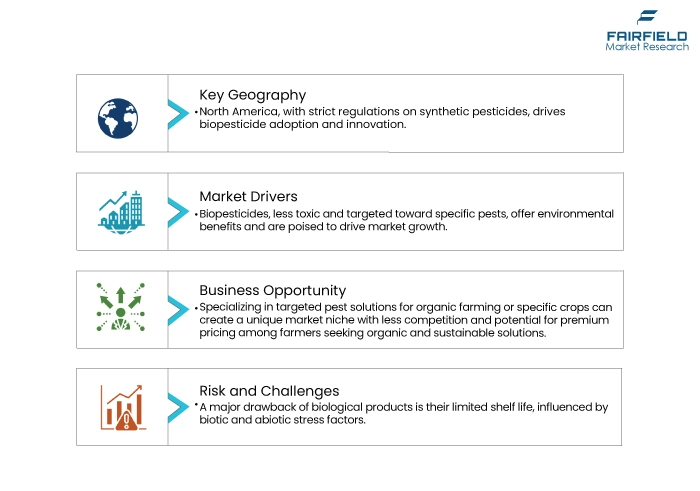
A significant limitation when the use of biological products is concerned is the short or limited shelf life of these products. This limitation in shelf life could be attributed to various biotic and abiotic stress factors.
Other factors that could negatively influence shelf-life include temperature maintenance when stored, exposure to sunlight, the physiological state of microorganisms when harvested, as well as water activity of inoculants. Moreover, biological products are also highly susceptible to contaminants. These major factors could potentially hinder the further growth of the global biopesticides market.
Key Trends and Opportunities Look at
- Targeting Niche Markets with Novel Biocontrol Agents.
Established players often focus on broad-spectrum solutions. By targeting specific pest problems in, say, organic farming or for a particular crop, you can carve out a unique space with less competition. Niche markets often have a higher tolerance for premium prices. Farmers willing to pay extra for organic or sustainable solutions can be receptive to biopesticides that address their specific needs.
Unexplored avenues like biopesticides derived from new strains of bacteria, fungi, or even bacteriophages (viruses that attack bacteria) offer exciting possibilities for development. Niche biopesticides with targeted action may qualify for faster registration compared to broad-spectrum solutions, allowing you to bring your product to market quicker.
This approach requires focused research and development, but the potential rewards are significant. By catering to specific needs in the market with innovative biocontrol agents, you can establish a strong foothold in a lucrative and fast-growing industry.
- Rise of Organic Farming, and Ascending Consumer Inclination Toward Sustainable Agriculture
As consumers become more conscious of the potential health and environmental risks associated with synthetic pesticides, the demand for organic food and sustainably grown produce is surging. This translates to a growing market for biopesticides, which offer a safer and more eco-friendly alternative. The growing demand for organic solutions is pushing biopesticide manufacturers to invest in research and development of novel biocontrol agents. This includes exploring new strains of beneficial microbes, plant extracts with pesticidal properties, and even bacteriophages (viruses that target bacteria) for pest control.
Governments in many regions are enacting stricter regulations on synthetic pesticide use and promoting organic farming practices. This policy shift creates a supportive environment for the biopesticides market. This trend presents a significant opportunity for the industry. By addressing consumer concerns about food safety and environmental sustainability, biopesticides can become a key driver in the shift towards more sustainable agricultural practices.
How Does Regulatory Scenario Shape this Industry?
The regulatory scenario plays a critical role in shaping the biopesticide industry. Stringent testing and approval processes can act as a double-edged sword. On one hand, they ensure the safety and efficacy of biopesticides, fostering consumer trust. However, these processes can also be time-consuming and expensive, creating hurdles for bringing new products to market. This can stifle innovation and limit competition, particularly for smaller companies who may struggle with the high development costs associated with navigating regulatory requirements.
Regulations can also influence how the market is positioned. If categorized as lower risk compared to synthetic pesticides, biopesticides gain an advantage in terms of consumer appeal. Additionally, regulations can establish clear standards for biopesticide performance and safety. This standardization not only protects consumers but also promotes market growth by boosting confidence in the effectiveness of these eco-friendly pest control solutions.
In conclusion, the regulatory landscape presents both challenges and opportunities for the biopesticide industry. By streamlining processes, focusing on risk assessment, and establishing clear categorization, regulatory bodies can pave the way for wider adoption, promoting a more sustainable approach to pest control.
Fairfield’s Ranking Board
Top Segments
- Biofungicides Continue to be Dominant over Other Product Type Categories
Biofungicides reign supreme in the biopesticides market. Fungal diseases like mildews, blights, and rots cause significant crop losses globally. Biofungicides offer a safe and effective alternative to traditional fungicides. They work through various mechanisms, including direct attack on fungal pathogens by beneficial microbes, inducing plant resistance, and competition for resources. The vast array of fungal threats across diverse crops fuels the demand for biofungicides, making them the dominant player in this category.
- Microbials Lead the Pack Based on Origin
Microbial biopesticides, encompassing bacteria, fungi, and beneficial nematodes, are the clear frontrunners in terms of origin. These living organisms offer several advantages. They can target specific pests, reducing harm to beneficial insects and the environment.
Some microbes produce antibiotics or antifungal compounds that suppress pathogens. Additionally, others promote plant immunity, providing long-term protection. The diverse functionalities and established efficacy of microbial biopesticides solidify their position as the dominant segment by origin.
- Fruits & Vegetables to be the Leading Crop Type Consuming Biopesticides
Fruits and vegetables currently dominate the market based on crop type. This is driven by several factors. These high-value crops are more susceptible to damage from pests and diseases. Consumers increasingly demand residue-free produce, making biopesticides a natural choice. The intensive cultivation practices often used for fruits and vegetables can create ideal conditions for pest outbreaks, further amplifying the need for effective biopesticides in this segment.
Regional Frontrunners
North America Maintains Primacy in Global Biopesticides Market
Owing to North America’s long history of responsibly using pesticides, this region has become a major exporter and end user of biopesticides over the last few decades. Moreover, there are stringent regulations and guidelines imposed on the use of synthetic crop protection chemicals in this region. This element has fostered efforts to develop and implement suitable alternatives to ensure compliance.
Additionally, farmers in this region are being compelled to use sustainable crop protection solutions due to a steady increase in the demand for organic products and produce. This is another major factor that has further contributed to the augmentation of this regional market.
Europe, and Asia Pacific Set to Exhibit Significant Growth Rates
The biopesticides market in Europe, and the Asia Pacific, more specifically China, followed North America, in terms of consumption and export. Moreover, Europe is slated to index the highest CAGR over the forecast timeline due to increasing emphasis being placed on the adoption of organic farming practices, as well as a higher number of initiatives being implemented by respective governments in this region to promote the use of biocontrol solutions/products.
Fairfield’s Competitive Landscape Analysis
As a means of gaining a competitive edge, various established industry players are more focused on new product launches, partnerships, collaborations, acquisitions, and alliances.
Who are Leading Companies in Biopesticides Space?
- BASF SE
- Syngenta AG
- Bayer CropScience
- Marrone Bio Innovations
- Novozyme
- Koppert Biological Systems
- BioWorks Inc.
- Gowan Group
- Sumitomo Chemical Co. Ltd.
- The Dow Chemical Company
- Certis USA LLC
Recent Industry Developments
- In April 2024, Syngenta, and Lavie Bio announced their partnership to speed up biopesticide R&D. It discusses the need for faster development in the biologicals sector. Lavie Bio uses computational shortcuts to identify promising microbes.
- Syngenta is interested in Lavie Bio's approach to bioinsecticides. The collaboration aims to develop new products for multiple geographies. Biologicals are not meant to replace chemicals, but rather to be used together. This is seen as Generation 1 of innovation in biologicals.
- In May 2022, UPL Limited announced a strategic collaboration with AISTech, a global leader in agricultural biological innovation. As per the terms of this venture, UPL will distribute AIDTech’s BioSolutions, commencing with two bioinsecticides – Fuligin, and Halogen.
- In March 2021, BASF and AgBiome penned an agreement to launch a new biological fungicide. Developed by AgBiome and marketed as Howler in the United States.
- In March 2020, Bayer AG launched Seranade, its first biofungicide, in China. It contains QST713, a biocontrol microorganism that aids plants to absorb nutrients and boosts plant immunity more effectively.
- In April 2020, Syngenta AG collaborated with Novozyme to launch its biofungicide, Taegro, in Europe, and Latin America.
Global Biopesticides Market is Segmented as Below-
By Product Type
- Bioinsecticides
- Bioherbicides
- Biofungicides
- Bionematicides
By Origin
- Microbial
- Biochemical
By Formulation
- Liquid Formulation
- Dry Formulation
By Application
- Foliar Spray
- Seed Treatment
- Soil Treatment
- Post-Harvest
By Crop Type
- Fruits & Vegetables
- Grains & Cereals
- Oilseeds & Pulses
- Other Crops
By Region
- North America
- Europe
- Asia Pacific
- Latin America
- Middle East and Africa
- Executive Summary
- Global Biopesticides Market Snapshot
- Future Projections
- Key Market Trends
- Regional Snapshot, by Value, 2026
- Analyst Recommendations
- Market Overview
- Market Definitions and Segmentations
- Market Dynamics
- Drivers
- Restraints
- Market Opportunities
- Value Chain Analysis
- COVID-19 Impact Analysis
- Porter's Five Forces Analysis
- Impact of Russia-Ukraine Conflict
- PESTLE Analysis
- Regulatory Analysis
- Price Trend Analysis
- Current Prices and Future Projections, 2025-2033
- Price Impact Factors
- Global Biopesticides Market Outlook, 2020 - 2033
- Global Biopesticides Market Outlook, by Product Type, Value (US$ Mn), 2020-2033
- Bioinsecticides
- Bioherbicides
- Biofungicides
- Bionematicides
- Global Biopesticides Market Outlook, by Origin, Value (US$ Mn), 2020-2033
- Microbial
- Biochemical
- Global Biopesticides Market Outlook, by Formulation, Value (US$ Mn), 2020-2033
- Liquid Formulation
- Dry Formulation
- Global Biopesticides Market Outlook, by Application, Value (US$ Mn), 2020-2033
- Foliar Spray
- Seed Treatment
- Soil Treatment
- Post-Harvest
- Global Biopesticides Market Outlook, by Crop Type, Value (US$ Mn), 2020-2033
- Fruits & Vegetables
- Grains & Cereals
- Oilseeds & Pulses
- Other Crops
- Global Biopesticides Market Outlook, by Region, Value (US$ Mn), 2020-2033
- North America
- Europe
- Asia Pacific
- Latin America
- Middle East & Africa
- Global Biopesticides Market Outlook, by Product Type, Value (US$ Mn), 2020-2033
- North America Biopesticides Market Outlook, 2020 - 2033
- North America Biopesticides Market Outlook, by Product Type, Value (US$ Mn), 2020-2033
- Bioinsecticides
- Bioherbicides
- Biofungicides
- Bionematicides
- North America Biopesticides Market Outlook, by Origin, Value (US$ Mn), 2020-2033
- Microbial
- Biochemical
- North America Biopesticides Market Outlook, by Formulation, Value (US$ Mn), 2020-2033
- Liquid Formulation
- Dry Formulation
- North America Biopesticides Market Outlook, by Application, Value (US$ Mn), 2020-2033
- Foliar Spray
- Seed Treatment
- Soil Treatment
- Post-Harvest
- North America Biopesticides Market Outlook, by Crop Type, Value (US$ Mn), 2020-2033
- Fruits & Vegetables
- Grains & Cereals
- Oilseeds & Pulses
- Other Crops
- North America Biopesticides Market Outlook, by Country, Value (US$ Mn), 2020-2033
- S. Biopesticides Market Outlook, by Product Type, 2020-2033
- S. Biopesticides Market Outlook, by Origin, 2020-2033
- S. Biopesticides Market Outlook, by Formulation, 2020-2033
- S. Biopesticides Market Outlook, by Application, 2020-2033
- S. Biopesticides Market Outlook, by Crop Type, 2020-2033
- Canada Biopesticides Market Outlook, by Product Type, 2020-2033
- Canada Biopesticides Market Outlook, by Origin, 2020-2033
- Canada Biopesticides Market Outlook, by Formulation, 2020-2033
- Canada Biopesticides Market Outlook, by Application, 2020-2033
- Canada Biopesticides Market Outlook, by Crop Type, 2020-2033
- BPS Analysis/Market Attractiveness Analysis
- North America Biopesticides Market Outlook, by Product Type, Value (US$ Mn), 2020-2033
- Europe Biopesticides Market Outlook, 2020 - 2033
- Europe Biopesticides Market Outlook, by Product Type, Value (US$ Mn), 2020-2033
- Bioinsecticides
- Bioherbicides
- Biofungicides
- Bionematicides
- Europe Biopesticides Market Outlook, by Origin, Value (US$ Mn), 2020-2033
- Microbial
- Biochemical
- Europe Biopesticides Market Outlook, by Formulation, Value (US$ Mn), 2020-2033
- Liquid Formulation
- Dry Formulation
- Europe Biopesticides Market Outlook, by Application, Value (US$ Mn), 2020-2033
- Foliar Spray
- Seed Treatment
- Soil Treatment
- Post-Harvest
- Europe Biopesticides Market Outlook, by Crop Type, Value (US$ Mn), 2020-2033
- Fruits & Vegetables
- Grains & Cereals
- Oilseeds & Pulses
- Other Crops
- Europe Biopesticides Market Outlook, by Country, Value (US$ Mn), 2020-2033
- Germany Biopesticides Market Outlook, by Product Type, 2020-2033
- Germany Biopesticides Market Outlook, by Origin, 2020-2033
- Germany Biopesticides Market Outlook, by Formulation, 2020-2033
- Germany Biopesticides Market Outlook, by Application, 2020-2033
- Germany Biopesticides Market Outlook, by Crop Type, 2020-2033
- Italy Biopesticides Market Outlook, by Product Type, 2020-2033
- Italy Biopesticides Market Outlook, by Origin, 2020-2033
- Italy Biopesticides Market Outlook, by Formulation, 2020-2033
- Italy Biopesticides Market Outlook, by Application, 2020-2033
- Italy Biopesticides Market Outlook, by Crop Type, 2020-2033
- France Biopesticides Market Outlook, by Product Type, 2020-2033
- France Biopesticides Market Outlook, by Origin, 2020-2033
- France Biopesticides Market Outlook, by Formulation, 2020-2033
- France Biopesticides Market Outlook, by Application, 2020-2033
- France Biopesticides Market Outlook, by Crop Type, 2020-2033
- K. Biopesticides Market Outlook, by Product Type, 2020-2033
- K. Biopesticides Market Outlook, by Origin, 2020-2033
- K. Biopesticides Market Outlook, by Formulation, 2020-2033
- K. Biopesticides Market Outlook, by Application, 2020-2033
- K. Biopesticides Market Outlook, by Crop Type, 2020-2033
- Spain Biopesticides Market Outlook, by Product Type, 2020-2033
- Spain Biopesticides Market Outlook, by Origin, 2020-2033
- Spain Biopesticides Market Outlook, by Formulation, 2020-2033
- Spain Biopesticides Market Outlook, by Application, 2020-2033
- Spain Biopesticides Market Outlook, by Crop Type, 2020-2033
- Russia Biopesticides Market Outlook, by Product Type, 2020-2033
- Russia Biopesticides Market Outlook, by Origin, 2020-2033
- Russia Biopesticides Market Outlook, by Formulation, 2020-2033
- Russia Biopesticides Market Outlook, by Application, 2020-2033
- Russia Biopesticides Market Outlook, by Crop Type, 2020-2033
- Rest of Europe Biopesticides Market Outlook, by Product Type, 2020-2033
- Rest of Europe Biopesticides Market Outlook, by Origin, 2020-2033
- Rest of Europe Biopesticides Market Outlook, by Formulation, 2020-2033
- Rest of Europe Biopesticides Market Outlook, by Application, 2020-2033
- Rest of Europe Biopesticides Market Outlook, by Crop Type, 2020-2033
- BPS Analysis/Market Attractiveness Analysis
- Europe Biopesticides Market Outlook, by Product Type, Value (US$ Mn), 2020-2033
- Asia Pacific Biopesticides Market Outlook, 2020 - 2033
- Asia Pacific Biopesticides Market Outlook, by Product Type, Value (US$ Mn), 2020-2033
- Bioinsecticides
- Bioherbicides
- Biofungicides
- Bionematicides
- Asia Pacific Biopesticides Market Outlook, by Origin, Value (US$ Mn), 2020-2033
- Microbial
- Biochemical
- Asia Pacific Biopesticides Market Outlook, by Formulation, Value (US$ Mn), 2020-2033
- Liquid Formulation
- Dry Formulation
- Asia Pacific Biopesticides Market Outlook, by Application, Value (US$ Mn), 2020-2033
- Foliar Spray
- Seed Treatment
- Soil Treatment
- Post-Harvest
- Asia Pacific Biopesticides Market Outlook, by Crop Type, Value (US$ Mn), 2020-2033
- Fruits & Vegetables
- Grains & Cereals
- Oilseeds & Pulses
- Other Crops
- Asia Pacific Biopesticides Market Outlook, by Country, Value (US$ Mn), 2020-2033
- China Biopesticides Market Outlook, by Product Type, 2020-2033
- China Biopesticides Market Outlook, by Origin, 2020-2033
- China Biopesticides Market Outlook, by Formulation, 2020-2033
- China Biopesticides Market Outlook, by Application, 2020-2033
- China Biopesticides Market Outlook, by Crop Type, 2020-2033
- Japan Biopesticides Market Outlook, by Product Type, 2020-2033
- Japan Biopesticides Market Outlook, by Origin, 2020-2033
- Japan Biopesticides Market Outlook, by Formulation, 2020-2033
- Japan Biopesticides Market Outlook, by Application, 2020-2033
- Japan Biopesticides Market Outlook, by Crop Type, 2020-2033
- South Korea Biopesticides Market Outlook, by Product Type, 2020-2033
- South Korea Biopesticides Market Outlook, by Origin, 2020-2033
- South Korea Biopesticides Market Outlook, by Formulation, 2020-2033
- South Korea Biopesticides Market Outlook, by Application, 2020-2033
- South Korea Biopesticides Market Outlook, by Crop Type, 2020-2033
- India Biopesticides Market Outlook, by Product Type, 2020-2033
- India Biopesticides Market Outlook, by Origin, 2020-2033
- India Biopesticides Market Outlook, by Formulation, 2020-2033
- India Biopesticides Market Outlook, by Application, 2020-2033
- India Biopesticides Market Outlook, by Crop Type, 2020-2033
- Southeast Asia Biopesticides Market Outlook, by Product Type, 2020-2033
- Southeast Asia Biopesticides Market Outlook, by Origin, 2020-2033
- Southeast Asia Biopesticides Market Outlook, by Formulation, 2020-2033
- Southeast Asia Biopesticides Market Outlook, by Application, 2020-2033
- Southeast Asia Biopesticides Market Outlook, by Crop Type, 2020-2033
- Rest of SAO Biopesticides Market Outlook, by Product Type, 2020-2033
- Rest of SAO Biopesticides Market Outlook, by Origin, 2020-2033
- Rest of SAO Biopesticides Market Outlook, by Formulation, 2020-2033
- Rest of SAO Biopesticides Market Outlook, by Application, 2020-2033
- Rest of SAO Biopesticides Market Outlook, by Crop Type, 2020-2033
- BPS Analysis/Market Attractiveness Analysis
- Asia Pacific Biopesticides Market Outlook, by Product Type, Value (US$ Mn), 2020-2033
- Latin America Biopesticides Market Outlook, 2020 - 2033
- Latin America Biopesticides Market Outlook, by Product Type, Value (US$ Mn), 2020-2033
- Bioinsecticides
- Bioherbicides
- Biofungicides
- Bionematicides
- Latin America Biopesticides Market Outlook, by Origin, Value (US$ Mn), 2020-2033
- Microbial
- Biochemical
- Latin America Biopesticides Market Outlook, by Formulation, Value (US$ Mn), 2020-2033
- Liquid Formulation
- Dry Formulation
- Latin America Biopesticides Market Outlook, by Application, Value (US$ Mn), 2020-2033
- Foliar Spray
- Seed Treatment
- Soil Treatment
- Post-Harvest
- Latin America Biopesticides Market Outlook, by Crop Type, Value (US$ Mn), 2020-2033
- Fruits & Vegetables
- Grains & Cereals
- Oilseeds & Pulses
- Other Crops
- Latin America Biopesticides Market Outlook, by Country, Value (US$ Mn), 2020-2033
- Brazil Biopesticides Market Outlook, by Product Type, 2020-2033
- Brazil Biopesticides Market Outlook, by Origin, 2020-2033
- Brazil Biopesticides Market Outlook, by Formulation, 2020-2033
- Brazil Biopesticides Market Outlook, by Application, 2020-2033
- Brazil Biopesticides Market Outlook, by Crop Type, 2020-2033
- Mexico Biopesticides Market Outlook, by Product Type, 2020-2033
- Mexico Biopesticides Market Outlook, by Origin, 2020-2033
- Mexico Biopesticides Market Outlook, by Formulation, 2020-2033
- Mexico Biopesticides Market Outlook, by Application, 2020-2033
- Mexico Biopesticides Market Outlook, by Crop Type, 2020-2033
- Argentina Biopesticides Market Outlook, by Product Type, 2020-2033
- Argentina Biopesticides Market Outlook, by Origin, 2020-2033
- Argentina Biopesticides Market Outlook, by Formulation, 2020-2033
- Argentina Biopesticides Market Outlook, by Application, 2020-2033
- Argentina Biopesticides Market Outlook, by Crop Type, 2020-2033
- Rest of LATAM Biopesticides Market Outlook, by Product Type, 2020-2033
- Rest of LATAM Biopesticides Market Outlook, by Origin, 2020-2033
- Rest of LATAM Biopesticides Market Outlook, by Formulation, 2020-2033
- Rest of LATAM Biopesticides Market Outlook, by Application, 2020-2033
- Rest of LATAM Biopesticides Market Outlook, by Crop Type, 2020-2033
- BPS Analysis/Market Attractiveness Analysis
- Latin America Biopesticides Market Outlook, by Product Type, Value (US$ Mn), 2020-2033
- Middle East & Africa Biopesticides Market Outlook, 2020 - 2033
- Middle East & Africa Biopesticides Market Outlook, by Product Type, Value (US$ Mn), 2020-2033
- Bioinsecticides
- Bioherbicides
- Biofungicides
- Bionematicides
- Middle East & Africa Biopesticides Market Outlook, by Origin, Value (US$ Mn), 2020-2033
- Microbial
- Biochemical
- Middle East & Africa Biopesticides Market Outlook, by Formulation, Value (US$ Mn), 2020-2033
- Liquid Formulation
- Dry Formulation
- Middle East & Africa Biopesticides Market Outlook, by Application, Value (US$ Mn), 2020-2033
- Foliar Spray
- Seed Treatment
- Soil Treatment
- Post-Harvest
- Middle East & Africa Biopesticides Market Outlook, by Crop Type, Value (US$ Mn), 2020-2033
- Fruits & Vegetables
- Grains & Cereals
- Oilseeds & Pulses
- Other Crops
- Middle East & Africa Biopesticides Market Outlook, by Country, Value (US$ Mn), 2020-2033
- GCC Biopesticides Market Outlook, by Product Type, 2020-2033
- GCC Biopesticides Market Outlook, by Origin, 2020-2033
- GCC Biopesticides Market Outlook, by Formulation, 2020-2033
- GCC Biopesticides Market Outlook, by Application, 2020-2033
- GCC Biopesticides Market Outlook, by Crop Type, 2020-2033
- South Africa Biopesticides Market Outlook, by Product Type, 2020-2033
- South Africa Biopesticides Market Outlook, by Origin, 2020-2033
- South Africa Biopesticides Market Outlook, by Formulation, 2020-2033
- South Africa Biopesticides Market Outlook, by Application, 2020-2033
- South Africa Biopesticides Market Outlook, by Crop Type, 2020-2033
- Egypt Biopesticides Market Outlook, by Product Type, 2020-2033
- Egypt Biopesticides Market Outlook, by Origin, 2020-2033
- Egypt Biopesticides Market Outlook, by Formulation, 2020-2033
- Egypt Biopesticides Market Outlook, by Application, 2020-2033
- Egypt Biopesticides Market Outlook, by Crop Type, 2020-2033
- Nigeria Biopesticides Market Outlook, by Product Type, 2020-2033
- Nigeria Biopesticides Market Outlook, by Origin, 2020-2033
- Nigeria Biopesticides Market Outlook, by Formulation, 2020-2033
- Nigeria Biopesticides Market Outlook, by Application, 2020-2033
- Nigeria Biopesticides Market Outlook, by Crop Type, 2020-2033
- Rest of Middle East Biopesticides Market Outlook, by Product Type, 2020-2033
- Rest of Middle East Biopesticides Market Outlook, by Origin, 2020-2033
- Rest of Middle East Biopesticides Market Outlook, by Formulation, 2020-2033
- Rest of Middle East Biopesticides Market Outlook, by Application, 2020-2033
- Rest of Middle East Biopesticides Market Outlook, by Crop Type, 2020-2033
- BPS Analysis/Market Attractiveness Analysis
- Middle East & Africa Biopesticides Market Outlook, by Product Type, Value (US$ Mn), 2020-2033
- Competitive Landscape
- Company Vs Segment Heatmap
- Company Market Share Analysis, 2025
- Competitive Dashboard
- Company Profiles
- BASF SE
- Company Overview
- Product Portfolio
- Financial Overview
- Business Strategies and Developments
- Syngenta AG
- Bayer CropScience
- Marrone Bio Innovations
- Novozyme
- Koppert Biological Systems
- BioWorks Inc.
- Gowan Group
- Sumitomo Chemical Co. Ltd.
- The Dow Chemical Company
- BASF SE
- Appendix
- Research Methodology
- Report Assumptions
- Acronyms and Abbreviations
|
BASE YEAR |
HISTORICAL DATA |
FORECAST PERIOD |
UNITS |
|||
 |
2025 |
 |
2019 - 2024 |
 |
2026 - 2033 |
Value: US$ Billion |
|
REPORT FEATURES |
DETAILS |
|
Product Type Coverage |
|
|
Origin Coverage |
|
|
Formulation Coverage |
|
|
Application Coverage |
|
|
Crop Type Coverage |
|
|
Geographical Coverage |
|
|
Leading Companies |
|
|
Report Highlights |
Key Market Indicators, Macro-micro economic impact analysis, Technological Roadmap, Key Trends, Driver, Restraints, and Future Opportunities & Revenue Pockets, Porter’s 5 Forces Analysis, Historical Trend (2019-2021), Market Estimates and Forecast, Market Dynamics, Industry Trends, Competition Landscape, Category, Region, Country-wise Trends & Analysis, COVID-19 Impact Analysis (Demand and Supply Chain) |
Our Research Methodology
Considering the volatility of business today, traditional approaches to strategizing a game plan can be unfruitful if not detrimental. True ambiguity is no way to determine a forecast. A myriad of predetermined factors must be accounted for such as the degree of risk involved, the magnitude of circumstances, as well as conditions or consequences that are not known or unpredictable. To circumvent binary views that cast uncertainty, the application of market research intelligence to strategically posture, move, and enable actionable outcomes is necessary.
View Methodology
Quality Assured
Rigorous Validation Process

Confidentiality Assured
End-to-end Data Security

Custom Research Services
Tailored To Your Objectives
FAQs
Biopesticides are natural or biological agents used to control pests, derived from natural materials like animals, plants, bacteria, and certain minerals.
The growth is driven by increasing demand for organic food, environmental concerns, and stringent regulations on chemical pesticides.
North America and Europe are leading the market due to high adoption rates and supportive regulatory frameworks.
The major types include microbial pesticides, biochemical pesticides, and plant-incorporated protectants (PIPs).
Challenges include high costs, limited shelf life, and lack of awareness among farmers in some regions.
Related Reports
Paints and Coatings Market Insights, Competitive Landscape, and Market Forecast - 2033
Paints and Coatings Market to reach US$324.69B by 2033 at 4.6% CAGR, driven by urbanization, infrastructure growth, and waterborne coatings.
Conveyor Belt Market Insights, Competitive Landscape, and Market Forecast - 2033
Conveyor Belt Market to reach US$9.35B by 2033 at 3.8% CAGR, driven by mining, infrastructure, automation, and smart belt monitoring.
Vapour Barrier Market Insights, Competitive Landscape, and Market Forecast - 2033
Vapour Barrier Market to reach US$24.67B by 2033 at 5.2% CAGR, driven by energy-efficient building codes, infrastructure growth, and polymers.
Technical Films Market Insights, Competitive Landscape and Market Forecast 2033
The technical films market is set to reach US$ 298.95 Mn by 2033 from US$ 167.80 Mn in 2026, at 8.6% CAGR driven by expanding industrial applications.
Polypropylene Market Insights, Competitive Landscape, and Market Forecast 2033
The polypropylene market is projected to grow from US$ 144.80 Bn in 2026 to US$ 235.58 Bn by 2033, at a 7.2% CAGR driven by rising industrial demand.
Medical Device Packaging Market Insights, Competitive Landscape, and Market Forecast 2033
The medical device packaging market is projected to grow from US$ 43.20 Bn in 2026 to US$ 67.57 Bn by 2033, at a 6.6% CAGR over the forecast period.