



E-bikes Market
E-bikes Market Insights, Competitive Landscape, and Market Forecast - 2033
Global E-bikes Market Industry Growth Forecast Analysis
- The E-bikes Market is valued at USD 76.9 Bn in 2026 and is projected to reach USD 130.1 Bn, growing at a CAGR of 8% by 2033
- The market for e-bikes is primarily driven by rising environmental consciousness, worsening urban traffic congestion, and a strong shift toward affordable, sustainable commuting, further accelerated by government-backed infrastructure development and policy incentives promoting electric mobility adoption.
E-bikes Market Summary: Key Trends & Insights
- Pedal-assisted e-bikes lead with over 60% share in 2024 due to their efficiency, health benefits, and suitability for diverse urban and recreational uses.
- Cargo e-bikes are the fastest-growing segment, projected to expand at a CAGR of 8.2% through 2032, driven by the rise of last-mile delivery and sustainable logistics.
- Lithium-ion batteries dominate the battery type segment with over 85% share in 2025, owing to their lightweight design, longer range, and fast-charging capabilities.
- Mid-drive motors present a key growth opportunity, expected to grow at 8.0% CAGR, as demand increases for premium performance in trekking and mountain e-bikes.
- Asia Pacific remains the largest regional market, capturing over 55% of global share in 2024, led by high production and government support in China and India.
- City e-bikes hold a more than 30% market share, gaining popularity in Europe for short-distance commuting amid growing cycling infrastructure and policy incentives.
A Look Back and a Look Forward - Comparative Analysis
The e-bikes market witnessed a steady growth from 2019 to 2024, driven by rising urban mobility needs and eco-conscious consumer trends. The COVID-19 pandemic initially disrupted supply chains, causing production delays and reduced sales in 2020. However, the post-pandemic recovery experienced a surge in demand as consumers sought sustainable, socially distanced transport options, particularly in urban areas. Government stimulus packages and investments in cycling infrastructure further accelerated growth, with pedal-assisted e-bikes gaining traction due to their versatility.
During the forecast period, advancements in lithium-ion battery technology, increasing urbanization, and supportive government policies are expected to drive demand for green mobility solutions, such as e-bikes. The Asia Pacific region, particularly China and India, will lead due to high demand and production capacity. At the same time, North America and Europe will witness strong growth from the recreational and cargo e-bike segments. Emerging smart technologies and subscription platforms are expected to expand market potential in the coming years.
Key Growth Drivers
- Eco-Friendly Transportation Drives Global Surge in E-bike Adoption
The market for e-bikes is propelled by growing environmental concerns, with consumers seeking low-carbon alternatives to traditional vehicles. e-bikes produce zero emissions, aligning with global sustainability goals, such as reducing greenhouse gas emissions by 50% by 2030, as targeted by many nations. Urban areas, facing air pollution challenges, see e-bikes as a viable solution, particularly in densely populated regions, such as Asia Pacific, where adoption is surging. Governments worldwide are implementing policies, such as the EU’s Green Deal, which promotes e-mobility through infrastructure development and subsidies. These initiatives make e-bikes an attractive option for commuting, reducing reliance on fossil fuel-based transport.
Additionally, e-bikes offer health benefits, combining physical activity with motorized assistance, appealing to fitness-conscious consumers. The rise in fuel costs further accelerates the shift to e-bikes, as they provide a cost-effective alternative, with operating costs significantly lower than cars or motorcycles. The integration of smart technologies, such as GPS and connectivity features, also enhances user experience, further boosting the e-bike market growth.
- Innovative Tech Enhances E-bike Performance, Range, and Rider Experience
Technological innovations significantly drive the electric bikes market by enhancing performance, range, and user experience. Advances in lithium-ion battery technology have extended e-bike ranges to over 100 miles per charge, addressing consumer concerns about battery. Mid-drive motors, offering better torque and efficiency, have gained popularity, particularly for mountain and trekking e-bikes. Smart features, such as app-integrated controls, GPS tracking, and anti-theft systems, enhance user convenience and security, making e-bikes more appealing. The integration of lightweight materials, such as carbon fiber frames, improves portability and durability, catering to urban commuters.
The market for e-bikes also benefits from AI-driven analytics, enabling manufacturers to optimize motor performance and battery management. For instance, Bosch’s eBike Systems integrate intelligent power delivery for seamless riding experiences. These advancements reduce maintenance costs and improve reliability, further boosting adoption. The rise of modular designs allows consumers to customize e-bikes, enhancing their appeal across diverse segments such as cargo and touring. As technology continues to evolve, the e-bikes market is expected to witness an increased penetration in both developed and emerging markets, driven by enhanced functionality and affordability.
Key Growth Barriers
- High Upfront Costs Remain a Major Barrier to E-bike Growth
The Global e-bikes market faces significant challenges due to the high initial purchase cost, which typically ranges between US$ 1,000 and US$ 5,000. Premium components like lithium-ion batteries and mid-drive motors drive up prices, making e-bikes less affordable for price-sensitive consumers, especially in developing regions with lower disposable incomes. This upfront investment barrier slows market penetration despite long-term savings on fuel and maintenance, notably in countries like India where traditional bicycles remain more accessible.
- Battery Life Limitations and Infrastructure Gaps Restrain E-bike Adoption
Another major restraint is the limited battery life and insufficient charging infrastructure. Although lithium-ion batteries have improved, their range of 20-100 miles often falls short for long-distance commuters. Frequent recharging and battery degradation increase maintenance costs. Additionally, the scarcity of charging stations, particularly in rural and developing areas, restricts usability and adoption, pushing consumers toward alternatives like scooters or cars for extended travel needs.
Electric Bikes Market Trends and Opportunities
- Urban Congestion Fuels Demand for Compact and Sustainable E-bikes
Urbanization is a significant opportunity, as cities worldwide face increasing traffic congestion. With urban populations projected to reach 68% by 2050, the demand for efficient, compact transport solutions Such as e-bikes is rising. e-bikes offer a practical alternative for navigating crowded urban areas, reducing commute times and environmental impact.
E-bikes also cater to last-mile connectivity, complementing public transport systems. The rise of e-bike sharing platforms further amplifies this opportunity, making e-bikes accessible without ownership costs. As urban planners prioritize sustainable transport, the E-bike are poised for significant growth, particularly in densely populated regions Such as Asia Pacific and Europe, where city commuting is a daily challenge.
- E-bike Subscription Platforms Expand Access and Attract Urban Commuters
The rise of e-bike subscription platforms presents a lucrative opportunity. These platforms allow users to access e-bikes without purchasing them, appealing to cost-conscious and environmentally aware consumers. The e-bike subscription platform market was valued at US$ 2.0 Bn in 2025 and is projected to reach US$ 9.7 Bn by 2032.
Services Such as Swapfiets and Zoomo offer flexible plans, enabling users to rent e-bikes for daily or monthly use, particularly in urban areas. This model reduces upfront costs, making e-bikes accessible to a broader audience, including students and gig economy workers. Subscription platforms also integrate maintenance and insurance, enhancing user convenience. As consumer preferences shift toward access over ownership, these platforms are driving electric bikes market growth, particularly in Europe and North America, where subscription models are gaining traction. This trend aligns with the broader sharing economy, positioning e-bikes as a key player in sustainable urban mobility.
Segment-wise Trends & Analysis
- Pedal-Assisted E-bikes Dominate as Throttle Variants Rapidly Gain Ground
Pedal-assisted e-bikes lead the e-bikes market due to their flexibility, offering multiple modes for varying levels of motorized assistance. They cater to fitness-conscious riders and urban commuters, holding a significant market share. Throttle-assisted e-bikes are the fastest-growing segment, driven by their ease of use, requiring minimal pedaling effort. This appeals to older consumers and those seeking convenience, especially in North America, where throttle-assisted models are gaining popularity. The segment’s growth is supported by advancements in motor technology, enhancing performance and range.
- Lithium-ion Batteries Power Market Growth with Superior Performance
Lithium-ion Batteries dominate due to their high energy density, lightweight design, and extended lifespan. They account for the majority of e-bike batteries, offering ranges up to 100 miles. Lithium-ion Batteries are also the fastest-growing segment, driven by continuous improvements in charging speed and cost reductions. Innovations in battery management systems enhance safety and efficiency, making them ideal for diverse e-bike applications.
- Hub Motors Hold Share While Mid-Drive Motors Witness Fastest Growth
Hub Motors lead due to their affordability, ease of installation, and suitability for urban e-bikes. They are widely used in pedal-assisted models, offering reliable performance. Mid-drive Motors are the fastest-growing segment, driven by their superior torque and efficiency, ideal for mountain and trekking e-bikes. Their ability to integrate with bike gears enhances climbing performance, appealing to adventure enthusiasts. The electric bikes market has witnessed a rising demand for mid-drive motors in premium models, particularly in Europe.
- City E-bikes Lead the Segment While Cargo E-bikes Witness Rapid Growth
City/Urban e-bikes dominate the e-bikes market, driven by their suitability for daily commuting in congested urban areas. Their compact design and efficiency make them popular in cities such as Amsterdam and Shanghai. Cargo e-bikes are the fastest-growing segment, with a projected CAGR of 8.2% through 2032, fueled by demand for last-mile delivery solutions. Businesses in Europe and North America increasingly adopt cargo e-bikes for logistics, reducing emissions and costs, significantly contributing to Market growth.
Regional Analysis
- North America E-Bikes Market Accelerates with Urban Shift and Incentives
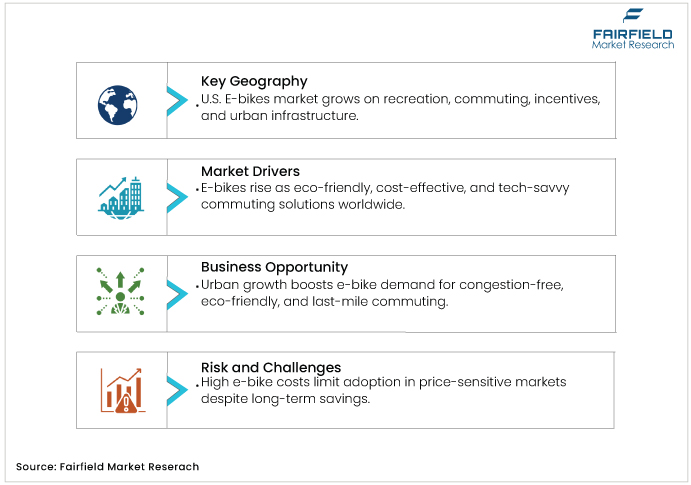
The U.S. e-bikes market, valued at US$3 Bn in 2025, is projected to reach US$5.5 Bn by 2032, with a CAGR of 9.0%. Growth is driven by increasing recreational cycling, supportive infrastructure, and government incentives, such as tax credits. Urbanization and rising fuel costs push consumers toward e-bikes for commuting. The popularity of pedal-assisted e-bikes and cargo models for last-mile delivery further boosts demand. Investments in cycling infrastructure, particularly in cities Such as Seattle and Portland, enhance e-bike adoption, positioning the U.S. as a key player.
Sustainability and Smart Transit Power E-bike Demand Across Europe
Europe leads the adoption of e-bikes, with Germany, the Netherlands, and France as key contributors. The region’s market is driven by strong cycling culture, government subsidies, and robust infrastructure. Germany’s subsidy programs and dedicated bike lanes support e-bike adoption, while the Netherlands’ cycling-friendly policies is boosting demand. France’s urban mobility initiatives promote e-bikes for commuting. The region’s focus on sustainability, backed by the EU’s Green Deal, fuels growth, with cargo e-bikes gaining traction for logistics. Europe’s market is projected to maintain its continued high demand through 2032.
- Asia Pacific Leads Global E-bike Market with Cost and Scale Advantage
Asia Pacific holds the largest share, driven by China, India, and Japan. China’s strict emission norms and urbanization fuel e-bike demand, with manufacturers Such as Yadea leading production. India’s FAME scheme and rising fuel costs drive adoption, particularly for city e-bikes. Japan’s aging population favors throttle-assisted models for ease of use.
Competitive Landscape
The e-bikes market is highly competitive, with key players Such as Aima Technology, Giant Manufacturing, Trek Bicycle, Merida Industry, and Yadea Group Holdings leading through innovation and expansion. Strategies include launching affordable models, integrating smart technologies, and expanding distribution networks. Companies focus on lightweight designs and enhanced battery performance to capture market share. Partnerships with urban mobility platforms and R&D investments strengthen their positions.
Key Companies
- Yadea Technology Group Co., Ltd.
- Accell Group N.V.
- Giant Manufacturing Co., Ltd.
- Yamaha Motor Co., Ltd.
- Merida Industry Co., Ltd.
- Trek Bicycle Corporation
- Specialized Bicycle Components, Inc.
- Rad Power Bikes Inc.
- Pedego Electric Bikes Inc.
- Shimano Inc.
- Bosch eBike Systems (Robert Bosch GmbH)
- Riese & Müller GmbH
- Ancheer / Yinac Ltd.
- Pon Holdings (Pon.Bike brands)
- Canyon Bicycles GmbH
Global E-bikes Market Segmentation
By Propulsion Type
- Pedal-assisted E-bikes
- Throttle-assisted E-bikes
By Motor Type
- Hub Motors
- Mid-Drive Motors
- Others
By E-bike Type
- City/Urban E-bikes
- Mountain E-bikes
- Trekking/Touring E-bikes
- Cargo E-bikes
- Cruiser
By Distribution Channel
- Online Retailers
- Direct-to-Consumer Brands
- Department Stores
- Independent Bike Shops
By Region
- North America
- Europe
- Asia Pacific
- Latin America
- Middle East & Africa
- Executive Summary
- Global E-bikes Market Snapshot
- Future Projections
- Key Market Trends
- Regional Snapshot, by Value, 2026
- Analyst Recommendations
- Market Overview
- Market Definitions and Segmentations
- Market Dynamics
- Drivers
- Restraints
- Market Opportunities
- Value Chain Analysis
- COVID-19 Impact Analysis
- Porter's Fiver Forces Analysis
- Impact of Russia-Ukraine Conflict
- PESTLE Analysis
- Regulatory Analysis
- Price Trend Analysis
- Current Prices and Future Projections, 2025-2033
- Price Impact Factors
- Global E-bikes Market Outlook, 2020 - 2033
- Global E-bikes Market Outlook, by Propulsion Type, Value (US$ Bn), 2020-2033
- Pedal-assisted E-bikes
- Throttle-assisted E-bikes
- Global E-bikes Market Outlook, by Motor Type, Value (US$ Bn), 2020-2033
- Hub Motors
- Mid-Drive Motors
- Others
- Global E-bikes Market Outlook, by E-bike Type, Value (US$ Bn), 2020-2033
- City/Urban E-bikes
- Mountain E-bikes
- Trekking/Touring E-bikes
- Cargo E-bikes
- Cruiser
- Global E-bikes Market Outlook, by Distribution Channel, Value (US$ Bn), 2020-2033
- Online Retailers
- Direct-to-Consumer Brands
- Department Stores
- Independent Bike Shops
- Global E-bikes Market Outlook, by Region, Value (US$ Bn), 2020-2033
- North America
- Europe
- Asia Pacific
- Latin America
- Middle East & Africa
- Global E-bikes Market Outlook, by Propulsion Type, Value (US$ Bn), 2020-2033
- North America E-bikes Market Outlook, 2020 - 2033
- North America E-bikes Market Outlook, by Propulsion Type, Value (US$ Bn), 2020-2033
- Pedal-assisted E-bikes
- Throttle-assisted E-bikes
- North America E-bikes Market Outlook, by Motor Type, Value (US$ Bn), 2020-2033
- Hub Motors
- Mid-Drive Motors
- Others
- North America E-bikes Market Outlook, by E-bike Type, Value (US$ Bn), 2020-2033
- City/Urban E-bikes
- Mountain E-bikes
- Trekking/Touring E-bikes
- Cargo E-bikes
- Cruiser
- North America E-bikes Market Outlook, by Distribution Channel, Value (US$ Bn), 2020-2033
- Online Retailers
- Direct-to-Consumer Brands
- Department Stores
- Independent Bike Shops
- North America E-bikes Market Outlook, by Country, Value (US$ Bn), 2020-2033
- S. E-bikes Market Outlook, by Propulsion Type, 2020-2033
- S. E-bikes Market Outlook, by Motor Type, 2020-2033
- S. E-bikes Market Outlook, by E-bike Type, 2020-2033
- S. E-bikes Market Outlook, by Distribution Channel, 2020-2033
- Canada E-bikes Market Outlook, by Propulsion Type, 2020-2033
- Canada E-bikes Market Outlook, by Motor Type, 2020-2033
- Canada E-bikes Market Outlook, by E-bike Type, 2020-2033
- Canada E-bikes Market Outlook, by Distribution Channel, 2020-2033
- BPS Analysis/Market Attractiveness Analysis
- North America E-bikes Market Outlook, by Propulsion Type, Value (US$ Bn), 2020-2033
- Europe E-bikes Market Outlook, 2020 - 2033
- Europe E-bikes Market Outlook, by Propulsion Type, Value (US$ Bn), 2020-2033
- Pedal-assisted E-bikes
- Throttle-assisted E-bikes
- Europe E-bikes Market Outlook, by Motor Type, Value (US$ Bn), 2020-2033
- Hub Motors
- Mid-Drive Motors
- Others
- Europe E-bikes Market Outlook, by E-bike Type, Value (US$ Bn), 2020-2033
- City/Urban E-bikes
- Mountain E-bikes
- Trekking/Touring E-bikes
- Cargo E-bikes
- Cruiser
- Europe E-bikes Market Outlook, by Distribution Channel, Value (US$ Bn), 2020-2033
- Online Retailers
- Direct-to-Consumer Brands
- Department Stores
- Independent Bike Shops
- Europe E-bikes Market Outlook, by Country, Value (US$ Bn), 2020-2033
- Germany E-bikes Market Outlook, by Propulsion Type, 2020-2033
- Germany E-bikes Market Outlook, by Motor Type, 2020-2033
- Germany E-bikes Market Outlook, by E-bike Type, 2020-2033
- Germany E-bikes Market Outlook, by Distribution Channel, 2020-2033
- Italy E-bikes Market Outlook, by Propulsion Type, 2020-2033
- Italy E-bikes Market Outlook, by Motor Type, 2020-2033
- Italy E-bikes Market Outlook, by E-bike Type, 2020-2033
- Italy E-bikes Market Outlook, by Distribution Channel, 2020-2033
- France E-bikes Market Outlook, by Propulsion Type, 2020-2033
- France E-bikes Market Outlook, by Motor Type, 2020-2033
- France E-bikes Market Outlook, by E-bike Type, 2020-2033
- France E-bikes Market Outlook, by Distribution Channel, 2020-2033
- K. E-bikes Market Outlook, by Propulsion Type, 2020-2033
- K. E-bikes Market Outlook, by Motor Type, 2020-2033
- K. E-bikes Market Outlook, by E-bike Type, 2020-2033
- K. E-bikes Market Outlook, by Distribution Channel, 2020-2033
- Spain E-bikes Market Outlook, by Propulsion Type, 2020-2033
- Spain E-bikes Market Outlook, by Motor Type, 2020-2033
- Spain E-bikes Market Outlook, by E-bike Type, 2020-2033
- Spain E-bikes Market Outlook, by Distribution Channel, 2020-2033
- Russia E-bikes Market Outlook, by Propulsion Type, 2020-2033
- Russia E-bikes Market Outlook, by Motor Type, 2020-2033
- Russia E-bikes Market Outlook, by E-bike Type, 2020-2033
- Russia E-bikes Market Outlook, by Distribution Channel, 2020-2033
- Rest of Europe E-bikes Market Outlook, by Propulsion Type, 2020-2033
- Rest of Europe E-bikes Market Outlook, by Motor Type, 2020-2033
- Rest of Europe E-bikes Market Outlook, by E-bike Type, 2020-2033
- Rest of Europe E-bikes Market Outlook, by Distribution Channel, 2020-2033
- BPS Analysis/Market Attractiveness Analysis
- Europe E-bikes Market Outlook, by Propulsion Type, Value (US$ Bn), 2020-2033
- Asia Pacific E-bikes Market Outlook, 2020 - 2033
- Asia Pacific E-bikes Market Outlook, by Propulsion Type, Value (US$ Bn), 2020-2033
- Pedal-assisted E-bikes
- Throttle-assisted E-bikes
- Asia Pacific E-bikes Market Outlook, by Motor Type, Value (US$ Bn), 2020-2033
- Hub Motors
- Mid-Drive Motors
- Others
- Asia Pacific E-bikes Market Outlook, by E-bike Type, Value (US$ Bn), 2020-2033
- City/Urban E-bikes
- Mountain E-bikes
- Trekking/Touring E-bikes
- Cargo E-bikes
- Cruiser
- Asia Pacific E-bikes Market Outlook, by Distribution Channel, Value (US$ Bn), 2020-2033
- Online Retailers
- Direct-to-Consumer Brands
- Department Stores
- Independent Bike Shops
- Asia Pacific E-bikes Market Outlook, by Country, Value (US$ Bn), 2020-2033
- China E-bikes Market Outlook, by Propulsion Type, 2020-2033
- China E-bikes Market Outlook, by Motor Type, 2020-2033
- China E-bikes Market Outlook, by E-bike Type, 2020-2033
- China E-bikes Market Outlook, by Distribution Channel, 2020-2033
- Japan E-bikes Market Outlook, by Propulsion Type, 2020-2033
- Japan E-bikes Market Outlook, by Motor Type, 2020-2033
- Japan E-bikes Market Outlook, by E-bike Type, 2020-2033
- Japan E-bikes Market Outlook, by Distribution Channel, 2020-2033
- South Korea E-bikes Market Outlook, by Propulsion Type, 2020-2033
- South Korea E-bikes Market Outlook, by Motor Type, 2020-2033
- South Korea E-bikes Market Outlook, by E-bike Type, 2020-2033
- South Korea E-bikes Market Outlook, by Distribution Channel, 2020-2033
- India E-bikes Market Outlook, by Propulsion Type, 2020-2033
- India E-bikes Market Outlook, by Motor Type, 2020-2033
- India E-bikes Market Outlook, by E-bike Type, 2020-2033
- India E-bikes Market Outlook, by Distribution Channel, 2020-2033
- Southeast Asia E-bikes Market Outlook, by Propulsion Type, 2020-2033
- Southeast Asia E-bikes Market Outlook, by Motor Type, 2020-2033
- Southeast Asia E-bikes Market Outlook, by E-bike Type, 2020-2033
- Southeast Asia E-bikes Market Outlook, by Distribution Channel, 2020-2033
- Rest of SAO E-bikes Market Outlook, by Propulsion Type, 2020-2033
- Rest of SAO E-bikes Market Outlook, by Motor Type, 2020-2033
- Rest of SAO E-bikes Market Outlook, by E-bike Type, 2020-2033
- Rest of SAO E-bikes Market Outlook, by Distribution Channel, 2020-2033
- BPS Analysis/Market Attractiveness Analysis
- Asia Pacific E-bikes Market Outlook, by Propulsion Type, Value (US$ Bn), 2020-2033
- Latin America E-bikes Market Outlook, 2020 - 2033
- Latin America E-bikes Market Outlook, by Propulsion Type, Value (US$ Bn), 2020-2033
- Pedal-assisted E-bikes
- Throttle-assisted E-bikes
- Latin America E-bikes Market Outlook, by Motor Type, Value (US$ Bn), 2020-2033
- Hub Motors
- Mid-Drive Motors
- Others
- Latin America E-bikes Market Outlook, by E-bike Type, Value (US$ Bn), 2020-2033
- City/Urban E-bikes
- Mountain E-bikes
- Trekking/Touring E-bikes
- Cargo E-bikes
- Cruiser
- Latin America E-bikes Market Outlook, by Distribution Channel, Value (US$ Bn), 2020-2033
- Online Retailers
- Direct-to-Consumer Brands
- Department Stores
- Independent Bike Shops
- Latin America E-bikes Market Outlook, by Country, Value (US$ Bn), 2020-2033
- Brazil E-bikes Market Outlook, by Propulsion Type, 2020-2033
- Brazil E-bikes Market Outlook, by Motor Type, 2020-2033
- Brazil E-bikes Market Outlook, by E-bike Type, 2020-2033
- Brazil E-bikes Market Outlook, by Distribution Channel, 2020-2033
- Mexico E-bikes Market Outlook, by Propulsion Type, 2020-2033
- Mexico E-bikes Market Outlook, by Motor Type, 2020-2033
- Mexico E-bikes Market Outlook, by E-bike Type, 2020-2033
- Mexico E-bikes Market Outlook, by Distribution Channel, 2020-2033
- Argentina E-bikes Market Outlook, by Propulsion Type, 2020-2033
- Argentina E-bikes Market Outlook, by Motor Type, 2020-2033
- Argentina E-bikes Market Outlook, by E-bike Type, 2020-2033
- Argentina E-bikes Market Outlook, by Distribution Channel, 2020-2033
- Rest of LATAM E-bikes Market Outlook, by Propulsion Type, 2020-2033
- Rest of LATAM E-bikes Market Outlook, by Motor Type, 2020-2033
- Rest of LATAM E-bikes Market Outlook, by E-bike Type, 2020-2033
- Rest of LATAM E-bikes Market Outlook, by Distribution Channel, 2020-2033
- BPS Analysis/Market Attractiveness Analysis
- Latin America E-bikes Market Outlook, by Propulsion Type, Value (US$ Bn), 2020-2033
- Middle East & Africa E-bikes Market Outlook, 2020 - 2033
- Middle East & Africa E-bikes Market Outlook, by Propulsion Type, Value (US$ Bn), 2020-2033
- Pedal-assisted E-bikes
- Throttle-assisted E-bikes
- Middle East & Africa E-bikes Market Outlook, by Motor Type, Value (US$ Bn), 2020-2033
- Hub Motors
- Mid-Drive Motors
- Others
- Middle East & Africa E-bikes Market Outlook, by E-bike Type, Value (US$ Bn), 2020-2033
- City/Urban E-bikes
- Mountain E-bikes
- Trekking/Touring E-bikes
- Cargo E-bikes
- Cruiser
- Middle East & Africa E-bikes Market Outlook, by Distribution Channel, Value (US$ Bn), 2020-2033
- Online Retailers
- Direct-to-Consumer Brands
- Department Stores
- Independent Bike Shops
- Middle East & Africa E-bikes Market Outlook, by Country, Value (US$ Bn), 2020-2033
- GCC E-bikes Market Outlook, by Propulsion Type, 2020-2033
- GCC E-bikes Market Outlook, by Motor Type, 2020-2033
- GCC E-bikes Market Outlook, by E-bike Type, 2020-2033
- GCC E-bikes Market Outlook, by Distribution Channel, 2020-2033
- South Africa E-bikes Market Outlook, by Propulsion Type, 2020-2033
- South Africa E-bikes Market Outlook, by Motor Type, 2020-2033
- South Africa E-bikes Market Outlook, by E-bike Type, 2020-2033
- South Africa E-bikes Market Outlook, by Distribution Channel, 2020-2033
- Egypt E-bikes Market Outlook, by Propulsion Type, 2020-2033
- Egypt E-bikes Market Outlook, by Motor Type, 2020-2033
- Egypt E-bikes Market Outlook, by E-bike Type, 2020-2033
- Egypt E-bikes Market Outlook, by Distribution Channel, 2020-2033
- Nigeria E-bikes Market Outlook, by Propulsion Type, 2020-2033
- Nigeria E-bikes Market Outlook, by Motor Type, 2020-2033
- Nigeria E-bikes Market Outlook, by E-bike Type, 2020-2033
- Nigeria E-bikes Market Outlook, by Distribution Channel, 2020-2033
- Rest of Middle East E-bikes Market Outlook, by Propulsion Type, 2020-2033
- Rest of Middle East E-bikes Market Outlook, by Motor Type, 2020-2033
- Rest of Middle East E-bikes Market Outlook, by E-bike Type, 2020-2033
- Rest of Middle East E-bikes Market Outlook, by Distribution Channel, 2020-2033
- BPS Analysis/Market Attractiveness Analysis
- Middle East & Africa E-bikes Market Outlook, by Propulsion Type, Value (US$ Bn), 2020-2033
- Competitive Landscape
- Company Vs Segment Heatmap
- Company Market Share Analysis, 2025
- Competitive Dashboard
- Company Profiles
- Yadea Technology Group Co., Ltd.
- Company Overview
- Product Portfolio
- Financial Overview
- Business Strategies and Developments
- Accell Group N.V.
- Giant Manufacturing Co., Ltd.
- Yamaha Motor Co., Ltd.
- Merida Industry Co., Ltd.
- Trek Bicycle Corporation
- Specialized Bicycle Components, Inc.
- Rad Power Bikes Inc.
- Pedego Electric Bikes Inc.
- Shimano Inc.
- Bosch eBike Systems (Robert Bosch GmbH)
- Riese & Müller GmbH
- Ancheer / Yinac Ltd.
- Pon Holdings (Pon.Bike brands)
- Canyon Bicycles GmbH
- Yadea Technology Group Co., Ltd.
- Appendix
- Research Methodology
- Report Assumptions
- Acronyms and Abbreviations
|
BASE YEAR |
HISTORICAL DATA |
FORECAST PERIOD |
UNITS |
|||
 |
2025 |
 |
2019 - 2024 |
 |
2026 - 2033 |
Value: US$ Million |
Our Research Methodology
Considering the volatility of business today, traditional approaches to strategizing a game plan can be unfruitful if not detrimental. True ambiguity is no way to determine a forecast. A myriad of predetermined factors must be accounted for such as the degree of risk involved, the magnitude of circumstances, as well as conditions or consequences that are not known or unpredictable. To circumvent binary views that cast uncertainty, the application of market research intelligence to strategically posture, move, and enable actionable outcomes is necessary.
View Methodology
Quality Assured
Rigorous Validation Process

Confidentiality Assured
End-to-end Data Security

Custom Research Services
Tailored To Your Objectives
FAQs
The E-bikes market size is valued at USD 76.9 Bn in 2026.
The E-bikes market is projected to grow at a CAGR of 8% by 2033.
The E-bikes market growth is driven by rising environmental awareness, urban congestion, government incentives, and demand for sustainable mobility.
Asia Pacific is the dominating region for the E-bikes market.
Yadea Group Holdings, Giant Manufacturing, Trek Bicycle Corporation, Yamaha Motor Co., Ltd., and Accell Group are some leading industry players in the E-bikes market.
Related Reports
Connected Logistics Market Insights, Competitive Landscape, and Market Forecast 2033
The connected logistics market is projected to grow from US$46.80 billion in 2026 to US$121.49 billion by 2033, at a CAGR of 14.6% over the forecast period.
Last Mile Delivery Market Insights, Competitive Landscape, and Market Forecast - 2033
The Last Mile Delivery Market is set to grow from USD 183.8 Billion in 2026 to USD 353.6 Billion by 2033, at a CAGR of 9.8% during 2026–2033 forecast
Compact Loaders Market Insights, Competitive Landscape, and Market Forecast 2033
The compact loaders market is projected to grow from US$ 10.40 billion in 2026 to US$ 14.73 billion by 2033, registering a 5.1% CAGR over the forecast period
Automotive Tire Market Insights, Competitive Landscape, and Market Forecast 2033
Automotive Tire Market to reach US$21.64 Bn by 2033 from US$14.20 Bn in 2026, growing at a 6.2% CAGR with rising global vehicle demand.
Automotive Interior Leather Market Insights, Competitive Landscape, and Market Forecast - 2033
Automotive interior leather market is set for strong growth through 2033, driven by premium vehicles, EV adoption, sustainable materials, and OEM innovation.
Bicycle Tires Market Insights, Competitive Landscape, and Market Forecast - 2033
Bicycle Tires Market is projected to reach US$18.23 Bn by 2033, fueled by e-bike adoption, smart tire innovation, and online aftermarket growth.