


Fire Pump Market
Fire Pump Market Insights, Competitive Landscape, and Market Forecast - 2033
Global Fire Pump Market Forecast
The Fire Pump Market is expected to grow from USD 613.8 Billion in 2026 to USD 818.7 Billion by 2033, reflecting strong industry expansion and registering a CAGR of 4.2% during the forecast period from 2026 to 2033.
Fire Pump Market Summary Key Insights & Trends
- Horizontal split case fire pumps dominated in 2025 with close to 60% market share, driven by reliability in large-scale commercial and industrial facilities.
- Vertical in-line fire pumps are the fastest-growing product type, gaining popularity for their compact design suited to urban construction projects.
- Diesel-powered fire pumps led the fire pump market by a power basis in 2025, accounting for around 40% of revenue, favored in heavy industrial applications.
- Electric fire pumps are expanding rapidly due to energy efficiency, lower running costs, and growing integration with IoT-enabled fire systems.
- The commercial application segment held a 55% revenue share in 2025, fueled by the rising construction of malls, hospitals, and office complexes.
- Industrial applications are the fastest-growing segment, driven by fire safety needs in high-risk sectors such as oil and gas and manufacturing.
- Asia Pacific is the fastest-growing regional market, led by China and India, where infrastructure investment and fire safety compliance are accelerating demand.
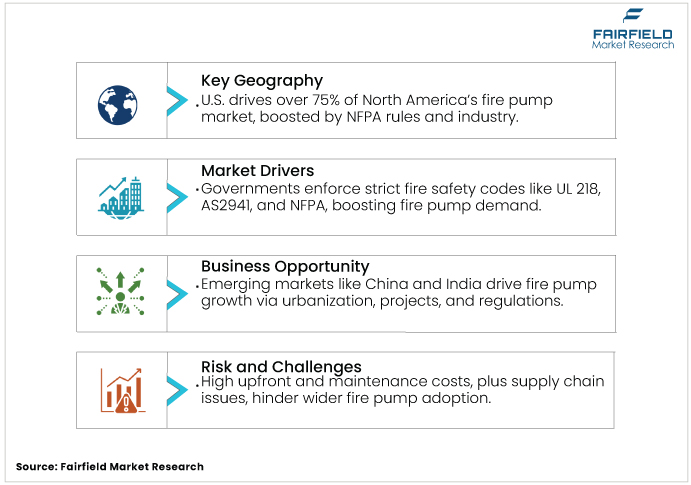
- North America continues to lead with over 75% of its regional demand driven by the U.S., where NFPA regulations and industrial retrofits sustain market strength.
- Adoption of sustainable and smart fire pumps, including AI and telemetry-based solutions, is rising globally due to increasing focus on energy efficiency.
- High initial costs and supply chain disruptions remain key restraints, especially in developing regions and for small-to-medium manufacturers.
A Look Back and a Look Forward - Comparative Analysis
The fire pump market experienced moderate growth from 2019 to 2024, though global growth faced challenges. The COVID-19 pandemic disrupted supply chains and slowed construction activities, leading to a negative CAGR in North America during 2019–2024. Economic slowdowns in 2019 and 2020 further restrained market expansion as industries deferred investments in fire safety infrastructure. Despite these setbacks, increasing awareness of fire safety and regulatory enforcement sustained demand, particularly in industrial and commercial applications. The market began recovering in 2024 as industries normalized operations, with a year-on-year growth of approximately 2.2% in North America, driven by renewed construction and safety compliance efforts.
The fire pump market is set for steady expansion over the forecast period, driven by increasing demand and consistent technological advancements. This growth is fueled by rising urbanization, stricter fire safety codes, and technological advancements such as energy-efficient and IoT-enabled fire pumps. Emerging markets, particularly in Asia Pacific, will drive demand due to rapid industrial and infrastructural development. The commercial sector, accounting for 60% of market revenue in 2022, will continue to dominate, supported by construction booms in high-rise buildings and warehouses. Innovations in smart pump systems and sustainable designs will further enhance market prospects, ensuring steady growth through 2032.
Key Growth Drivers
- Fire Safety Regulations Boost Compliance and Drive Fire Pump Installations Globally
Governments worldwide are enforcing rigorous fire safety codes, significantly driving the fire pump market. Regulations such as UL 218 and AS2941 mandate compliant fire pump installations in commercial and industrial buildings, boosting demand. For instance, the U.S. requires fire pumps in high-rise structures to meet NFPA standards, ensuring employee and property safety. In 2021, Europe’s second-worst wildfire season, with Italy reporting over 1,302 fires, underscored the need for robust fire protection systems, further propelling market growth. These regulations compel industries, especially oil and gas and manufacturing, to invest in advanced fire pumps to mitigate fire risks effectively.
- Urbanization and Infrastructure Surge Fuel Demand for Fire Pump Systems
The market for fire pump is thriving due to rapid urbanization and infrastructure expansion, particularly in developing regions. Asia Pacific, with countries such as China and India, is witnessing significant construction of commercial complexes, airports, and industrial facilities, necessitating fire pumps. India’s industrial output surged over 10% year-on-year in October 2023, reflecting increased demand for fire safety systems. Similarly, China’s infrastructure investment reached 500 billion yuan in 2024, boosting the need for fire protection in new projects. Urbanization drives the construction of high-rise buildings and warehouses, especially in the e-commerce sector, requiring advanced fire pump systems to ensure safety. This trend fuels consistent market growth globally.
- Smart Fire Pump Technologies Enhance Safety and Operational Efficiency Worldwide
Innovations in fire pump technology, such as IoT-enabled controllers and energy-efficient systems, are key drivers. Smart pumps with real-time monitoring and variable frequency drives (VFDs) optimize performance, reducing energy consumption. For example, Pentair’s smart fire pumps launched in April 2024 feature telemetry for enhanced diagnostics. These advancements improve response times and reliability, critical for industrial and commercial applications. The integration of AI and sensors allows pumps to assess and respond without human intervention, saving time in emergencies. Such developments create lucrative opportunities, as manufacturers invest heavily in R&D to meet evolving safety standards, driving market expansion.
Key Growth Restraints
- High Initial Costs Limit Adoption of Advanced Fire Pump Systems
The fire pump market faces challenges due to the high initial costs of fire pump systems, which can hinder adoption, particularly among small businesses. Advanced fire pumps, especially those with smart technology, require significant investment in installation and maintenance. The U.S. International Trade Commission noted in 2024 that supply chain disruptions capped market growth at 5.5% annually, partly due to cost barriers. Diesel-powered systems, while robust, incur high maintenance expenses, deterring cost-sensitive sectors. These financial constraints limit market penetration in developing regions where budget constraints are prominent. Manufacturers are addressing this by developing cost-effective hybrid systems, but high upfront costs remain a significant restraint.
- Global Supply Chain Disruptions Slow Fire Pump Production and Delivery
The fire pump market has been impacted by supply chain disruptions, particularly during and post-COVID-19. Delays in raw material procurement and logistics increased production costs and slowed delivery timelines. The U.S. International Trade Commission reported that these disruptions restricted market growth to 5.2% annually in 2024. Semiconductor shortages and transportation bottlenecks affected the availability of advanced components such as IoT controllers, critical for modern fire pumps. These challenges particularly impacted small and medium-scale manufacturers, limiting their ability to meet demand. While recovery efforts are underway, ongoing global supply chain volatility continues to pose a restraint on the growth trajectory.
Fire Pump Market Trends and Opportunities
- Emerging Markets Drive Fire Pump Demand Across Asia Pacific Infrastructure Projects
The fire pump market has significant growth potential in emerging markets, driven by rapid urbanization and industrialization. Asia Pacific, particularly China and India, offers substantial opportunities due to increasing infrastructure projects and stringent safety regulations. China’s market was valued with a projected CAGR of 6.0% through 2025, reflecting robust demand. India’s sports infrastructure investment of US$ 1.103 Bn from 2022–2025 further boosts the need for fire safety systems in new facilities. The rise in commercial construction, such as malls and office complexes, fuels demand for reliable fire pumps. Manufacturers can capitalize by tailoring cost-effective, energy-efficient solutions to meet regional needs, enhancing market penetration. Strategic partnerships with local distributors and compliance with regional standards will further strengthen market presence in these high-growth regions.
- Sustainable and Smart Technologies Accelerate Shift Toward Eco-Friendly Fire Pumps
The fire pump market is poised to benefit from the growing demand for sustainable and smart fire pump technologies. Green building initiatives and environmental concerns are pushing manufacturers to develop energy-efficient pumps with reduced carbon footprints. For instance, Flowserve’s energy-efficient fire pumps launched in January 2024 align with eco-friendly design trends. IoT-enabled controllers and AI-driven systems enhance operational efficiency, offering real-time monitoring and predictive maintenance. These innovations reduce energy consumption and operational costs, appealing to industries that prioritize sustainability. By investing in R&D for sustainable solutions, manufacturers can gain a competitive edge, tapping into the rising demand for eco-conscious fire protection systems.
Segment-wise Trends & Analysis
- Horizontal Split Case Pumps Lead with Vertical Inline, Growing Fastest
The horizontal split case segment led, which held a 55–60% market share in 2024 due to its reliability, ease of maintenance, and suitability for commercial and industrial applications. These pumps are favored for their ability to handle high-pressure water flow efficiently, dominating sectors such as fire protection for buildings and data centers. The horizontal split case segment is projected to grow at a CAGR of 5–7% through 2032, driven by stringent safety standards. The fastest-growing segment is vertical in-line pumps, expected to exhibit rapid growth due to their compact design and increasing adoption in space-constrained urban settings, catering to modern infrastructure needs.
- Diesel-Powered Fire Pumps Dominate while Electric Pumps Expand Rapidly
Diesel-powered fire pumps dominated the market, accounting for nearly 40% of revenue due to their robustness and reliability in industrial settings such as petrochemicals and mining. These pumps ensure functionality in diverse conditions, making them a preferred choice. However, electric fire pumps are the fastest-growing segment, projected to expand at the highest CAGR through 2032. Their low running costs and integration with IoT-enabled controllers drive adoption, particularly in commercial and residential applications, aligning with the global shift toward energy-efficient systems.
- Commercial Applications Remain the Largest, with the Industrial Segment Growing Fastest
The commercial application segment led the fire pump market in 2024, capturing 55% of revenue, driven by the construction of malls, hospitals, and office complexes requiring sophisticated fire protection systems. This segment is expected to maintain dominance through 2032 due to ongoing urbanization. The industry application segment is the fastest-growing, projected to grow at a CAGR of 4.9% from 2025 to 2032. High-risk industries such as oil and gas and manufacturing demand robust fire pumps to protect valuable assets, fueling rapid growth in this segment.
Regional Analysis
- North America is Driven by US Regulations and Strong Industrial Demand
North America, led by the U.S., holds a significant share of the fire pump market, with the U.S. accounting for over 75% of the regional market in 2024. The market is driven by stringent NFPA regulations and a robust industrial sector, particularly in oil and gas, where 60% of regional demand originates. The U.S. market is projected to grow at a CAGR of 3.5% through 2032, fueled by infrastructure development and replacement demand. Integration of cloud-based solutions and electrification trends further enhances market growth.
- Europe is Led by Germany and the UK with Rising Fire Safety Needs
Europe’s market is led by Germany and the UK, with Germany holding the largest share due to its advanced industrial base and strict fire safety regulations. The UK is the fastest-growing market, driven by the increasing construction of commercial buildings and warehouses. The 2024 wildfire season, with Italy reporting over 1,400 fires, underscored the need for fire pumps, boosting demand. Europe’s market growth is supported by regulatory compliance and rising fire safety awareness.
- Asia Pacific Experiences the Fastest Growth Led by China and India Development
Asia Pacific is the fastest-growing region, with China and India leading due to rapid urbanization and industrialization. China’s market, valued at over US$2,200 Mn in 2025, benefits from robust infrastructure investment, while India’s 11.2% industrial output growth in 2032 drives demand. Stringent safety regulations and increasing fire incidents in South Asia further propel market expansion.
Competitive Landscape
The fire pump market is moderately fragmented, with key players such as Pentair PLC, Xylem Inc., and Grundfos Pumps Corporation holding significant shares through innovation and strategic partnerships. Companies focus on R&D for energy-efficient and IoT-enabled pumps, mergers, and acquisitions to expand portfolios, and collaborations with regional distributors to enhance market reach. These strategies ensure compliance with evolving safety standards and cater to growing demand in emerging markets.
Key Companies
- Xylem Inc.
- Pentair plc
- Grundfos Holding A/S
- Sulzer Ltd.
- KSB SE & Co. KGaA
- ITT Inc.
- Ebara Corporation
- Wilo SE
- Rosenbauer International AG
- Armstrong Fluid Technology
Global Fire Pump Market Segmentation
By Product Type
- Horizontal Split Case Pumps
- Vertical Split Case Pumps
- Vertical Inline Pumps
- End Suction Pumps
- Multistage Multiport Pumps
By Power Source
- Electric Driven Pumps
- Diesel Driven Pumps
- Steam Turbine Driven Pumps
By Application
- Commercial Buildings
- Industrial Facilities
- Residential Buildings
- Government & Municipal Infrastructure
- Oil & Gas Facilities
By End User
- Commercial
- Industrial
- Residential
- Energy & Utilities
- Government Sector
By Region
- North America
- Europe
- Asia Pacific
- Latin America
- Middle East & Africa
- Executive Summary
- Global Fire Pump Market Snapshot
- Future Projections
- Key Market Trends
- Regional Snapshot, by Value, 2026
- Analyst Recommendations
- Market Overview
- Market Definitions and Segmentations
- Market Dynamics
- Drivers
- Restraints
- Market Opportunities
- Value Chain Analysis
- COVID-19 Impact Analysis
- Porter's Five Forces Analysis
- Impact of Russia-Ukraine Conflict
- PESTLE Analysis
- Regulatory Analysis
- Price Trend Analysis
- Current Prices and Future Projections, 2025-2033
- Price Impact Factors
- Global Fire Pump Market Outlook, 2020 - 2033
- Global Fire Pump Market Outlook, by Product Type, Value (US$ Bn), 2020-2033
- Horizontal Split Case Pumps
- Vertical Split Case Pumps
- Vertical Inline Pumps
- End Suction Pumps
- Multistage Multiport Pumps
- Global Fire Pump Market Outlook, by Power Source, Value (US$ Bn), 2020-2033
- Electric Driven Pumps
- Diesel Driven Pumps
- Steam Turbine Driven Pumps
- Global Fire Pump Market Outlook, by Application, Value (US$ Bn), 2020-2033
- Commercial Buildings
- Industrial Facilities
- Residential Buildings
- Government & Municipal Infrastructure
- Oil & Gas Facilities
- Global Fire Pump Market Outlook, by End User, Value (US$ Bn), 2020-2033
- Commercial
- Industrial
- Residential
- Energy & Utilities
- Government Sector
- Global Fire Pump Market Outlook, by Region, Value (US$ Bn), 2020-2033
- North America
- Europe
- Asia Pacific
- Latin America
- Middle East & Africa
- Global Fire Pump Market Outlook, by Product Type, Value (US$ Bn), 2020-2033
- North America Fire Pump Market Outlook, 2020 - 2033
- North America Fire Pump Market Outlook, by Product Type, Value (US$ Bn), 2020-2033
- Horizontal Split Case Pumps
- Vertical Split Case Pumps
- Vertical Inline Pumps
- End Suction Pumps
- Multistage Multiport Pumps
- North America Fire Pump Market Outlook, by Power Source, Value (US$ Bn), 2020-2033
- Electric Driven Pumps
- Diesel Driven Pumps
- Steam Turbine Driven Pumps
- North America Fire Pump Market Outlook, by Application, Value (US$ Bn), 2020-2033
- Commercial Buildings
- Industrial Facilities
- Residential Buildings
- Government & Municipal Infrastructure
- Oil & Gas Facilities
- North America Fire Pump Market Outlook, by End User, Value (US$ Bn), 2020-2033
- Commercial
- Industrial
- Residential
- Energy & Utilities
- Government Sector
- North America Fire Pump Market Outlook, by Country, Value (US$ Bn), 2020-2033
- U.S. Fire Pump Market Outlook, by Product Type, 2020-2033
- U.S. Fire Pump Market Outlook, by Power Source, 2020-2033
- U.S. Fire Pump Market Outlook, by Application, 2020-2033
- U.S. Fire Pump Market Outlook, by End User, 2020-2033
- Canada Fire Pump Market Outlook, by Product Type, 2020-2033
- Canada Fire Pump Market Outlook, by Power Source, 2020-2033
- Canada Fire Pump Market Outlook, by Application, 2020-2033
- Canada Fire Pump Market Outlook, by End User, 2020-2033
- BPS Analysis/Market Attractiveness Analysis
- North America Fire Pump Market Outlook, by Product Type, Value (US$ Bn), 2020-2033
- Europe Fire Pump Market Outlook, 2020 - 2033
- Europe Fire Pump Market Outlook, by Product Type, Value (US$ Bn), 2020-2033
- Horizontal Split Case Pumps
- Vertical Split Case Pumps
- Vertical Inline Pumps
- End Suction Pumps
- Multistage Multiport Pumps
- Europe Fire Pump Market Outlook, by Power Source, Value (US$ Bn), 2020-2033
- Electric Driven Pumps
- Diesel Driven Pumps
- Steam Turbine Driven Pumps
- Europe Fire Pump Market Outlook, by Application, Value (US$ Bn), 2020-2033
- Commercial Buildings
- Industrial Facilities
- Residential Buildings
- Government & Municipal Infrastructure
- Oil & Gas Facilities
- Europe Fire Pump Market Outlook, by End User, Value (US$ Bn), 2020-2033
- Commercial
- Industrial
- Residential
- Energy & Utilities
- Government Sector
- Europe Fire Pump Market Outlook, by Country, Value (US$ Bn), 2020-2033
- Germany Fire Pump Market Outlook, by Product Type, 2020-2033
- Germany Fire Pump Market Outlook, by Power Source, 2020-2033
- Germany Fire Pump Market Outlook, by Application, 2020-2033
- Germany Fire Pump Market Outlook, by End User, 2020-2033
- Italy Fire Pump Market Outlook, by Product Type, 2020-2033
- Italy Fire Pump Market Outlook, by Power Source, 2020-2033
- Italy Fire Pump Market Outlook, by Application, 2020-2033
- Italy Fire Pump Market Outlook, by End User, 2020-2033
- France Fire Pump Market Outlook, by Product Type, 2020-2033
- France Fire Pump Market Outlook, by Power Source, 2020-2033
- France Fire Pump Market Outlook, by Application, 2020-2033
- France Fire Pump Market Outlook, by End User, 2020-2033
- U.K. Fire Pump Market Outlook, by Product Type, 2020-2033
- U.K. Fire Pump Market Outlook, by Power Source, 2020-2033
- U.K. Fire Pump Market Outlook, by Application, 2020-2033
- U.K. Fire Pump Market Outlook, by End User, 2020-2033
- Spain Fire Pump Market Outlook, by Product Type, 2020-2033
- Spain Fire Pump Market Outlook, by Power Source, 2020-2033
- Spain Fire Pump Market Outlook, by Application, 2020-2033
- Spain Fire Pump Market Outlook, by End User, 2020-2033
- Russia Fire Pump Market Outlook, by Product Type, 2020-2033
- Russia Fire Pump Market Outlook, by Power Source, 2020-2033
- Russia Fire Pump Market Outlook, by Application, 2020-2033
- Russia Fire Pump Market Outlook, by End User, 2020-2033
- Rest of Europe Fire Pump Market Outlook, by Product Type, 2020-2033
- Rest of Europe Fire Pump Market Outlook, by Power Source, 2020-2033
- Rest of Europe Fire Pump Market Outlook, by Application, 2020-2033
- Rest of Europe Fire Pump Market Outlook, by End User, 2020-2033
- BPS Analysis/Market Attractiveness Analysis
- Europe Fire Pump Market Outlook, by Product Type, Value (US$ Bn), 2020-2033
- Asia Pacific Fire Pump Market Outlook, 2020 - 2033
- Asia Pacific Fire Pump Market Outlook, by Product Type, Value (US$ Bn), 2020-2033
- Horizontal Split Case Pumps
- Vertical Split Case Pumps
- Vertical Inline Pumps
- End Suction Pumps
- Multistage Multiport Pumps
- Asia Pacific Fire Pump Market Outlook, by Power Source, Value (US$ Bn), 2020-2033
- Electric Driven Pumps
- Diesel Driven Pumps
- Steam Turbine Driven Pumps
- Asia Pacific Fire Pump Market Outlook, by Application, Value (US$ Bn), 2020-2033
- Commercial Buildings
- Industrial Facilities
- Residential Buildings
- Government & Municipal Infrastructure
- Oil & Gas Facilities
- Asia Pacific Fire Pump Market Outlook, by End User, Value (US$ Bn), 2020-2033
- Commercial
- Industrial
- Residential
- Energy & Utilities
- Government Sector
- Asia Pacific Fire Pump Market Outlook, by Country, Value (US$ Bn), 2020-2033
- China Fire Pump Market Outlook, by Product Type, 2020-2033
- China Fire Pump Market Outlook, by Power Source, 2020-2033
- China Fire Pump Market Outlook, by Application, 2020-2033
- China Fire Pump Market Outlook, by End User, 2020-2033
- Japan Fire Pump Market Outlook, by Product Type, 2020-2033
- Japan Fire Pump Market Outlook, by Power Source, 2020-2033
- Japan Fire Pump Market Outlook, by Application, 2020-2033
- Japan Fire Pump Market Outlook, by End User, 2020-2033
- South Korea Fire Pump Market Outlook, by Product Type, 2020-2033
- South Korea Fire Pump Market Outlook, by Power Source, 2020-2033
- South Korea Fire Pump Market Outlook, by Application, 2020-2033
- South Korea Fire Pump Market Outlook, by End User, 2020-2033
- India Fire Pump Market Outlook, by Product Type, 2020-2033
- India Fire Pump Market Outlook, by Power Source, 2020-2033
- India Fire Pump Market Outlook, by Application, 2020-2033
- India Fire Pump Market Outlook, by End User, 2020-2033
- Southeast Asia Fire Pump Market Outlook, by Product Type, 2020-2033
- Southeast Asia Fire Pump Market Outlook, by Power Source, 2020-2033
- Southeast Asia Fire Pump Market Outlook, by Application, 2020-2033
- Southeast Asia Fire Pump Market Outlook, by End User, 2020-2033
- Rest of SAO Fire Pump Market Outlook, by Product Type, 2020-2033
- Rest of SAO Fire Pump Market Outlook, by Power Source, 2020-2033
- Rest of SAO Fire Pump Market Outlook, by Application, 2020-2033
- Rest of SAO Fire Pump Market Outlook, by End User, 2020-2033
- BPS Analysis/Market Attractiveness Analysis
- Asia Pacific Fire Pump Market Outlook, by Product Type, Value (US$ Bn), 2020-2033
- Latin America Fire Pump Market Outlook, 2020 - 2033
- Latin America Fire Pump Market Outlook, by Product Type, Value (US$ Bn), 2020-2033
- Horizontal Split Case Pumps
- Vertical Split Case Pumps
- Vertical Inline Pumps
- End Suction Pumps
- Multistage Multiport Pumps
- Latin America Fire Pump Market Outlook, by Power Source, Value (US$ Bn), 2020-2033
- Electric Driven Pumps
- Diesel Driven Pumps
- Steam Turbine Driven Pumps
- Latin America Fire Pump Market Outlook, by Application, Value (US$ Bn), 2020-2033
- Commercial Buildings
- Industrial Facilities
- Residential Buildings
- Government & Municipal Infrastructure
- Oil & Gas Facilities
- Latin America Fire Pump Market Outlook, by End User, Value (US$ Bn), 2020-2033
- Commercial
- Industrial
- Residential
- Energy & Utilities
- Government Sector
- Latin America Fire Pump Market Outlook, by Country, Value (US$ Bn), 2020-2033
- Brazil Fire Pump Market Outlook, by Product Type, 2020-2033
- Brazil Fire Pump Market Outlook, by Power Source, 2020-2033
- Brazil Fire Pump Market Outlook, by Application, 2020-2033
- Brazil Fire Pump Market Outlook, by End User, 2020-2033
- Mexico Fire Pump Market Outlook, by Product Type, 2020-2033
- Mexico Fire Pump Market Outlook, by Power Source, 2020-2033
- Mexico Fire Pump Market Outlook, by Application, 2020-2033
- Mexico Fire Pump Market Outlook, by End User, 2020-2033
- Argentina Fire Pump Market Outlook, by Product Type, 2020-2033
- Argentina Fire Pump Market Outlook, by Power Source, 2020-2033
- Argentina Fire Pump Market Outlook, by Application, 2020-2033
- Argentina Fire Pump Market Outlook, by End User, 2020-2033
- Rest of LATAM Fire Pump Market Outlook, by Product Type, 2020-2033
- Rest of LATAM Fire Pump Market Outlook, by Power Source, 2020-2033
- Rest of LATAM Fire Pump Market Outlook, by Application, 2020-2033
- Rest of LATAM Fire Pump Market Outlook, by End User, 2020-2033
- BPS Analysis/Market Attractiveness Analysis
- Latin America Fire Pump Market Outlook, by Product Type, Value (US$ Bn), 2020-2033
- Middle East & Africa Fire Pump Market Outlook, 2020 - 2033
- Middle East & Africa Fire Pump Market Outlook, by Product Type, Value (US$ Bn), 2020-2033
- Horizontal Split Case Pumps
- Vertical Split Case Pumps
- Vertical Inline Pumps
- End Suction Pumps
- Multistage Multiport Pumps
- Middle East & Africa Fire Pump Market Outlook, by Power Source, Value (US$ Bn), 2020-2033
- Electric Driven Pumps
- Diesel Driven Pumps
- Steam Turbine Driven Pumps
- Middle East & Africa Fire Pump Market Outlook, by Application, Value (US$ Bn), 2020-2033
- Commercial Buildings
- Industrial Facilities
- Residential Buildings
- Government & Municipal Infrastructure
- Oil & Gas Facilities
- Middle East & Africa Fire Pump Market Outlook, by End User, Value (US$ Bn), 2020-2033
- Commercial
- Industrial
- Residential
- Energy & Utilities
- Government Sector
- Middle East & Africa Fire Pump Market Outlook, by Country, Value (US$ Bn), 2020-2033
- GCC Fire Pump Market Outlook, by Product Type, 2020-2033
- GCC Fire Pump Market Outlook, by Power Source, 2020-2033
- GCC Fire Pump Market Outlook, by Application, 2020-2033
- GCC Fire Pump Market Outlook, by End User, 2020-2033
- South Africa Fire Pump Market Outlook, by Product Type, 2020-2033
- South Africa Fire Pump Market Outlook, by Power Source, 2020-2033
- South Africa Fire Pump Market Outlook, by Application, 2020-2033
- South Africa Fire Pump Market Outlook, by End User, 2020-2033
- Egypt Fire Pump Market Outlook, by Product Type, 2020-2033
- Egypt Fire Pump Market Outlook, by Power Source, 2020-2033
- Egypt Fire Pump Market Outlook, by Application, 2020-2033
- Egypt Fire Pump Market Outlook, by End User, 2020-2033
- Nigeria Fire Pump Market Outlook, by Product Type, 2020-2033
- Nigeria Fire Pump Market Outlook, by Power Source, 2020-2033
- Nigeria Fire Pump Market Outlook, by Application, 2020-2033
- Nigeria Fire Pump Market Outlook, by End User, 2020-2033
- Rest of Middle East Fire Pump Market Outlook, by Product Type, 2020-2033
- Rest of Middle East Fire Pump Market Outlook, by Power Source, 2020-2033
- Rest of Middle East Fire Pump Market Outlook, by Application, 2020-2033
- Rest of Middle East Fire Pump Market Outlook, by End User, 2020-2033
- BPS Analysis/Market Attractiveness Analysis
- Middle East & Africa Fire Pump Market Outlook, by Product Type, Value (US$ Bn), 2020-2033
- Competitive Landscape
- Company Vs Segment Heatmap
- Company Market Share Analysis, 2025
- Competitive Dashboard
- Company Profiles
- Xylem Inc.
- Company Overview
- Product Portfolio
- Financial Overview
- Business Strategies and Developments
- Pentair plc
- Grundfos Holding A/S
- Sulzer Ltd.
- KSB SE & Co. KGaA
- ITT Inc.
- Ebara Corporation
- Wilo SE
- Rosenbauer International AG
- Armstrong Fluid Technology
- Xylem Inc.
- Appendix
- Research Methodology
- Report Assumptions
- Acronyms and Abbreviations
|
BASE YEAR |
HISTORICAL DATA |
FORECAST PERIOD |
UNITS |
|||
 |
2025 |
 |
2020 - 2025 |
 |
2026 - 2033 |
Value: US$ Million |
|
REPORT FEATURES |
DETAILS |
|
Product Type Coverage |
|
|
Power Basis Coverage |
|
|
Application Coverage |
|
|
Geographical Coverage |
|
|
Leading Companies |
|
|
Report Highlights |
Key Market Indicators, Macro-micro economic impact analysis, Technological Roadmap, Key Trends, Driver, Restraints, and Future Opportunities & Revenue Pockets, Porter’s 5 Forces Analysis, Historical Trend (2019-2024), Market Estimates and Forecast, Market Dynamics, Industry Trends, Competition Landscape, Category, Region, Country-wise Trends & Analysis, COVID-19 Impact Analysis (Demand and Supply Chain) |
Our Research Methodology
Considering the volatility of business today, traditional approaches to strategizing a game plan can be unfruitful if not detrimental. True ambiguity is no way to determine a forecast. A myriad of predetermined factors must be accounted for such as the degree of risk involved, the magnitude of circumstances, as well as conditions or consequences that are not known or unpredictable. To circumvent binary views that cast uncertainty, the application of market research intelligence to strategically posture, move, and enable actionable outcomes is necessary.
View Methodology
Quality Assured
Rigorous Validation Process

Confidentiality Assured
End-to-end Data Security

Custom Research Services
Tailored To Your Objectives
FAQs
The Fire Pump market size is expected to reach USD 613.8 billion in 2026.
The Fire Pump market is projected to expand at a 4.2% CAGR from 2026 to 2033.
The Fire Pump market growth is driven by stricter fire safety regulations, rapid urbanization, and advancements in smart, energy-efficient fire pump technologies.
North America is the dominant regional market for the Fire Pump market.
Xylem Inc., Pentair plc, Grundfos Holding A/S, Sulzer Ltd., and KSB SE & Co. KGaA are some of the leading industry players in the Fire Pump market.
Related Reports
Aircraft Ground Support Equipment Market Insights, Competitive Landscape, and Market Forecast - 2033
Aircraft Ground Support Equipment Market to reach US$2.28B by 2033 at 4.3% CAGR, driven by airport expansion, electric GSE, and fleet growth.
Condition Monitoring System Market Insights, Competitive Landscape, and Market Forecast 2033
The condition monitoring system market is projected to grow from US$ 6.90 billion in 2026 to US$ 12.53 billion by 2033, growing at an 8.9% CAGR.
Automotive Performance Parts Market Insights, Competitive Landscape, and Market Forecast 2033
Automotive Performance Parts Market is projected to reach US$579.72 billion by 2033, driven by motorsports, vehicle customization, and OEM demand.
Automotive Load Floor Market Insights, Competitive Landscape, and Market Forecast 2033
Automotive Load Floor Market is projected to reach US$452.03 million by 2033, driven by EV adoption, lightweight materials, and SUV demand.
Hand Tools Market Insights, Competitive Landscape, and Market Forecast - 2033
Hand Tools Market to reach US$37.54 billion by 2033 at 5.8% CAGR, driven by construction, infrastructure projects, and industrial demand.
Gaskets and Seals Market Insights, Competitive Landscape, and Market Forecast - 2033
Gaskets and Seals Market to reach US$97.27 billion by 2033 at 4.6% CAGR, driven by EVs, renewable energy, and industrial demand