


Gene Expression Market
Gene Expression Market Insights, Competitive Landscape, and Market Forecast - 2033
Global Gene Expression Market Forecast
The Gene Expression Market is expected to grow from USD 17.5 Billion in 2026 to USD 24.1 Billion by 2033, reflecting strong industry expansion and registering a CAGR of 4.6% during the forecast period from 2026 to 2033.
Quick Report Digest
A Look Back and a Look Forward - Comparative Analysis
The identification and verification of prospective therapeutic targets is done using gene expression analysis. Researchers can identify genes and pathways that might make good targets for the creation of new drugs by examining the patterns of gene expression in disease tissues.
Pharmacogenomic research aims to understand how genetic variants affect drug reactions, and gene expression analysis helps with this. According to each patient's genetic makeup, this information is used to customise medicine dosages and therapies.
The market witnessed staggered growth during the historical period 2018 – 2022. Researchers were able to analyse gene expression at the molecular level because of developments in molecular biology tools, including the polymerase chain reaction (PCR), DNA sequencing, and microarray technologies.
With the aid of these technologies, it was feasible to examine the patterns of gene expression in diverse tissues and environments. Discussions about the ethical and social ramifications of gene expression, such as concerns about genetic privacy, genetic testing, and genetic prejudice, were also prompted by the increased public knowledge of gene expression.
Based on gene expression profiles, AI may create prediction models for disease diagnosis, prognosis, and therapy response. The development of diagnostic tests and personalised medicine strategies will be made possible by these models in the coming years. Additionally, reducing dimensionality, enhancing the quality of downstream analysis, and choosing the most pertinent genes or features from gene expression data are all made possible by AI techniques.
Furthermore, in-situ hybridisation and immunohistochemistry are two techniques that use AI-driven image analysis to measure the amount of gene expression in tissue samples. It quickens data processing and minimizes human error during the next five years.
Key Growth Determinants
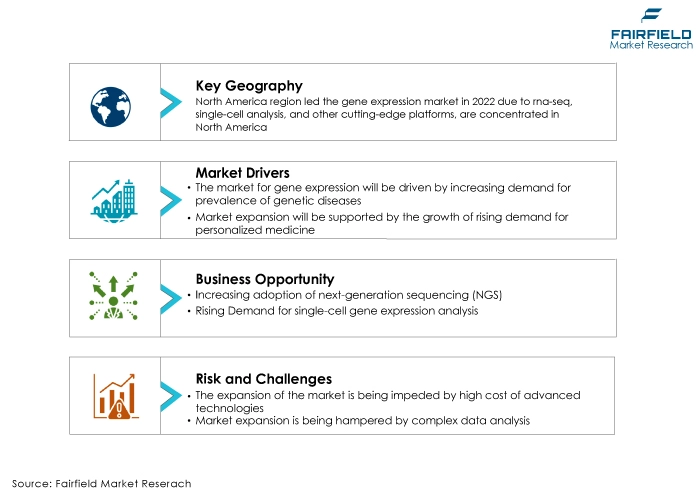
- Mounting Prevalence of Genetic Diseases
The need for understanding the molecular mechanisms causing hereditary illnesses is increasing as their frequency rises. Through gene expression analysis, researchers may determine which genes are overexpressed or under-expressed in patients, offering important insights into disease processes.
For the proper classification and diagnosis of genetic illnesses, this information may be vital. The identification of biomarkers associated with genetic illnesses can be aided by gene expression profiling.
Early disease detection, disease monitoring, and gauging therapy effectiveness all depend on biomarkers. The creation of accurate biomarkers may facilitate the development of diagnostic procedures and individualised therapeutic strategies.
- Rising Demand for Personalised Medicine
Analysis of a person's genetic information, including gene expression patterns, is a key component of personalised medicine. Through the identification of certain genes that are overexpressed or under-expressed, gene expression profiling can shed light on a patient's particular medical issues and suggest prospective therapeutic approaches.
Based on a patient's genetic profile, gene expression analysis helps healthcare professionals in making the best treatment decisions. This may result in more efficient therapies, fewer negative effects, and better patient outcomes.
Personalised medicine is particularly important in oncology. Based on the genetic features of the tumour, gene expression profiling can assist in identifying the most efficient cancer treatments, such as targeted medicines and immunotherapies.
- Increasing Demand for Technological Advancements to Drive Market Growth
Gene expression analysis has undergone a revolutionary change drive by the next-generation sequencing (NGS) technologies, including RNA sequencing (RNA-seq), which provide high-resolution data on gene expression levels. Researchers now have easier access to gene expression profiling because of ongoing advancements in NGS technologies that increase their efficiency, speed, and accuracy.
The development of scRNA-seq technology has made it possible for researchers to examine single-cell gene expression. This makes it possible to identify rare cell types, comprehend cellular heterogeneity, and thoroughly examine the dynamics of gene expression.
Major Growth Barriers
- High Costs of Advanced Technologies
Research organisations, especially smaller academic labs, and organisations with tighter resources, may find the price of modern gene expression methods, such as single-cell RNA sequencing and next-generation sequencing (NGS), to be prohibitive. Access to innovative instruments and methods is constrained, which hinders the advancement of research.
Research projects and organisations may need financial assistance to meet the high initial costs of high-end sequencing machines as well as the continuous expenditures associated with reagents and data analysis. Budget restrictions and a slower pace of research advancement may result from this.
- Complex Data Analysis
Bioinformatics and computational biology specialists are frequently needed for gene expression data analysis. The analysis of gene expression databases by researchers and laboratories without access to bioinformatics specialists may be challenging, which might impede the advancement of research.
Gene expression data is typically combined with other omics data (such as genomes, and proteomics), or clinical data. Due to varying data formats platforms and the requirement for advanced data integration methodologies, this integration can take time and effort.
Key Trends and Opportunities to Look at
The simultaneous sequencing of millions to billions of DNA or RNA fragments in a single run is made possible by NGS platforms. To investigate more genes and samples in less time, this high throughput radically accelerates gene expression analysis.
NGS offers quantitative data on gene expression levels, which is essential for precisely determining the amount of RNA transcripts. For an understanding of gene regulation and for locating genes that are differentially expressed in diverse biological settings, this quantitative data is crucial.
- Rising Demand for Single-Cell Gene Expression Analysis
- Growing Prominence of Precision Oncology
The diversity of gene expression profiles within complex tissues and cell populations can be discovered by researchers using single-cell gene expression analysis. This provides a deeper understanding of tissue composition and function because it exposes cellular heterogeneity that may have been hidden in bulk analysis.
Studying diseases characterised by cellular heterogeneity, such as cancer and neurological disorders, requires an understanding of gene expression at the single-cell level. Rare cell forms, cell states associated with disease, and possible therapeutic targets can all be found by researchers.
The identification of specific genes and pathways that are dysregulated in cancer is helped by gene expression profiling. Identification of prospective therapeutic targets for drug development depends on these insights.
The most appropriate type of treatment for each cancer patient can be chosen using gene expression data. Based on the molecular profile of the patient, it enables oncologists to select targeted medicines that are more likely to be beneficial.
How Does the Regulatory Scenario Shape this Industry?
Over the last three years, regulation of the gene expression market has been required to guarantee the security, precision, and dependability of gene expression analysis goods and services, particularly when utilised in clinical and diagnostic applications.
Gene expression-based diagnoses and treatments are heavily regulated in the US by the Food and Drug Administration (FDA). To ensure that gene expression tests used in clinical settings comply with safety and efficacy criteria, they supervise their approval and clearance. Gene expression tests that have received FDA approval have a big commercial influence as medical professionals start to trust and embrace them.
The European Medicines Agency (EMA) holds control over the gene expression-based medicines and diagnostics in Europe. For usage in the European Union, they assess and give their approval for new gene expression tests and therapies.
EMA approvals can significantly influence the acceptance of gene expression products in European markets. Gene expression test reimbursement decisions in the US are influenced by the Centers for Medicare & Medicaid Services (CMS). Their choices over whether to pay for specific tests can have a big impact on whether they are used in clinical practice.
Fairfield’s Ranking Board
Top Segments
In 2022, the segment of cDNA synthesis & conversion dominated the market. Because there is a large variety of kits available to meet different research needs, such as the ideal reaction temperature, the number of reactions, and the sample size. Additionally, the ongoing introduction of new cDNA synthesis & conversion synthesis and library preparation kits is anticipated to drive the segment's growth.
Furthermore, data analysis & interpretation category is anticipated to grow significantly throughout the forecast period. The considerable investments made in cancer research and the rising need for sophisticated software for cancer gene expression investigations are both responsible for this expansion. To analyse gene expression in complicated disorders like cancer, several methodologies and algorithms are being developed.
- Kits & Reagents Top-selling
- The High-Plex Category Leads by Capacity
- Application Highest in Drug Discovery & Development Sector
- RNA Expression Remains Sought-after than Other Techniques
In 2022, the kits & reagents segment dominated the industry. The presence of a significant number of businesses selling various kits and reagents for gene expression is responsible for the segment's large market share. For instance, Agilent Technologies, Inc. provides a wide selection of kits and reagents for gene expression microarrays. The development of cutting-edge items created for specific applications is another factor in the growth of the market.
The DNA chips category is expected to grow significantly during the forecast period. Microscope slides are used for DNA microarrays, which have thousands of tiny dots printed in precise places; each dot corresponds to a known DNA sequence or gene. Many people refer to these slides as DNA or gene chips.
In the domains of molecular biology, biomedical research, and genomics, these chips are often employed in the study of gene expression profiles to find illnesses, biomarkers, and therapeutic responses.
The high-plex segment dominated the market in 2022. It typically involves the evaluation of thousands of genes or a significant number of gene targets. RNA sequencing and microarrays are two examples of high-plex technologies used in gene expression investigation.
Furthermore, compared to qPCR and other traditional technologies, high-plex analysis requires less hands-on time. The method is also very straightforward and accurate because it does not require prior probe validation.
The low- to mid-plex category is expected to grow the fastest. Low-level plex measurements entail the examination of a small subset of genes, typically 5–500 targets. These cost-effective, low- to medium-complexity solutions are doable. For hypothesis-driven research, specialised studies, or more general exploratory analysis, researchers use low to mid-plex approaches.
The drug discovery & development category dominated the industry in 2022. Pharma companies now use gene-expression profiling as a powerful tool for drug discovery. Pharmaceuticals' potency, toxicity, and other characteristics are assessed by seeing their effects on a cell's gene activity. Conventional profiling methods can be extremely expensive, often costing millions of dollars.
The clinical diagnostics segment is expected to rise the fastest. This is because gene expression analysis and profiling are being used more frequently to diagnose genetic illnesses quickly and accurately, comprehend disease pathophysiology, and track the evolution of diseases and how they respond to treatments.
In 2022, the RNA expression segment dominated the industry. Analysing cDNA transcripts is done using the high-throughput sequencing (HTS) method known as RNA-sequencing (RNA-seq). A lot of clinical investigations have made use of this relatively new technology.
RNA-seq is most frequently used in a differential gene expression (DGE) analysis to compare the expression levels of genes and transcripts between two or more situations (i.e., comparison groups). DGE has been crucial in cancer research for analysing biological function, etiology, and biomarker development.
The promoter analysis category is anticipated to grow the fastest. It is essential for understanding the regulation of gene expression and figuring out the main variables that control gene activity. The computer study's first phase, which predicts regulatory variables, is promoter identification. This is a relatively straightforward issue in lower eukaryotes because of the relatively high gene density in comparison to genome size.
Regional Frontrunners
North America Represents the Lion’s Share
North America is expected to lead the gene expression market during the forecast period. Rising funding and expanding R&D efforts, particularly in the US, are responsible for this expansion of the gene therapy market. Additionally, the market for gene expression analysis is expanding in North America due to elements such as the rising importance of gene expression studies, government initiatives, and the availability of financing for NGS research.
The market in the area is expanding on the back of the increasing financing for next-generation sequencing from research institutions, businesses, and universities. For instance, the Department of Health and Human Services announced funding in August 2022 for novel studies and research on structural congenital disabilities using human translational/clinical approaches (genomics, metabolomics, proteomics, etc.) and animal models.
Asia Pacific to Take a Sprint Through 2030
Asia Pacific is expected to be the fastest-growing gene expression market region. Due to rising R&D investments and the vast populations in nations like China, and India, which offer individualised and cutting-edge healthcare.
Several services and goods linked to gene expression analysis, RNA sequencing, and expression microarrays are offered by key businesses. Japan is a significant market for gene expression analysis, too. The nation's top universities, cutting-edge research facilities, and well-established biotech industry are driving the market's expansion.
Prominent Players in Global Gene Expression Market
• Thermo Fisher Scientific Inc.
• F. Hoffmann-La Roche Ltd.
• PerkinElmer, Inc.
• Bio-Rad Laboratories, Inc.
• OriGene Technologies, Inc.
• Illumina, Inc.
• QIAGEN
• Agilent Technologies
• Oxford Nanopore Technologies
• Promega Corporation
The Global Gene Expression Market is Segmented as Below
By Service
• Gene Expression Profiling
• Bioinformatics Solutions
By Technology
• Polymerase Chain Reaction
• DNA Microarray
• Next Generation Sequencing
• Other Technologies
By Consumables
• Reagents and Kits
• DNA Chips
• Other Consumables
By Region
• North America
• Europe
• Asia Pacific
• Latin America
• Middle East & Africa
- Executive Summary
- Global Gene Expression Market Snapshot
- Future Projections
- Key Market Trends
- Regional Snapshot, by Value, 2026
- Analyst Recommendations
- Market Overview
- Market Definitions and Segmentations
- Market Dynamics
- Drivers
- Restraints
- Market Opportunities
- Value Chain Analysis
- COVID-19 Impact Analysis
- Porter's Five Forces Analysis
- Impact of Russia-Ukraine Conflict
- PESTLE Analysis
- Regulatory Analysis
- Price Trend Analysis
- Current Prices and Future Projections, 2025-2033
- Price Impact Factors
- Global Gene Expression Market Outlook, 2020 - 2033
- Global Gene Expression Market Outlook, by Service, Value (US$ Bn), 2020-2033
- Gene Expression Profiling
- Bioinformatics Solutions
- Global Gene Expression Market Outlook, by Technology, Value (US$ Bn), 2020-2033
- Polymerase Chain Reaction
- DNA Microarray
- Next Generation Sequencing
- Global Gene Expression Market Outlook, by Consumables, Value (US$ Bn), 2020-2033
- Reagents and Kits
- DNA Chips
- Global Gene Expression Market Outlook, by Region, Value (US$ Bn), 2020-2033
- North America
- Europe
- Asia Pacific
- Latin America
- Middle East & Africa
- Global Gene Expression Market Outlook, by Service, Value (US$ Bn), 2020-2033
- North America Gene Expression Market Outlook, 2020 - 2033
- North America Gene Expression Market Outlook, by Service, Value (US$ Bn), 2020-2033
- Gene Expression Profiling
- Bioinformatics Solutions
- North America Gene Expression Market Outlook, by Technology, Value (US$ Bn), 2020-2033
- Polymerase Chain Reaction
- DNA Microarray
- Next Generation Sequencing
- North America Gene Expression Market Outlook, by Consumables, Value (US$ Bn), 2020-2033
- Reagents and Kits
- DNA Chips
- North America Gene Expression Market Outlook, by Country, Value (US$ Bn), 2020-2033
- U.S. Gene Expression Market Outlook, by Service, 2020-2033
- U.S. Gene Expression Market Outlook, by Technology, 2020-2033
- U.S. Gene Expression Market Outlook, by Consumables, 2020-2033
- Canada Gene Expression Market Outlook, by Service, 2020-2033
- Canada Gene Expression Market Outlook, by Technology, 2020-2033
- Canada Gene Expression Market Outlook, by Consumables, 2020-2033
- BPS Analysis/Market Attractiveness Analysis
- North America Gene Expression Market Outlook, by Service, Value (US$ Bn), 2020-2033
- Europe Gene Expression Market Outlook, 2020 - 2033
- Europe Gene Expression Market Outlook, by Service, Value (US$ Bn), 2020-2033
- Gene Expression Profiling
- Bioinformatics Solutions
- Europe Gene Expression Market Outlook, by Technology, Value (US$ Bn), 2020-2033
- Polymerase Chain Reaction
- DNA Microarray
- Next Generation Sequencing
- Europe Gene Expression Market Outlook, by Consumables, Value (US$ Bn), 2020-2033
- Reagents and Kits
- DNA Chips
- Europe Gene Expression Market Outlook, by Country, Value (US$ Bn), 2020-2033
- Germany Gene Expression Market Outlook, by Service, 2020-2033
- Germany Gene Expression Market Outlook, by Technology, 2020-2033
- Germany Gene Expression Market Outlook, by Consumables, 2020-2033
- Italy Gene Expression Market Outlook, by Service, 2020-2033
- Italy Gene Expression Market Outlook, by Technology, 2020-2033
- Italy Gene Expression Market Outlook, by Consumables, 2020-2033
- France Gene Expression Market Outlook, by Service, 2020-2033
- France Gene Expression Market Outlook, by Technology, 2020-2033
- France Gene Expression Market Outlook, by Consumables, 2020-2033
- U.K. Gene Expression Market Outlook, by Service, 2020-2033
- U.K. Gene Expression Market Outlook, by Technology, 2020-2033
- U.K. Gene Expression Market Outlook, by Consumables, 2020-2033
- Spain Gene Expression Market Outlook, by Service, 2020-2033
- Spain Gene Expression Market Outlook, by Technology, 2020-2033
- Spain Gene Expression Market Outlook, by Consumables, 2020-2033
- Russia Gene Expression Market Outlook, by Service, 2020-2033
- Russia Gene Expression Market Outlook, by Technology, 2020-2033
- Russia Gene Expression Market Outlook, by Consumables, 2020-2033
- Rest of Europe Gene Expression Market Outlook, by Service, 2020-2033
- Rest of Europe Gene Expression Market Outlook, by Technology, 2020-2033
- Rest of Europe Gene Expression Market Outlook, by Consumables, 2020-2033
- BPS Analysis/Market Attractiveness Analysis
- Europe Gene Expression Market Outlook, by Service, Value (US$ Bn), 2020-2033
- Asia Pacific Gene Expression Market Outlook, 2020 - 2033
- Asia Pacific Gene Expression Market Outlook, by Service, Value (US$ Bn), 2020-2033
- Gene Expression Profiling
- Bioinformatics Solutions
- Asia Pacific Gene Expression Market Outlook, by Technology, Value (US$ Bn), 2020-2033
- Polymerase Chain Reaction
- DNA Microarray
- Next Generation Sequencing
- Asia Pacific Gene Expression Market Outlook, by Consumables, Value (US$ Bn), 2020-2033
- Reagents and Kits
- DNA Chips
- Asia Pacific Gene Expression Market Outlook, by Country, Value (US$ Bn), 2020-2033
- China Gene Expression Market Outlook, by Service, 2020-2033
- China Gene Expression Market Outlook, by Technology, 2020-2033
- China Gene Expression Market Outlook, by Consumables, 2020-2033
- Japan Gene Expression Market Outlook, by Service, 2020-2033
- Japan Gene Expression Market Outlook, by Technology, 2020-2033
- Japan Gene Expression Market Outlook, by Consumables, 2020-2033
- South Korea Gene Expression Market Outlook, by Service, 2020-2033
- South Korea Gene Expression Market Outlook, by Technology, 2020-2033
- South Korea Gene Expression Market Outlook, by Consumables, 2020-2033
- India Gene Expression Market Outlook, by Service, 2020-2033
- India Gene Expression Market Outlook, by Technology, 2020-2033
- India Gene Expression Market Outlook, by Consumables, 2020-2033
- Southeast Asia Gene Expression Market Outlook, by Service, 2020-2033
- Southeast Asia Gene Expression Market Outlook, by Technology, 2020-2033
- Southeast Asia Gene Expression Market Outlook, by Consumables, 2020-2033
- Rest of SAO Gene Expression Market Outlook, by Service, 2020-2033
- Rest of SAO Gene Expression Market Outlook, by Technology, 2020-2033
- Rest of SAO Gene Expression Market Outlook, by Consumables, 2020-2033
- BPS Analysis/Market Attractiveness Analysis
- Asia Pacific Gene Expression Market Outlook, by Service, Value (US$ Bn), 2020-2033
- Latin America Gene Expression Market Outlook, 2020 - 2033
- Latin America Gene Expression Market Outlook, by Service, Value (US$ Bn), 2020-2033
- Gene Expression Profiling
- Bioinformatics Solutions
- Latin America Gene Expression Market Outlook, by Technology, Value (US$ Bn), 2020-2033
- Polymerase Chain Reaction
- DNA Microarray
- Next Generation Sequencing
- Latin America Gene Expression Market Outlook, by Consumables, Value (US$ Bn), 2020-2033
- Reagents and Kits
- DNA Chips
- Latin America Gene Expression Market Outlook, by Country, Value (US$ Bn), 2020-2033
- Brazil Gene Expression Market Outlook, by Service, 2020-2033
- Brazil Gene Expression Market Outlook, by Technology, 2020-2033
- Brazil Gene Expression Market Outlook, by Consumables, 2020-2033
- Mexico Gene Expression Market Outlook, by Service, 2020-2033
- Mexico Gene Expression Market Outlook, by Technology, 2020-2033
- Mexico Gene Expression Market Outlook, by Consumables, 2020-2033
- Argentina Gene Expression Market Outlook, by Service, 2020-2033
- Argentina Gene Expression Market Outlook, by Technology, 2020-2033
- Argentina Gene Expression Market Outlook, by Consumables, 2020-2033
- Rest of LATAM Gene Expression Market Outlook, by Service, 2020-2033
- Rest of LATAM Gene Expression Market Outlook, by Technology, 2020-2033
- Rest of LATAM Gene Expression Market Outlook, by Consumables, 2020-2033
- BPS Analysis/Market Attractiveness Analysis
- Latin America Gene Expression Market Outlook, by Service, Value (US$ Bn), 2020-2033
- Middle East & Africa Gene Expression Market Outlook, 2020 - 2033
- Middle East & Africa Gene Expression Market Outlook, by Service, Value (US$ Bn), 2020-2033
- Gene Expression Profiling
- Bioinformatics Solutions
- Middle East & Africa Gene Expression Market Outlook, by Technology, Value (US$ Bn), 2020-2033
- Polymerase Chain Reaction
- DNA Microarray
- Next Generation Sequencing
- Middle East & Africa Gene Expression Market Outlook, by Consumables, Value (US$ Bn), 2020-2033
- Reagents and Kits
- DNA Chips
- Middle East & Africa Gene Expression Market Outlook, by Country, Value (US$ Bn), 2020-2033
- GCC Gene Expression Market Outlook, by Service, 2020-2033
- GCC Gene Expression Market Outlook, by Technology, 2020-2033
- GCC Gene Expression Market Outlook, by Consumables, 2020-2033
- South Africa Gene Expression Market Outlook, by Service, 2020-2033
- South Africa Gene Expression Market Outlook, by Technology, 2020-2033
- South Africa Gene Expression Market Outlook, by Consumables, 2020-2033
- Egypt Gene Expression Market Outlook, by Service, 2020-2033
- Egypt Gene Expression Market Outlook, by Technology, 2020-2033
- Egypt Gene Expression Market Outlook, by Consumables, 2020-2033
- Nigeria Gene Expression Market Outlook, by Service, 2020-2033
- Nigeria Gene Expression Market Outlook, by Technology, 2020-2033
- Nigeria Gene Expression Market Outlook, by Consumables, 2020-2033
- Rest of Middle East Gene Expression Market Outlook, by Service, 2020-2033
- Rest of Middle East Gene Expression Market Outlook, by Technology, 2020-2033
- Rest of Middle East Gene Expression Market Outlook, by Consumables, 2020-2033
- BPS Analysis/Market Attractiveness Analysis
- Middle East & Africa Gene Expression Market Outlook, by Service, Value (US$ Bn), 2020-2033
- Competitive Landscape
- Company Vs Segment Heatmap
- Company Market Share Analysis, 2025
- Competitive Dashboard
- Company Profiles
- Thermo Fisher Scientific Inc.
- Company Overview
- Product Portfolio
- Financial Overview
- Business Strategies and Developments
- Hoffmann-La Roche Ltd.
- PerkinElmer, Inc.
- Bio-Rad Laboratories, Inc.
- OriGene Technologies, Inc.
- Illumina, Inc.
- QIAGEN
- Agilent Technologies
- Oxford Nanopore Technologies
- Promega Corporation
- Thermo Fisher Scientific Inc.
- Appendix
- Research Methodology
- Report Assumptions
- Acronyms and Abbreviations
|
BASE YEAR |
HISTORICAL DATA |
FORECAST PERIOD |
UNITS |
|||
 |
2025 |
 |
2020 - 2025 |
 |
2026 - 2033 |
Value: US$ Million |
Our Research Methodology
Considering the volatility of business today, traditional approaches to strategizing a game plan can be unfruitful if not detrimental. True ambiguity is no way to determine a forecast. A myriad of predetermined factors must be accounted for such as the degree of risk involved, the magnitude of circumstances, as well as conditions or consequences that are not known or unpredictable. To circumvent binary views that cast uncertainty, the application of market research intelligence to strategically posture, move, and enable actionable outcomes is necessary.
View Methodology
Quality Assured
Rigorous Validation Process

Confidentiality Assured
End-to-end Data Security

Custom Research Services
Tailored To Your Objectives
FAQs
The Gene Expression market size is USD 17.5 Billion in 2026.
The Gene Expression market is projected to register a 4.6% CAGR by 2033.
The Gene Expression market growth drivers include rising demand for personalized medicine, increasing prevalence of genetic diseases, and advancements in next-generation sequencing (NGS) technologies.
North America is the dominating region for the Gene Expression market.
Thermo Fisher Scientific Inc., F. Hoffmann-La Roche Ltd., Illumina, Inc., QIAGEN, and Agilent Technologies are some leading industry players in the Gene Expression market.
Related Reports
Retinoids Market Insights, Competitive Landscape, and Market Forecast 2033
Retinoids Market to reach US$2.83B by 2033 at 6.7% CAGR, driven by acne treatments, skincare demand, telehealth, and FDA-approved therapies.
Companion Animal Drugs Market Insights, Competitive Landscape, and Market Forecast - 2033
Companion Animal Drugs Market to reach US$45.80B by 2033 at 6.8% CAGR, driven by biologics, pet healthcare, vaccines, and telehealth.
Lung Cancer Surgery Market Insights, Competitive Landscape, and Market Forecast - 2033
Lung Cancer Surgery Market to reach US$6.69B by 2033 at 3.1% CAGR, driven by expanded CT screening, robotic surgery, and early diagnosis.
Corneal Ulcer Treatment Market Insights, Competitive Landscape, and Market Forecast 2033
The corneal ulcer treatment market is projected to grow from US$ 1.10 billion in 2026 to US$ 1.56 billion by 2033, registering a 5.1% CAGR during 2026–2033.
Narcolepsy Drugs Market Insights, Competitive Landscape, and Market Forecast - 2033
Global narcolepsy drugs market is expected to be worth US$6,588.0 Mn by 2026 from US$3,875.1 Mn in 2021, registering an 11.2% CAGR during the period.
Gene Therapy Market Insights, Competitive Landscape, and Market Forecast - 2033
The Gene Therapy Market is projected to grow from USD 9.9 Billion in 2026 to USD 32.3 Billion by 2033, registering a CAGR of 18.3%