


Nuclear Medicine Market
Nuclear Medicine Market Insights, Competitive Landscape, and Market Forecast - 2033
Global Nuclear Medicine Market Forecast
The Nuclear Medicine Market is expected to grow from USD 25.7 Billion in 2026 to USD 57.6 Billion by 2033, reflecting strong industry expansion and registering a CAGR of 12.2% during the forecast period from 2026 to 2033.
Major Report Findings - Fairfield's Perspective
A Look Back and a Look Forward - Comparative Analysis
The market is expanding on the back of a strong product pipeline and supportive government programs to expand access to nuclear medicine. A favourable reimbursement environment for radiopharmaceuticals is projected to boost market expansion. The application domains for radiopharmaceuticals are expanding, and as a result, their demand and market share are expected to increase throughout the forecasted period.
The market witnessed staggered growth during the historical period 2018 – 2022. Nuclear medicine was in high demand due to the rise in cardiovascular disorders among the elderly population. Additionally, there had been an increase in the number of cancer patients worldwide, which is a serious condition that necessitates the use of nuclear medications.
It has been predicted that the sector will benefit in the next years from the development of nuclear medicine centres, which will render nuclear medicine therapies accessible to everyone. As a direct result of these advancements in medical technology, more people will get PET and Single-Photon Emission Computed Tomography (SPECT) scans. To increase the usage of radiopharmaceuticals in new ways, research is being done.
Key Growth Determinants
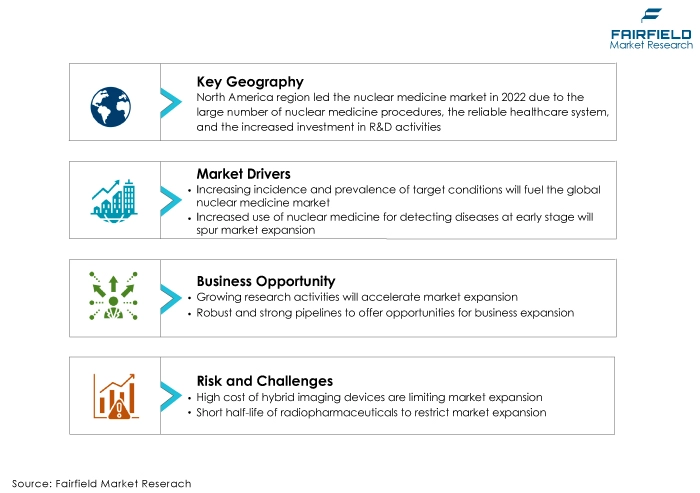
- Increasing Incidence and Prevalence of Target Conditions
A major factor promoting market expansion is the rising incidence of cardiovascular disease and cancer. Most of the cases can be prevented with the help of early detection and treatment, which is where nuclear medicine can play a vital role.
According to the American Heart Association's 2022 projections, 19.1 million deaths worldwide in 2020 were attributable to CVD. Age-adjusted mortality per 100,000 people was 239.8, and age-adjusted prevalence per 100,000 people was 7354.1.
Due to the importance of nuclear medicine in the detection and treatment of disease, it is anticipated that the rising prevalence of a large number of ailments will fuel market expansion throughout the projection period.
- Expanding Application for Early Disease Detection
Medical applications for nuclear imaging techniques include identifying problems of the central nervous system, treating intracranial tumours and arteriovenous malformations, and assisting in the diagnosis of heart and breast diseases. These methods precisely identify molecular activity, making it possible to identify diseases early and evaluate treatments.
Nuclear medicine is used in therapeutic and diagnostic processes to identify many ailments, primarily heart diseases, using SPECT scanning systems and PET scanners. During the projected period, the worldwide nuclear medicine market is anticipated to rise because of the expanding use of nuclear medicine for early disease detection.
- Ascending Chronic Disease Incidence
Chronic conditions like cardiovascular illness, cancer, respiratory problems, neurological issues, and metabolic disorders are becoming more commonplace on a global scale at a worrying rate. According to the Lymphoma Research Foundation, lymphoma is the most prevalent disease in both children and adults and affects over 100,000 Americans annually.
The Global Burden of Diseases suggests that cardiovascular disease is one of the major causes of death. Around 35 million people also suffer from heart-related conditions, which is increasing demand for nuclear medicines for both diagnostic and therapeutic uses.
Nuclear medicine is highly sought after because of its wide range of medical diagnostic procedures and applications, including the detection of the predominate lymph nodes, the drainage of malignant lymphocytes in the incidence of lymphoma, and functional cardiac imaging used to diagnose ischemic heart disease.
Major Growth Barriers
- High Price Points of Hybrid Imaging Devices
Hybrid imaging device adoption is hampered by the high costs associated with them, which also prompts doctors to prefer less expensive conventional imaging systems. For instance, SPECT gamma cameras are priced between US$0.4 Mn and US$0.6 Mn, and PET/CT scanners cost around US$2 Mn. Limited uptake is also a problem for the pricey SPECT/CT hybrid imaging devices, particularly in developing nations.
- Short Half-Life of Radiopharmaceuticals
A nuclear medicine shelf-life mostly depends on the radioisotope's half-life and the radionuclide's composition. Tc-99m, for instance, loses radioactivity after 6 hours in SPECT diagnosis, whereas 1-123 and 1n-111 isotopes should be employed within 13 and 67 hours, respectively.
Radiochemical purity is reduced to an undesirable level by not using radioisotopes within the allotted shelf-life due to radiation and chemical decomposition, which could be fatal during diagnosis and treatment.
Additionally, because nuclear medicine has a shorter half-life, hospitals must produce their own nuclear medicine on-site in cyclotrons or generators, which drives up the cost of capital for hospitals.
Key Trends and Opportunities to Look at
Due to increased research and development efforts to broaden hybrid imaging applications, the worldwide nuclear medicine market is anticipated to grow. The widespread use of SPECT and PET/CT systems in oncology, notably in the US, is what spurs R&D efforts to extend the application of hybrid imaging.
The goal of the research is to expand the use of dual optical and PET/CT probes for the non-invasive detection of atherosclerotic plaque inflammation. To identify people who are at a high risk of developing early atherosclerosis, SPECT hybrid imaging is useful.
- Robust and Strong Pipelines
- Technological Advancements
The market's companies put a steady emphasis on the creation of nuclear medicine treatments. Global demand for this therapy option is being driven by the therapeutic impact it has compared to other medicines. The demand for market therapeutics is also predicted to expand in nations with a high cancer burden due to reasons like the development of more sophisticated therapeutic applications and success rates in the treatment of cancer and other ailments.
Compared to other pharmacological products, the use of nuclear medicines was still in its infancy in the healthcare industry during the beginning of the 1990s. Today, however, it is becoming more popular and in greater demand in line with the developments and improvements in neurology and oncology diagnosis and treatment, which are also creating new growth prospects for market participants.
How Does the Regulatory Scenario Shape this Industry?
Extreme caution must be exercised during the production, administration, storage, and disposal of radionuclides due to their intrinsic danger and the related worry about radiation safety for patients and those handling them. Therefore, it is necessary to apply regulatory criteria to improve the radiopharmaceuticals' quality, safety, and potency.
The Cosmetic and Drug Act of 1940 and other regulations control the pharmaceutical businesses in India, and the EANM and USFDA regulations are followed in Europe and the USA. Using this guideline makes it easier to improvise and lowers the threshold for submitting information to regulatory agencies.
Licenses are published by the Nuclear Regulatory Commission (NRC) for the use of byproduct material in healthcare settings. The specialised license with limited scope is the one commonly sought for diagnostic nuclear medicine purposes. This kind of license is given by the NRC to medical institutes and private or group practices.
Atomic Energy (Radiation Protection) Rules, 2004, and AERB Safety Codes [AERB/RF-SC/MED-1] specify the regulatory requirements that must be met before a radiotherapy facility or nuclear medicine infrastructure in India. The user institute must also obtain the necessary regulatory approval from the AERB in accordance with the AERB Safety Guide for Consenting Process for Radiation Facilities (AERB/SG/G-3).
Fairfield’s Ranking Board
Top Segments
The PET applications segment dominated the market in 2022. In PET Applications, the oncology subsegment acquired a major market share. Imaging methods are widely used to diagnose cancer all around the world. The rising incidence of cancer, the advantages of early detection in treating and controlling cancer in all its forms, and the expanding public awareness of the significance of diagnosis all contribute to this.
Furthermore, the diagnostic applications category is projected to experience the fastest market growth. This is because SPECT applications are expanding, healthcare awareness is rising, and more money is being invested in the research and development of innovative nuclear medications for the treatment of cancer.
During the projection period, the cardiology sub-segment is expected to grow at a significant CAGR. The rising use of nuclear medications for the detection and treatment of cardiovascular disorders is blamed for the segment's growth.
- Therapeutic Nuclear Medicine Leads
- Demand for Brachytherapy Procedures Higher
In 2022, the therapeutic nuclear medicine category dominated the industry. The segment's robust product pipeline and the approval and commercialisation of nuclear medicine treatments may both contribute to the segment's growth. Currently, the most often used alpha emitter in therapeutics is radium (Ra-223). The creation of potential radioisotopes like Terbium (Tb-149), Bismuth (Bi-212), and Actinium (Ac-225) is expected to accelerate the sector's growth.
Due to the large patient population and accessibility of cutting-edge technologies like SPECT and PET, the diagnostic nuclear medicine category is predicted to expand significantly throughout the projected time. The segment is expanding because of the large variety of radiotracers now used in the diagnosis of tumours and technological improvements.
The brachytherapy procedures segment dominated the market in 2022. Brachytherapy is used to treat cancers in different parts of the body, including the head and neck, as well as tumours of the prostate, cervix, breast, and scalp. The rise in elderly populations, rise in cancer prevalence, and rise in cancer prevalence are the main factors driving the sector for brachytherapy.
The alpha emitter procedures category is expected to experience the fastest growth within the forecast time frame. The segment is expanding on account of various causes, such as growing public awareness of the potential advantages of targeted alpha treatment and an increase in the number of cancer and cardiac patients.
Additionally, alpha particles have an advantage in targeted therapy because of their unusually strong cell-killing potential. This is known as targeted anticancer or alpha therapy (TAT), which is increasingly used in the treatment of cancer.
Regional Frontrunners
North America Takes up the Largest Share of Market Revenue Pie
A sizable portion of the population in the area suffers from cancer and cardiovascular disorders. The market is expanding due to the simple accessibility of radiopharmaceuticals from regional manufacturers, physician adoption of nuclear medicine in a variety of diagnostic and therapeutic procedures, and technological advancements.
The US dominates the local market. This is explained by the increased emphasis on home production of radiopharmaceuticals and nuclear drugs like Technetium (Tc 99m). The FDA in the United States has also approved a number of nuclear medications, including Alpha emitters and injections of radium Ra 223 dichloride, for the treatment of prostate cancer.
The market is also growing due to the growing demand for patient screening and the creation of high-performance medical diagnostic technologies.
Asia Pacific Develops the Most Favourable Environment for Market Expansion
The market for nuclear medicines in the Asia Pacific is primarily driven by rising consumer knowledge of nuclear medicine, rising rates of cancer and cardiovascular disease, rising healthcare costs, and expanding SPECT and PET applications.
As disposable incomes increase across the region, more people are becoming conscious of diagnostic imaging techniques and how to use them to effectively identify and treat a variety of illnesses. China has made significant strides in the R&D of nuclear medicine over more than 50 years of development.
Nuclear imaging procedures are being performed in greater numbers because of the rising prevalence of chronic diseases in developed nations like India, China, and Japan, which is further fuelling the expansion of the nuclear medicine market in the Asia Pacific region.
Prominent Players in Global Nuclear Medicine Market
• GE Healthcare
• Jubilant Life Sciences Ltd
• Nordion (Canada), Inc.
• Bracco Imaging S.P.A
• The institute for radioelements (IRE)
• NTP Radioisotopes SOC Ltd.
• The Australian Nuclear Science and Technology Organization
• Eczacıbaşı-Monrol
• Lantheus Medical Imaging, Inc
• Eckert & Ziegler
The Global Nuclear Medicine Market is Segmented as Below
Product Outlook
• Diagnostics
• PET
• Therapeutics
Application Outlook
• Cardiology
• Neurology
• Oncology
• Thyroid
• Lymphoma
• Bone Metastasis
• Endocrine Tumor
• Pulmonary Scans
• Urology
• Other
End Use Outlook
• Hospitals
• Diagnostic Centers
• Others
By Region
• North America
• Europe
• Asia Pacific
• Latin America
• Middle East & Africa
- Executive Summary
- Global Nuclear Medicine Market Snapshot
- Future Projections
- Key Market Trends
- Regional Snapshot, by Value, 2026
- Analyst Recommendations
- Market Overview
- Market Definitions and Segmentations
- Market Dynamics
- Drivers
- Restraints
- Market Opportunities
- Value Chain Analysis
- COVID-19 Impact Analysis
- Porter's Five Forces Analysis
- Impact of Russia-Ukraine Conflict
- PESTLE Analysis
- Regulatory Analysis
- Price Trend Analysis
- Current Prices and Future Projections, 2025-2033
- Price Impact Factors
- Global Nuclear Medicine Market Outlook, 2020 - 2033
- Global Nuclear Medicine Market Outlook, by Product Outlook, Value (US$ Bn), 2020-2033
- Diagnostics
- PET
- Therapeutics
- Global Nuclear Medicine Market Outlook, by Application Outlook, Value (US$ Bn), 2020-2033
- Cardiology
- Neurology
- Oncology
- Thyroid
- Lymphoma
- Bone Metastasis
- Endocrine Tumor
- Pulmonary Scans
- Urology
- Global Nuclear Medicine Market Outlook, by End Use Outlook, Value (US$ Bn), 2020-2033
- Hospitals
- Diagnostic Centers
- Others
- Global Nuclear Medicine Market Outlook, by Region, Value (US$ Bn), 2020-2033
- North America
- Europe
- Asia Pacific
- Latin America
- Middle East & Africa
- Global Nuclear Medicine Market Outlook, by Product Outlook, Value (US$ Bn), 2020-2033
- North America Nuclear Medicine Market Outlook, 2020 - 2033
- North America Nuclear Medicine Market Outlook, by Product Outlook, Value (US$ Bn), 2020-2033
- Diagnostics
- PET
- Therapeutics
- North America Nuclear Medicine Market Outlook, by Application Outlook, Value (US$ Bn), 2020-2033
- Cardiology
- Neurology
- Oncology
- Thyroid
- Lymphoma
- Bone Metastasis
- Endocrine Tumor
- Pulmonary Scans
- Urology
- North America Nuclear Medicine Market Outlook, by End Use Outlook, Value (US$ Bn), 2020-2033
- Hospitals
- Diagnostic Centers
- Others
- North America Nuclear Medicine Market Outlook, by Country, Value (US$ Bn), 2020-2033
- U.S. Nuclear Medicine Market Outlook, by Product Outlook, 2020-2033
- U.S. Nuclear Medicine Market Outlook, by Application Outlook, 2020-2033
- U.S. Nuclear Medicine Market Outlook, by End Use Outlook, 2020-2033
- Canada Nuclear Medicine Market Outlook, by Product Outlook, 2020-2033
- Canada Nuclear Medicine Market Outlook, by Application Outlook, 2020-2033
- Canada Nuclear Medicine Market Outlook, by End Use Outlook, 2020-2033
- BPS Analysis/Market Attractiveness Analysis
- North America Nuclear Medicine Market Outlook, by Product Outlook, Value (US$ Bn), 2020-2033
- Europe Nuclear Medicine Market Outlook, 2020 - 2033
- Europe Nuclear Medicine Market Outlook, by Product Outlook, Value (US$ Bn), 2020-2033
- Diagnostics
- PET
- Therapeutics
- Europe Nuclear Medicine Market Outlook, by Application Outlook, Value (US$ Bn), 2020-2033
- Cardiology
- Neurology
- Oncology
- Thyroid
- Lymphoma
- Bone Metastasis
- Endocrine Tumor
- Pulmonary Scans
- Urology
- Europe Nuclear Medicine Market Outlook, by End Use Outlook, Value (US$ Bn), 2020-2033
- Hospitals
- Diagnostic Centers
- Others
- Europe Nuclear Medicine Market Outlook, by Country, Value (US$ Bn), 2020-2033
- Germany Nuclear Medicine Market Outlook, by Product Outlook, 2020-2033
- Germany Nuclear Medicine Market Outlook, by Application Outlook, 2020-2033
- Germany Nuclear Medicine Market Outlook, by End Use Outlook, 2020-2033
- Italy Nuclear Medicine Market Outlook, by Product Outlook, 2020-2033
- Italy Nuclear Medicine Market Outlook, by Application Outlook, 2020-2033
- Italy Nuclear Medicine Market Outlook, by End Use Outlook, 2020-2033
- France Nuclear Medicine Market Outlook, by Product Outlook, 2020-2033
- France Nuclear Medicine Market Outlook, by Application Outlook, 2020-2033
- France Nuclear Medicine Market Outlook, by End Use Outlook, 2020-2033
- U.K. Nuclear Medicine Market Outlook, by Product Outlook, 2020-2033
- U.K. Nuclear Medicine Market Outlook, by Application Outlook, 2020-2033
- U.K. Nuclear Medicine Market Outlook, by End Use Outlook, 2020-2033
- Spain Nuclear Medicine Market Outlook, by Product Outlook, 2020-2033
- Spain Nuclear Medicine Market Outlook, by Application Outlook, 2020-2033
- Spain Nuclear Medicine Market Outlook, by End Use Outlook, 2020-2033
- Russia Nuclear Medicine Market Outlook, by Product Outlook, 2020-2033
- Russia Nuclear Medicine Market Outlook, by Application Outlook, 2020-2033
- Russia Nuclear Medicine Market Outlook, by End Use Outlook, 2020-2033
- Rest of Europe Nuclear Medicine Market Outlook, by Product Outlook, 2020-2033
- Rest of Europe Nuclear Medicine Market Outlook, by Application Outlook, 2020-2033
- Rest of Europe Nuclear Medicine Market Outlook, by End Use Outlook, 2020-2033
- BPS Analysis/Market Attractiveness Analysis
- Europe Nuclear Medicine Market Outlook, by Product Outlook, Value (US$ Bn), 2020-2033
- Asia Pacific Nuclear Medicine Market Outlook, 2020 - 2033
- Asia Pacific Nuclear Medicine Market Outlook, by Product Outlook, Value (US$ Bn), 2020-2033
- Diagnostics
- PET
- Therapeutics
- Asia Pacific Nuclear Medicine Market Outlook, by Application Outlook, Value (US$ Bn), 2020-2033
- Cardiology
- Neurology
- Oncology
- Thyroid
- Lymphoma
- Bone Metastasis
- Endocrine Tumor
- Pulmonary Scans
- Urology
- Asia Pacific Nuclear Medicine Market Outlook, by End Use Outlook, Value (US$ Bn), 2020-2033
- Hospitals
- Diagnostic Centers
- Others
- Asia Pacific Nuclear Medicine Market Outlook, by Country, Value (US$ Bn), 2020-2033
- China Nuclear Medicine Market Outlook, by Product Outlook, 2020-2033
- China Nuclear Medicine Market Outlook, by Application Outlook, 2020-2033
- China Nuclear Medicine Market Outlook, by End Use Outlook, 2020-2033
- Japan Nuclear Medicine Market Outlook, by Product Outlook, 2020-2033
- Japan Nuclear Medicine Market Outlook, by Application Outlook, 2020-2033
- Japan Nuclear Medicine Market Outlook, by End Use Outlook, 2020-2033
- South Korea Nuclear Medicine Market Outlook, by Product Outlook, 2020-2033
- South Korea Nuclear Medicine Market Outlook, by Application Outlook, 2020-2033
- South Korea Nuclear Medicine Market Outlook, by End Use Outlook, 2020-2033
- India Nuclear Medicine Market Outlook, by Product Outlook, 2020-2033
- India Nuclear Medicine Market Outlook, by Application Outlook, 2020-2033
- India Nuclear Medicine Market Outlook, by End Use Outlook, 2020-2033
- Southeast Asia Nuclear Medicine Market Outlook, by Product Outlook, 2020-2033
- Southeast Asia Nuclear Medicine Market Outlook, by Application Outlook, 2020-2033
- Southeast Asia Nuclear Medicine Market Outlook, by End Use Outlook, 2020-2033
- Rest of SAO Nuclear Medicine Market Outlook, by Product Outlook, 2020-2033
- Rest of SAO Nuclear Medicine Market Outlook, by Application Outlook, 2020-2033
- Rest of SAO Nuclear Medicine Market Outlook, by End Use Outlook, 2020-2033
- BPS Analysis/Market Attractiveness Analysis
- Asia Pacific Nuclear Medicine Market Outlook, by Product Outlook, Value (US$ Bn), 2020-2033
- Latin America Nuclear Medicine Market Outlook, 2020 - 2033
- Latin America Nuclear Medicine Market Outlook, by Product Outlook, Value (US$ Bn), 2020-2033
- Diagnostics
- PET
- Therapeutics
- Latin America Nuclear Medicine Market Outlook, by Application Outlook, Value (US$ Bn), 2020-2033
- Cardiology
- Neurology
- Oncology
- Thyroid
- Lymphoma
- Bone Metastasis
- Endocrine Tumor
- Pulmonary Scans
- Urology
- Latin America Nuclear Medicine Market Outlook, by End Use Outlook, Value (US$ Bn), 2020-2033
- Hospitals
- Diagnostic Centers
- Others
- Latin America Nuclear Medicine Market Outlook, by Country, Value (US$ Bn), 2020-2033
- Brazil Nuclear Medicine Market Outlook, by Product Outlook, 2020-2033
- Brazil Nuclear Medicine Market Outlook, by Application Outlook, 2020-2033
- Brazil Nuclear Medicine Market Outlook, by End Use Outlook, 2020-2033
- Mexico Nuclear Medicine Market Outlook, by Product Outlook, 2020-2033
- Mexico Nuclear Medicine Market Outlook, by Application Outlook, 2020-2033
- Mexico Nuclear Medicine Market Outlook, by End Use Outlook, 2020-2033
- Argentina Nuclear Medicine Market Outlook, by Product Outlook, 2020-2033
- Argentina Nuclear Medicine Market Outlook, by Application Outlook, 2020-2033
- Argentina Nuclear Medicine Market Outlook, by End Use Outlook, 2020-2033
- Rest of LATAM Nuclear Medicine Market Outlook, by Product Outlook, 2020-2033
- Rest of LATAM Nuclear Medicine Market Outlook, by Application Outlook, 2020-2033
- Rest of LATAM Nuclear Medicine Market Outlook, by End Use Outlook, 2020-2033
- BPS Analysis/Market Attractiveness Analysis
- Latin America Nuclear Medicine Market Outlook, by Product Outlook, Value (US$ Bn), 2020-2033
- Middle East & Africa Nuclear Medicine Market Outlook, 2020 - 2033
- Middle East & Africa Nuclear Medicine Market Outlook, by Product Outlook, Value (US$ Bn), 2020-2033
- Diagnostics
- PET
- Therapeutics
- Middle East & Africa Nuclear Medicine Market Outlook, by Application Outlook, Value (US$ Bn), 2020-2033
- Cardiology
- Neurology
- Oncology
- Thyroid
- Lymphoma
- Bone Metastasis
- Endocrine Tumor
- Pulmonary Scans
- Urology
- Middle East & Africa Nuclear Medicine Market Outlook, by End Use Outlook, Value (US$ Bn), 2020-2033
- Hospitals
- Diagnostic Centers
- Others
- Middle East & Africa Nuclear Medicine Market Outlook, by Country, Value (US$ Bn), 2020-2033
- GCC Nuclear Medicine Market Outlook, by Product Outlook, 2020-2033
- GCC Nuclear Medicine Market Outlook, by Application Outlook, 2020-2033
- GCC Nuclear Medicine Market Outlook, by End Use Outlook, 2020-2033
- South Africa Nuclear Medicine Market Outlook, by Product Outlook, 2020-2033
- South Africa Nuclear Medicine Market Outlook, by Application Outlook, 2020-2033
- South Africa Nuclear Medicine Market Outlook, by End Use Outlook, 2020-2033
- Egypt Nuclear Medicine Market Outlook, by Product Outlook, 2020-2033
- Egypt Nuclear Medicine Market Outlook, by Application Outlook, 2020-2033
- Egypt Nuclear Medicine Market Outlook, by End Use Outlook, 2020-2033
- Nigeria Nuclear Medicine Market Outlook, by Product Outlook, 2020-2033
- Nigeria Nuclear Medicine Market Outlook, by Application Outlook, 2020-2033
- Nigeria Nuclear Medicine Market Outlook, by End Use Outlook, 2020-2033
- Rest of Middle East Nuclear Medicine Market Outlook, by Product Outlook, 2020-2033
- Rest of Middle East Nuclear Medicine Market Outlook, by Application Outlook, 2020-2033
- Rest of Middle East Nuclear Medicine Market Outlook, by End Use Outlook, 2020-2033
- BPS Analysis/Market Attractiveness Analysis
- Middle East & Africa Nuclear Medicine Market Outlook, by Product Outlook, Value (US$ Bn), 2020-2033
- Competitive Landscape
- Company Vs Segment Heatmap
- Company Market Share Analysis, 2025
- Competitive Dashboard
- Company Profiles
- GE Healthcare
- Company Overview
- Product Portfolio
- Financial Overview
- Business Strategies and Developments
- Jubilant Life Sciences Ltd
- Nordion (Canada), Inc.
- Bracco Imaging S.P.A
- The institute for radioelements (IRE)
- NTP Radioisotopes SOC Ltd.
- The Australian Nuclear Science and Technology Organization
- Eczacıbaşı-Monrol
- Lantheus Medical Imaging, Inc
- Eckert & Ziegler
- GE Healthcare
- Appendix
- Research Methodology
- Report Assumptions
- Acronyms and Abbreviations
|
BASE YEAR |
HISTORICAL DATA |
FORECAST PERIOD |
UNITS |
|||
 |
2025 |
 |
2020 - 2025 |
 |
2026 - 2033 |
Value: US$ Million |
Our Research Methodology
Considering the volatility of business today, traditional approaches to strategizing a game plan can be unfruitful if not detrimental. True ambiguity is no way to determine a forecast. A myriad of predetermined factors must be accounted for such as the degree of risk involved, the magnitude of circumstances, as well as conditions or consequences that are not known or unpredictable. To circumvent binary views that cast uncertainty, the application of market research intelligence to strategically posture, move, and enable actionable outcomes is necessary.
View Methodology
Quality Assured
Rigorous Validation Process

Confidentiality Assured
End-to-end Data Security

Custom Research Services
Tailored To Your Objectives
FAQs
The Nuclear Medicine market size is USD 25.7 Billion in 2026.
The Nuclear Medicine market is projected to register a 12.2% CAGR by 2033.
The Nuclear Medicine market growth drivers include rising prevalence of cancer and cardiovascular diseases, expanding applications of early disease detection, and advancements in radiopharmaceuticals and hybrid imaging technologies.
North America is a dominating region for the Nuclear Medicine market.
GE Healthcare, Lantheus Medical Imaging, Inc., Bracco Imaging S.P.A, Nordion (Canada), Inc., and Eckert & Ziegler are some leading industry players in the Nuclear Medicine market.
Related Reports
Retinoids Market Insights, Competitive Landscape, and Market Forecast 2033
Retinoids Market to reach US$2.83B by 2033 at 6.7% CAGR, driven by acne treatments, skincare demand, telehealth, and FDA-approved therapies.
Companion Animal Drugs Market Insights, Competitive Landscape, and Market Forecast - 2033
Companion Animal Drugs Market to reach US$45.80B by 2033 at 6.8% CAGR, driven by biologics, pet healthcare, vaccines, and telehealth.
Lung Cancer Surgery Market Insights, Competitive Landscape, and Market Forecast - 2033
Lung Cancer Surgery Market to reach US$6.69B by 2033 at 3.1% CAGR, driven by expanded CT screening, robotic surgery, and early diagnosis.
Corneal Ulcer Treatment Market Insights, Competitive Landscape, and Market Forecast 2033
The corneal ulcer treatment market is projected to grow from US$ 1.10 billion in 2026 to US$ 1.56 billion by 2033, registering a 5.1% CAGR during 2026–2033.
Narcolepsy Drugs Market Insights, Competitive Landscape, and Market Forecast - 2033
Global narcolepsy drugs market is expected to be worth US$6,588.0 Mn by 2026 from US$3,875.1 Mn in 2021, registering an 11.2% CAGR during the period.
Gene Therapy Market Insights, Competitive Landscape, and Market Forecast - 2033
The Gene Therapy Market is projected to grow from USD 9.9 Billion in 2026 to USD 32.3 Billion by 2033, registering a CAGR of 18.3%