



5G Infrastructure Market
5G Infrastructure Market Insights, Competitive Landscape, and Market Forecast - 2033
5G Infrastructure Market Growth and Industry Forecast
The 5G Infrastructure Market is expected to grow from USD 78.6 billion in 2026 to USD 325.4 billion by 2033, reflecting strong industry expansion and registering a CAGR of 22.5% during the forecast period from 2026 to 2033.
5G Infrastructure Market Summary: Key Insights & Trends
- Hardware leads with over 68% share, supported by strong investments in RAN, antennas, and small cells.
- Services emerge as the fastest-growing segment, driven by consulting, integration, and optimization needs for standalone 5G.
- Rising IoT adoption and connectivity needs push demand for sub-6 GHz and mmWave infrastructure in smart cities and industries.
- Private 5G networks gain notable enterprise share, enabling secure, low-latency Industry 4.0 applications in manufacturing and healthcare.
- Sub-6 GHz holds over 62% share, while mmWave expands in smart city and autonomous mobility projects.
- Non-Standalone architecture dominates with the largest share, offering programmability, edge capabilities, and ultra-low latency benefits.
- Industrial end-users lead adoption with the highest share, while smart city deployments expand rapidly through government initiatives.
- Asia Pacific accounts for ~47% share, with North America rising fastest on spectrum auctions and private network rollouts.
Key Growth Drivers
- Rising IoT Adoption and Connectivity Needs Drive 5G Infrastructure Growth
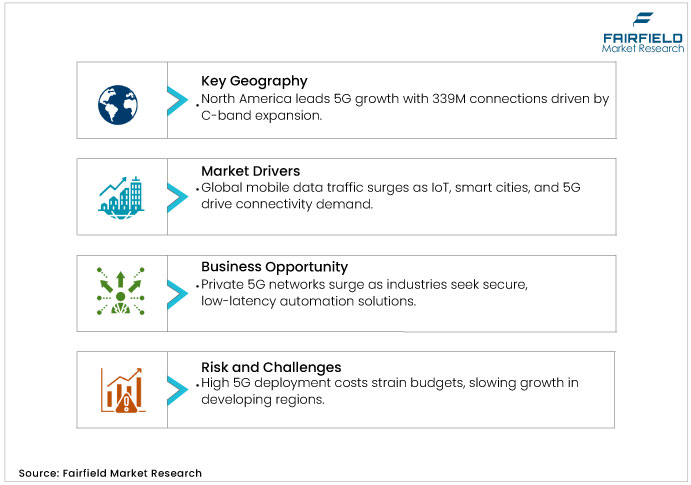
Global mobile data traffic is expected to surge, fueled by the rapid adoption of IoT devices, the rise of smart cities, and the growing use of real-time applications such as autonomous vehicles. According to studies, there are over 75 billion connected IoT devices by 2025, necessitating a robust 5G infrastructure market for low-latency, high-bandwidth connectivity. This demand pushes telecom operators to deploy small cells and massive MIMO technologies, enhancing network capacity. The market benefits as enterprises across healthcare, manufacturing, and logistics adopt 5G to optimize operations, with industrial IoT applications growing at a CAGR through 2030. This trend drives significant infrastructure investments, particularly in urban and industrial hubs.
- Government Policies and Spectrum Initiatives Accelerate Global 5G Deployment
Governments globally are prioritizing 5G deployment through spectrum auctions and public-private partnerships. For instance, the FCC’s 2020 spectrum auction in the U.S. raised USD 4.6 billion, enabling widespread 5G rollouts. In China, investments could reach over USD 170 billion by 2025 to support 5G-Advanced networks for applications such as autonomous driving. Regulatory frameworks, such as the European Commission’s 5G Action Plan, promote cross-border collaboration and spectrum harmonization. These policies reduce deployment barriers and encourage private sector investment, directly contributing to market growth by ensuring scalable and accessible 5G networks.
Key Restraints
- High Capital Costs and Infrastructure Barriers Slow 5G Network Expansion
Deploying 5G networks requires significant capital expenditure, with costs for small cells, base stations, and fiber backhaul posing barriers, especially in developing regions. The GSMA estimates global 5G infrastructure market investments could exceed USD 1 trillion by 2025, with high-frequency mmWave deployments increasing costs due to dense network requirements. These expenses strain telecom operators’ budgets, particularly in markets with limited financial resources, slowing adoption and limiting scalability in rural or underdeveloped areas.
- Regulatory Barriers and Environmental Concerns Impede Global 5G Deployment
Regulatory complexities, including spectrum allocation delays and local zoning laws, hinder 5G rollouts. For example, urban small cell installations face resistance due to concerns over radiofrequency exposure and environmental impact. The energy consumption of 5G networks, projected to rise significantly, necessitates sustainable solutions to meet stringent environmental regulations. These challenges delay deployments and increase compliance costs, impacting market growth in regions with underdeveloped regulatory frameworks.
5G Infrastructure Market Trends and Opportunities
- Enterprise Adoption of Private 5G Networks Fuels Industrial IoT Growth
Private 5G networks are experiencing rapid expansion, driven by rising demand for secure, reliable, and high-performance connectivity across industries. Enterprises in manufacturing, healthcare, and logistics adopt private networks for secure, low-latency connectivity, supporting automation and IoT. For example, Nestle’s partnership with Ericsson in Brazil deployed a private 5G network for autonomous operations. Supportive spectrum policies and partnerships, such as Nokia’s collaboration with John Deere in 2025, drive adoption, offering significant growth potential in industrial applications.
- Rising Smartphone Penetration and Digital Initiatives Boost 5G in Emerging Markets
Developing economies, particularly in Asia Pacific and LAMEA, present untapped opportunities due to rising smartphone penetration and government-backed digital initiatives. India’s 5G market is expected to grow at a sustainable CAGR through 2035, driven by fiberization programs and affordable data plans. China’s over USD 170 billion investment by 2025 supports 5G-Advanced networks, fostering smart mobility and IoT applications. These markets offer scalable growth opportunities as governments provide subsidies and streamline regulations to enhance connectivity.
Segment-wise Trends & Analysis
Hardware Investments in Base Stations and Small Cells Drive Market Growth
Hardware, commanding over 68% of the 5G Infrastructure Market share in 2025, is driven by investments in base stations, antennas, and small cells. Valued at approximately USD 26.7 billion, this segment benefits from the need for dense network coverage and advanced technologies such as massive MIMO.
The services segment is fueled by demand for consulting and optimization services. These services, expected to grow significantly, supported by network performance and cost efficiency, particularly for standalone deployments.
- Trend: Increasing adoption of virtualized RAN reduces hardware dependency.
- Challenge: High service costs limit adoption in smaller enterprises.
- Opportunity: Consulting services for network optimization drive scalability.
- Competitive Positioning: Service providers leverage partnerships to offer tailored solutions.
Private 5G Networks Lead Enterprise Adoption with Secure, Dedicated Connectivity
Private 5G networks lead due to their secure, dedicated connectivity, holding a significant share in 2025. They cater to industries such as manufacturing and healthcare, driven by Industry 4.0 adoption.
Public 5G networks are expanding rapidly, driven by telecom operators’ investments in urban coverage. Expected to grow at a 23.1% CAGR, public networks benefit from spectrum availability and consumer demand for high-speed mobile broadband.
- Trend: Private networks prioritize enterprise-specific applications.
- Challenge: Public networks face spectrum congestion in urban areas.
- Opportunity: Public-private partnerships enhance network scalability.
- Competitive Positioning: Operators focus on hybrid models for flexibility.
Sub-6 GHz Spectrum Dominates with Balanced Coverage and Speed for Rollouts
Sub-6 GHz dominates with a 62% market share in 2025, offering a balance of coverage and speed ideal for urban and suburban deployments. Valued at over USD 24 billion in 2025, it supports large-scale rollouts.
mmWave supports high-speed, low-latency applications such as AR/VR and autonomous vehicles. Its adoption is driven by advancements in antenna designs, with a projected market size of more than USD 50 billion by 2032.
- Trend: mmWave adoption rises in smart city projects.
- Challenge: Limited coverage requires dense infrastructure.
- Opportunity: Cost reductions in mmWave technology spur growth.
- Competitive Positioning: Vendors innovate to improve mmWave signal reliability.
Standalone 5G Architectures Dominate with Low-Latency and Edge Capabilities
Standalone architectures, growing at a 24.1% CAGR, dominate due to their programmable, low-latency capabilities. They support advanced applications such as edge computing and private networks.
Non-standalone networks, relying on 4G LTE, are expected to hold a 61% share in 2025 but are transitioning to standalone. Their growth is driven by cost-effective early deployments, with a market size of USD 24 billion in 2025.
- Trend: Shift to standalone enhances network efficiency.
- Challenge: Legacy 4G dependency limits performance.
- Opportunity: Hybrid models bridge transition gaps.
- Competitive Positioning: Operators prioritize standalone for scalability.
Industrial IoT and Automation Make Enterprises Key 5G Infrastructure Adopters
The industrial sector leads the adoption driven by IoT and automation in manufacturing and logistics. It supports applications such as cloud robotics and AGVs.
Smart city applications, projected to reach over USD 25 billion by 2030, grow due to IoT sensor deployments and urban connectivity needs. Government initiatives, such as China’s 5G-A networks, drive rapid adoption.
- Trend: Industrial IoT fuels automation demand.
- Challenge: High costs limit smart city scalability.
- Opportunity: Government subsidies enhance smart city growth.
- Competitive Positioning: Vendors target niche industrial solutions.
Regional Trends & Analysis
North America Leads 5G Growth with Spectrum Auctions and Private Networks
North America emerges as the fastest-growing region, with 5G connections reaching 339 million connections, propelled by aggressive spectrum auctions and private network incentives. U.S. trends focus on mid-band C-band deployments, enhancing rural broadband under the Infrastructure Act.
U.S. 5G Infrastructure Market – 2025 Snapshot & Outlook
The U.S. market witnesses robust demand from autonomous vehicle pilots and edge AI in logistics, where FCC's 3.45 GHz auction generates more than $21.8 billion in revenues. Government policies, including $65 billion from the Broadband Equity program. Of this, $42.45 billion is designated for the Broadband Equity, Access, and Deployment (BEAD) Program, which focuses on providing high-speed internet to underserved and unserved areas across all 50 states. A GSMA survey reveals enterprises prioritizing 5G for supply chain resilience, citing reduced latency impacts on inventory accuracy. Retail shifts toward omnichannel experiences further drive adoption, with 5G enabling AR try-ons, boosting conversion rates.
Theoretical models of spectrum economics highlight how auction designs optimize allocation, fostering competition. This supports long-term outlooks of 80% - 90% coverage by 2030.
- Mid-band expansions target 80% urban penetration.
- Tax credits enhance ROI for private 5G.
- Consumer trend: 5G FWA adoption rises 20-30% in suburbs.
Europe Advances 5G with Green Deployments and Industrial Applications Leadership
Europe advances steadily, with 5G covering 60%-70% of populated areas by 2025, emphasizing green deployments under the Green Deal. Germany and the U.K. lead in industrial applications, though fragmentation in spectrum harmonization poses hurdles.
Germany 5G Infrastructure Market – 2025 Snapshot & Outlook
Germany's market thrives on Industry 4.0 initiatives, with Bundesnetzagentur allocating frequencies in the 3.7–3.8 GHz range for private 5G (campus) networks, primarily for industrial and enterprise use. Supportive policies such as KfW subsidies cover 30% of capex, mainly for energy efficiency and technology modernization, supporting investments in digital infrastructure. In the automotive sector, V2X (Vehicle-to-Everything) testing and 5G-enabled connected mobility projects are ongoing, aligning with the EU’s goals for smart and connected transportation, demonstrated in projects like the Aachen–Düsseldorf test corridor and Berlin’s 5G-V2X integration trials.
- mmWave pilots in ports optimize logistics.
- EU GDPR compliance bolsters secure deployments.
- Trend: Energy-efficient small cells gain 20% share.
U.K. 5G Infrastructure Market – 2025 Snapshot & Outlook
The UK government has set a target for gigabit-capable broadband to be available to a minimum of 85% of UK premises by 2025. Post-Brexit policies offer R&D tax relief up to 33%, easing financial burdens. Consumer trends indicate a strong preference for 5G streaming, encouraging retailers to pilot AR/VR experiences, which have shown measurable improvements in customer engagement and sales. Healthcare is also embracing 5G, with remote surgery and telemedicine supported by NHS digital strategies.
- Open RAN trials reduce vendor costs by 20-25%.
- Green mandates favor low-power base stations.
- Trend: Private 5G in campuses surges 30-40%.
Asia Pacific Dominates Global 5G Growth with China, Japan, and India
Asia Pacific holds approximately 47% global share in 2025, led by China, Japan, and South Korea's mature ecosystems, with India emerging rapidly. China is at the forefront of urban 5G deployment, with plans to add 4.5 million new 5G base stations by 2025. Massive MIMO technology is the standard for these sites, enhancing network capacity and efficiency, and China currently accounts for over 60% of the global massive MIMO installed base.
Japan 5G Infrastructure Market – 2025 Snapshot & Outlook
Japan is advancing its technological infrastructure with a focus on resilience and innovation. The Ministry of Internal Affairs and Communications (MIC) is planning to introduce a 5G spectrum auction by early 2026, moving away from its previous free allocation model. Under the Society 5.0 initiative, Japan aims to implement approximately 100 smart city projects by 2025, promoting human-centric urban development.
Beamforming theory bolsters high-mobility reliability.
- mmWave enhances stadium experiences.
- Earthquake-proof designs prioritize resilience.
India 5G Infrastructure Market – 2025 Snapshot & Outlook
India's DoT has auctioned spectrum valued at ₹17.23 lakh crore between 2010 and 2024, though only ₹5.64 lakh crore was successfully sold, reflecting a 32.7% revenue efficiency. The Production-Linked Incentive (PLI) scheme for telecom equipment manufacturing has led to sales exceeding ₹91,000 crore, including ₹17,800 crore in exports, with incentives ranging from 4% to 7% to encourage domestic production. The Telecom Regulatory Authority of India (TRAI) reports that 55% of rural internet users rely on voice commands to access the internet, highlighting the growing demand for digital learning tools.
Dynamic spectrum access theory suits dense populations.
- Sub-6 GHz targets 60% coverage.
- Digital villages drive inclusive growth.
- Trend: FWA replaces copper in 40% homes.
Competitive Landscape Analysis
Players in the 5G Infrastructure Market focus on open RAN architectures to achieve 10-30% cost reductions in deployments. Ericsson secures 140+ core contracts, while Huawei dominates Asia with 40% share in base stations. M&A activity has increased as operators consolidate spectrum and infrastructure, driven by the need to enhance network efficiency. Regulatory trends promoting vendor diversification are helping operators reduce risks and improve network resilience. Early movers benefit from first-mover advantages in network slicing patents, while operators integrating legacy equipment face higher deployment complexities.
Key Companies
- NEC Corporation
- Nokia Corporation
- ZTE Corporation
- Cisco Systems, Inc.
- Huawei Technologies Co., Ltd.
- Samsung Electronics Co., Ltd.
- Mavenir
- Telefonaktiebolaget LM Ericsson
- Casa Systems
- JMA Wireless
- Ceragon
- Fujitsu Limited
- Aviat Networks, Inc.
- Comba Telecom Systems Holdings Ltd.
- Altiostar
- Airspan Networks
- Hewlett Packard Enterprise Development LP
- Parallel Wireless
- CommScope Inc.
Global 5G Infrastructure Market Segmentation
By Component
- Hardware
- Radio Access Network (RAN)
- Core Network
- Backhaul & Transport
- FrontHaul
- MidHaul
- Services
- Consulting
- Implementation & Integration
- Support & Maintenance
- Training & Education
By Type Outlook
- Private
- Pubic
By Spectrum
- Sub-6 GHz
- Low Band
- Mid Band
- mmWave
By Network Architecture
- Standalone
- Non-standalone
By Vertical
- Industrial
- Residential
- Energy & Utility
- Enterprise/Corporate
- Smart City
- Transportation & Logistics
- Public Safety and Defense
- Healthcare Facilities
- Retail
- Agriculture
- Others
By Region
- North America
- Europe
- Asia-Pacific
- Latin America
- Middle East & Africa
- Executive Summary
- Global 5G Infrastructure Market Snapshot
- Future Projections
- Key Market Trends
- Regional Snapshot, by Value, 2026
- Analyst Recommendations
- Market Overview
- Market Definitions and Segmentations
- Market Dynamics
- Drivers
- Restraints
- Market Opportunities
- Value Chain Analysis
- COVID-19 Impact Analysis
- Porter's Five Forces Analysis
- Impact of Russia-Ukraine Conflict
- PESTLE Analysis
- Regulatory Analysis
- Price Trend Analysis
- Current Prices and Future Projections, 2025-2033
- Price Impact Factors
- Global 5G Infrastructure Market Outlook, 2020 - 2033
- Global 5G Infrastructure Market Outlook, by Component, Value (US$ Mn), 2020-2033
- Hardware
- Radio Access Network (RAN)
- Core Network
- Backhaul & Transport
- FrontHaul
- MidHaul
- Services
- Consulting
- Implementation & Integration
- Support & Maintenance
- Training & Education
- Global 5G Infrastructure Market Outlook, by Type Outlook, Value (US$ Mn), 2020-2033
- Private
- Pubic
- Global 5G Infrastructure Market Outlook, by Spectrum, Value (US$ Mn), 2020-2033
- Sub-6 GHz
- mmWave
- Global 5G Infrastructure Market Outlook, by Network Architecture, Value (US$ Mn), 2020-2033
- Standalone
- Non-standalone
- Global 5G Infrastructure Market Outlook, by Vertical, Value (US$ Mn), 2020-2033
- Industrial
- Residential
- Energy & Utility
- Enterprise/Corporate
- Smart City
- Transportation & Logistics
- Public Safety and Defense
- Healthcare Facilities
- Retail
- Agriculture
- Global 5G Infrastructure Market Outlook, by Region, Value (US$ Mn), 2020-2033
- North America
- Europe
- Asia Pacific
- Latin America
- Middle East & Africa
- Hardware
- Global 5G Infrastructure Market Outlook, by Component, Value (US$ Mn), 2020-2033
- North America 5G Infrastructure Market Outlook, 2020 - 2033
- North America 5G Infrastructure Market Outlook, by Component, Value (US$ Mn), 2020-2033
- Hardware
- Radio Access Network (RAN)
- Core Network
- Backhaul & Transport
- FrontHaul
- MidHaul
- Services
- Consulting
- Implementation & Integration
- Support & Maintenance
- Training & Education
- North America 5G Infrastructure Market Outlook, by Type Outlook, Value (US$ Mn), 2020-2033
- Private
- Pubic
- North America 5G Infrastructure Market Outlook, by Spectrum, Value (US$ Mn), 2020-2033
- Sub-6 GHz
- mmWave
- North America 5G Infrastructure Market Outlook, by Network Architecture, Value (US$ Mn), 2020-2033
- Standalone
- Non-standalone
- North America 5G Infrastructure Market Outlook, by Vertical, Value (US$ Mn), 2020-2033
- Industrial
- Residential
- Energy & Utility
- Enterprise/Corporate
- Smart City
- Transportation & Logistics
- Public Safety and Defense
- Healthcare Facilities
- Retail
- Agriculture
- North America 5G Infrastructure Market Outlook, by Country, Value (US$ Mn), 2020-2033
- U.S. 5G Infrastructure Market Outlook, by Component, 2020-2033
- U.S. 5G Infrastructure Market Outlook, by Type Outlook, 2020-2033
- U.S. 5G Infrastructure Market Outlook, by Spectrum, 2020-2033
- U.S. 5G Infrastructure Market Outlook, by Network Architecture, 2020-2033
- U.S. 5G Infrastructure Market Outlook, by Vertical, 2020-2033
- Canada 5G Infrastructure Market Outlook, by Component, 2020-2033
- Canada 5G Infrastructure Market Outlook, by Type Outlook, 2020-2033
- Canada 5G Infrastructure Market Outlook, by Spectrum, 2020-2033
- Canada 5G Infrastructure Market Outlook, by Network Architecture, 2020-2033
- Canada 5G Infrastructure Market Outlook, by Vertical, 2020-2033
- BPS Analysis/Market Attractiveness Analysis
- Hardware
- North America 5G Infrastructure Market Outlook, by Component, Value (US$ Mn), 2020-2033
- Europe 5G Infrastructure Market Outlook, 2020 - 2033
- Europe 5G Infrastructure Market Outlook, by Component, Value (US$ Mn), 2020-2033
- Hardware
- Radio Access Network (RAN)
- Core Network
- Backhaul & Transport
- FrontHaul
- MidHaul
- Services
- Consulting
- Implementation & Integration
- Support & Maintenance
- Training & Education
- Europe 5G Infrastructure Market Outlook, by Type Outlook, Value (US$ Mn), 2020-2033
- Private
- Pubic
- Europe 5G Infrastructure Market Outlook, by Spectrum, Value (US$ Mn), 2020-2033
- Sub-6 GHz
- mmWave
- Europe 5G Infrastructure Market Outlook, by Network Architecture, Value (US$ Mn), 2020-2033
- Standalone
- Non-standalone
- Europe 5G Infrastructure Market Outlook, by Vertical, Value (US$ Mn), 2020-2033
- Industrial
- Residential
- Energy & Utility
- Enterprise/Corporate
- Smart City
- Transportation & Logistics
- Public Safety and Defense
- Healthcare Facilities
- Retail
- Agriculture
- Europe 5G Infrastructure Market Outlook, by Country, Value (US$ Mn), 2020-2033
- Germany 5G Infrastructure Market Outlook, by Component, 2020-2033
- Germany 5G Infrastructure Market Outlook, by Type Outlook, 2020-2033
- Germany 5G Infrastructure Market Outlook, by Spectrum, 2020-2033
- Germany 5G Infrastructure Market Outlook, by Network Architecture, 2020-2033
- Germany 5G Infrastructure Market Outlook, by Vertical, 2020-2033
- Italy 5G Infrastructure Market Outlook, by Component, 2020-2033
- Italy 5G Infrastructure Market Outlook, by Type Outlook, 2020-2033
- Italy 5G Infrastructure Market Outlook, by Spectrum, 2020-2033
- Italy 5G Infrastructure Market Outlook, by Network Architecture, 2020-2033
- Italy 5G Infrastructure Market Outlook, by Vertical, 2020-2033
- France 5G Infrastructure Market Outlook, by Component, 2020-2033
- France 5G Infrastructure Market Outlook, by Type Outlook, 2020-2033
- France 5G Infrastructure Market Outlook, by Spectrum, 2020-2033
- France 5G Infrastructure Market Outlook, by Network Architecture, 2020-2033
- France 5G Infrastructure Market Outlook, by Vertical, 2020-2033
- U.K. 5G Infrastructure Market Outlook, by Component, 2020-2033
- U.K. 5G Infrastructure Market Outlook, by Type Outlook, 2020-2033
- U.K. 5G Infrastructure Market Outlook, by Spectrum, 2020-2033
- U.K. 5G Infrastructure Market Outlook, by Network Architecture, 2020-2033
- U.K. 5G Infrastructure Market Outlook, by Vertical, 2020-2033
- Spain 5G Infrastructure Market Outlook, by Component, 2020-2033
- Spain 5G Infrastructure Market Outlook, by Type Outlook, 2020-2033
- Spain 5G Infrastructure Market Outlook, by Spectrum, 2020-2033
- Spain 5G Infrastructure Market Outlook, by Network Architecture, 2020-2033
- Spain 5G Infrastructure Market Outlook, by Vertical, 2020-2033
- Russia 5G Infrastructure Market Outlook, by Component, 2020-2033
- Russia 5G Infrastructure Market Outlook, by Type Outlook, 2020-2033
- Russia 5G Infrastructure Market Outlook, by Spectrum, 2020-2033
- Russia 5G Infrastructure Market Outlook, by Network Architecture, 2020-2033
- Russia 5G Infrastructure Market Outlook, by Vertical, 2020-2033
- Rest of Europe 5G Infrastructure Market Outlook, by Component, 2020-2033
- Rest of Europe 5G Infrastructure Market Outlook, by Type Outlook, 2020-2033
- Rest of Europe 5G Infrastructure Market Outlook, by Spectrum, 2020-2033
- Rest of Europe 5G Infrastructure Market Outlook, by Network Architecture, 2020-2033
- Rest of Europe 5G Infrastructure Market Outlook, by Vertical, 2020-2033
- BPS Analysis/Market Attractiveness Analysis
- Hardware
- Europe 5G Infrastructure Market Outlook, by Component, Value (US$ Mn), 2020-2033
- Asia Pacific 5G Infrastructure Market Outlook, 2020 - 2033
- Asia Pacific 5G Infrastructure Market Outlook, by Component, Value (US$ Mn), 2020-2033
- Hardware
- Radio Access Network (RAN)
- Core Network
- Backhaul & Transport
- FrontHaul
- MidHaul
- Services
- Consulting
- Implementation & Integration
- Support & Maintenance
- Training & Education
- Asia Pacific 5G Infrastructure Market Outlook, by Type Outlook, Value (US$ Mn), 2020-2033
- Private
- Pubic
- Asia Pacific 5G Infrastructure Market Outlook, by Spectrum, Value (US$ Mn), 2020-2033
- Sub-6 GHz
- mmWave
- Asia Pacific 5G Infrastructure Market Outlook, by Network Architecture, Value (US$ Mn), 2020-2033
- Standalone
- Non-standalone
- Asia Pacific 5G Infrastructure Market Outlook, by Vertical, Value (US$ Mn), 2020-2033
- Industrial
- Residential
- Energy & Utility
- Enterprise/Corporate
- Smart City
- Transportation & Logistics
- Public Safety and Defense
- Healthcare Facilities
- Retail
- Agriculture
- Asia Pacific 5G Infrastructure Market Outlook, by Country, Value (US$ Mn), 2020-2033
- China 5G Infrastructure Market Outlook, by Component, 2020-2033
- China 5G Infrastructure Market Outlook, by Type Outlook, 2020-2033
- China 5G Infrastructure Market Outlook, by Spectrum, 2020-2033
- China 5G Infrastructure Market Outlook, by Network Architecture, 2020-2033
- China 5G Infrastructure Market Outlook, by Vertical, 2020-2033
- Japan 5G Infrastructure Market Outlook, by Component, 2020-2033
- Japan 5G Infrastructure Market Outlook, by Type Outlook, 2020-2033
- Japan 5G Infrastructure Market Outlook, by Spectrum, 2020-2033
- Japan 5G Infrastructure Market Outlook, by Network Architecture, 2020-2033
- Japan 5G Infrastructure Market Outlook, by Vertical, 2020-2033
- South Korea 5G Infrastructure Market Outlook, by Component, 2020-2033
- South Korea 5G Infrastructure Market Outlook, by Type Outlook, 2020-2033
- South Korea 5G Infrastructure Market Outlook, by Spectrum, 2020-2033
- South Korea 5G Infrastructure Market Outlook, by Network Architecture, 2020-2033
- South Korea 5G Infrastructure Market Outlook, by Vertical, 2020-2033
- India 5G Infrastructure Market Outlook, by Component, 2020-2033
- India 5G Infrastructure Market Outlook, by Type Outlook, 2020-2033
- India 5G Infrastructure Market Outlook, by Spectrum, 2020-2033
- India 5G Infrastructure Market Outlook, by Network Architecture, 2020-2033
- India 5G Infrastructure Market Outlook, by Vertical, 2020-2033
- Southeast Asia 5G Infrastructure Market Outlook, by Component, 2020-2033
- Southeast Asia 5G Infrastructure Market Outlook, by Type Outlook, 2020-2033
- Southeast Asia 5G Infrastructure Market Outlook, by Spectrum, 2020-2033
- Southeast Asia 5G Infrastructure Market Outlook, by Network Architecture, 2020-2033
- Southeast Asia 5G Infrastructure Market Outlook, by Vertical, 2020-2033
- Rest of SAO 5G Infrastructure Market Outlook, by Component, 2020-2033
- Rest of SAO 5G Infrastructure Market Outlook, by Type Outlook, 2020-2033
- Rest of SAO 5G Infrastructure Market Outlook, by Spectrum, 2020-2033
- Rest of SAO 5G Infrastructure Market Outlook, by Network Architecture, 2020-2033
- Rest of SAO 5G Infrastructure Market Outlook, by Vertical, 2020-2033
- BPS Analysis/Market Attractiveness Analysis
- Hardware
- Asia Pacific 5G Infrastructure Market Outlook, by Component, Value (US$ Mn), 2020-2033
- Latin America 5G Infrastructure Market Outlook, 2020 - 2033
- Latin America 5G Infrastructure Market Outlook, by Component, Value (US$ Mn), 2020-2033
- Hardware
- Radio Access Network (RAN)
- Core Network
- Backhaul & Transport
- FrontHaul
- MidHaul
- Services
- Consulting
- Implementation & Integration
- Support & Maintenance
- Training & Education
- Latin America 5G Infrastructure Market Outlook, by Type Outlook, Value (US$ Mn), 2020-2033
- Private
- Pubic
- Latin America 5G Infrastructure Market Outlook, by Spectrum, Value (US$ Mn), 2020-2033
- Sub-6 GHz
- mmWave
- Latin America 5G Infrastructure Market Outlook, by Network Architecture, Value (US$ Mn), 2020-2033
- Standalone
- Non-standalone
- Latin America 5G Infrastructure Market Outlook, by Vertical, Value (US$ Mn), 2020-2033
- Industrial
- Residential
- Energy & Utility
- Enterprise/Corporate
- Smart City
- Transportation & Logistics
- Public Safety and Defense
- Healthcare Facilities
- Retail
- Agriculture
- Latin America 5G Infrastructure Market Outlook, by Country, Value (US$ Mn), 2020-2033
- Brazil 5G Infrastructure Market Outlook, by Component, 2020-2033
- Brazil 5G Infrastructure Market Outlook, by Type Outlook, 2020-2033
- Brazil 5G Infrastructure Market Outlook, by Spectrum, 2020-2033
- Brazil 5G Infrastructure Market Outlook, by Network Architecture, 2020-2033
- Brazil 5G Infrastructure Market Outlook, by Vertical, 2020-2033
- Mexico 5G Infrastructure Market Outlook, by Component, 2020-2033
- Mexico 5G Infrastructure Market Outlook, by Type Outlook, 2020-2033
- Mexico 5G Infrastructure Market Outlook, by Spectrum, 2020-2033
- Mexico 5G Infrastructure Market Outlook, by Network Architecture, 2020-2033
- Mexico 5G Infrastructure Market Outlook, by Vertical, 2020-2033
- Argentina 5G Infrastructure Market Outlook, by Component, 2020-2033
- Argentina 5G Infrastructure Market Outlook, by Type Outlook, 2020-2033
- Argentina 5G Infrastructure Market Outlook, by Spectrum, 2020-2033
- Argentina 5G Infrastructure Market Outlook, by Network Architecture, 2020-2033
- Argentina 5G Infrastructure Market Outlook, by Vertical, 2020-2033
- Rest of LATAM 5G Infrastructure Market Outlook, by Component, 2020-2033
- Rest of LATAM 5G Infrastructure Market Outlook, by Type Outlook, 2020-2033
- Rest of LATAM 5G Infrastructure Market Outlook, by Spectrum, 2020-2033
- Rest of LATAM 5G Infrastructure Market Outlook, by Network Architecture, 2020-2033
- Rest of LATAM 5G Infrastructure Market Outlook, by Vertical, 2020-2033
- BPS Analysis/Market Attractiveness Analysis
- Hardware
- Latin America 5G Infrastructure Market Outlook, by Component, Value (US$ Mn), 2020-2033
- Middle East & Africa 5G Infrastructure Market Outlook, 2020 - 2033
- Middle East & Africa 5G Infrastructure Market Outlook, by Component, Value (US$ Mn), 2020-2033
- Hardware
- Radio Access Network (RAN)
- Core Network
- Backhaul & Transport
- FrontHaul
- MidHaul
- Services
- Consulting
- Implementation & Integration
- Support & Maintenance
- Training & Education
- Middle East & Africa 5G Infrastructure Market Outlook, by Type Outlook, Value (US$ Mn), 2020-2033
- Private
- Pubic
- Middle East & Africa 5G Infrastructure Market Outlook, by Spectrum, Value (US$ Mn), 2020-2033
- Sub-6 GHz
- mmWave
- Middle East & Africa 5G Infrastructure Market Outlook, by Network Architecture, Value (US$ Mn), 2020-2033
- Standalone
- Non-standalone
- Middle East & Africa 5G Infrastructure Market Outlook, by Vertical, Value (US$ Mn), 2020-2033
- Industrial
- Residential
- Energy & Utility
- Enterprise/Corporate
- Smart City
- Transportation & Logistics
- Public Safety and Defense
- Healthcare Facilities
- Retail
- Agriculture
- Middle East & Africa 5G Infrastructure Market Outlook, by Country, Value (US$ Mn), 2020-2033
- GCC 5G Infrastructure Market Outlook, by Component, 2020-2033
- GCC 5G Infrastructure Market Outlook, by Type Outlook, 2020-2033
- GCC 5G Infrastructure Market Outlook, by Spectrum, 2020-2033
- GCC 5G Infrastructure Market Outlook, by Network Architecture, 2020-2033
- GCC 5G Infrastructure Market Outlook, by Vertical, 2020-2033
- South Africa 5G Infrastructure Market Outlook, by Component, 2020-2033
- South Africa 5G Infrastructure Market Outlook, by Type Outlook, 2020-2033
- South Africa 5G Infrastructure Market Outlook, by Spectrum, 2020-2033
- South Africa 5G Infrastructure Market Outlook, by Network Architecture, 2020-2033
- South Africa 5G Infrastructure Market Outlook, by Vertical, 2020-2033
- Egypt 5G Infrastructure Market Outlook, by Component, 2020-2033
- Egypt 5G Infrastructure Market Outlook, by Type Outlook, 2020-2033
- Egypt 5G Infrastructure Market Outlook, by Spectrum, 2020-2033
- Egypt 5G Infrastructure Market Outlook, by Network Architecture, 2020-2033
- Egypt 5G Infrastructure Market Outlook, by Vertical, 2020-2033
- Nigeria 5G Infrastructure Market Outlook, by Component, 2020-2033
- Nigeria 5G Infrastructure Market Outlook, by Type Outlook, 2020-2033
- Nigeria 5G Infrastructure Market Outlook, by Spectrum, 2020-2033
- Nigeria 5G Infrastructure Market Outlook, by Network Architecture, 2020-2033
- Nigeria 5G Infrastructure Market Outlook, by Vertical, 2020-2033
- Rest of Middle East 5G Infrastructure Market Outlook, by Component, 2020-2033
- Rest of Middle East 5G Infrastructure Market Outlook, by Type Outlook, 2020-2033
- Rest of Middle East 5G Infrastructure Market Outlook, by Spectrum, 2020-2033
- Rest of Middle East 5G Infrastructure Market Outlook, by Network Architecture, 2020-2033
- Rest of Middle East 5G Infrastructure Market Outlook, by Vertical, 2020-2033
- BPS Analysis/Market Attractiveness Analysis
- Hardware
- Middle East & Africa 5G Infrastructure Market Outlook, by Component, Value (US$ Mn), 2020-2033
- Competitive Landscape
- Company Vs Segment Heatmap
- Company Market Share Analysis, 2025
- Competitive Dashboard
- Company Profiles
- NEC Corporation
- Company Overview
- Product Portfolio
- Financial Overview
- Business Strategies and Developments
- Nokia Corporation
- ZTE Corporation
- Cisco Systems, Inc.
- Huawei Technologies Co., Ltd.
- Samsung Electronics Co., Ltd.
- Mavenir
- Telefonaktiebolaget LM Ericsson
- Casa Systems
- JMA Wireless
- NEC Corporation
- Appendix
- Research Methodology
- Report Assumptions
- Acronyms and Abbreviations
|
BASE YEAR |
HISTORICAL DATA |
FORECAST PERIOD |
UNITS |
|||
 |
2025 |
 |
2020 - 2025 |
 |
2026 - 2033 |
Value: US$ Billion |
|
REPORT FEATURES |
DETAILS |
|
By Component Coverage |
|
|
By Type Outlook Coverage |
|
|
By Spectrum Coverage |
|
|
By Network Architecture Coverage |
|
|
By Vertical Coverage |
|
|
Geographical Coverage |
|
|
Leading Companies |
|
|
Report Highlights |
Key Market Indicators, Macro-micro economic impact analysis, Technological Roadmap, Key Trends, Driver, Restraints, and Future Opportunities & Revenue Pockets, Porter’s 5 Forces Analysis, Historical Trend (2019-2024), Market Estimates and Forecast, Market Dynamics, Industry Trends, Competition Landscape, Category, Region, Country-wise Trends & Analysis, COVID-19 Impact Analysis (Demand and Supply Chain) |
Our Research Methodology
Considering the volatility of business today, traditional approaches to strategizing a game plan can be unfruitful if not detrimental. True ambiguity is no way to determine a forecast. A myriad of predetermined factors must be accounted for such as the degree of risk involved, the magnitude of circumstances, as well as conditions or consequences that are not known or unpredictable. To circumvent binary views that cast uncertainty, the application of market research intelligence to strategically posture, move, and enable actionable outcomes is necessary.
View Methodology
Quality Assured
Rigorous Validation Process

Confidentiality Assured
End-to-end Data Security

Custom Research Services
Tailored To Your Objectives
FAQs
The 5G Infrastructure Market is valued at USD 78.6 Billion in 2026.
The 5G Infrastructure Market is projected to grow at a CAGR of 22.5% by 2033.
The 5G Infrastructure Market growth drivers include rising IoT adoption, government spectrum initiatives, and expanding private 5G networks.
Asia Pacific is the dominating region for the 5G Infrastructure Market.
Ericsson, Huawei, Nokia, Samsung Electronics, and ZTE Corporation are some leading industry players in the 5G Infrastructure Market.
Related Reports
Global AR Glasses Industry Analysis, Size, Share, Growth, Trends, Regional Outlook, and Forecast 2021-2025 - (By Type Coverage, By Industry Coverage, By Geography, By Company)
AR Glasses Market to grow from USD 2.4 Bn in 2026 to USD 38.2 Bn by 2033, registering a remarkable CAGR of 48.5% during the forecast period
Mentoring Software Market Insights, Competitive Landscape, and Market Forecast - 2033
Mentoring Software Market to grow from USD 981.3 Mn in 2026 to USD 2,790.1 Mn by 2033, registering a strong CAGR of 16.1%.
Micro-Fulfillment Market Insights, Competitive Landscape, and Market Forecast - 2033
The micro-fulfillment market to grow from USD 9.3 Bn in 2026 to USD 67.7 Bn by 2033, registering a robust CAGR of 32.8%
Electrical Control Panel Market Insights, Competitive Landscape, and Market Forecast - 2033
Electrical Control Panel Market to grow from USD 7.4 Bn in 2026 to USD 11.3 Bn by 2033, registering a CAGR of 6.2% during the forecast period
Blockchain in Insurance Market Insights, Competitive Landscape, and Market Forecast - 2033
Blockchain in Insurance Market to grow from USD 2.8 Bn in 2026 to USD 22.5 Bn by 2033, registering a robust CAGR of 34.7% during the forecast period
Video Conferencing Market Insights, Competitive Landscape, and Market Forecast - 2033
Video Conferencing Market to grow from USD 13.9 Bn in 2026 to USD 22.8 Bn by 2033, registering a 7.3% CAGR during the 2026–2033 forecast period.