



Blockchain in Insurance Market
Blockchain in Insurance Market Insights, Competitive Landscape, and Market Forecast - 2033
Global Blockchain in Insurance Market Forecast
The Blockchain in Insurance Market is expected to grow from USD 2.8 Billion in 2026 to USD 22.5 Billion by 2033, reflecting strong industry expansion and registering a CAGR of 34.7% during the forecast period from 2026 to 2033.
Quick Report Digest
A Look Back and a Look Forward - Comparative Analysis
The rise in fraudulent insurance claims and the simplification of the intricate insurance processes are major market revenue drivers. Another important element that is anticipated to fuel demand for blockchain in insurance and promote market revenue growth is efficiency. These other significant factors are cost savings, transparency, quicker payouts, and fraud prevention. Smart contracts can also carry out a number of tasks without requiring human intervention, which significantly increases efficiency and is anticipated to continue driving market growth in the future.
Blockchain technology attracted more attention in the insurance sector between 2018 and 2022. Several use cases, such as policy issuance, claims processing, fraud detection, and reinsurance, were being investigated by insurers. The possibility for large efficiency improvements was another reason encouraging blockchain adoption in the insurance industry. Insurers sought to save administrative expenses and streamline operations by utilising blockchain for smart contracts and automated procedures.
Blockchain technology appears to have an encouraging future in the insurance industry. One can anticipate greater use and integration of blockchain solutions across different insurance processes as the technology develops and industry standards change. Blockchain has the potential to significantly improve security, transparency, and efficiency, making it a game-changing technology in the insurance industry.
Key Growth Determinants
- Increasing Use of Cutting-edge Software Platforms
The adoption of technology by the insurance sector has risen dramatically over time, fueling the expansion of the insurance sector. The adoption of technology by the insurance sector has risen dramatically over time, fueling the expansion of the insurance sector.
On the other side, chatbots are revolutionising the insurance industry by personalising consumer encounters with interfaces that resemble human beings. In addition, AR-based games and tutorials can be effective marketing tools for gathering customer insights and lowering training costs by improving the learning experience.
Moreover, chatbots and voicebots are made possible by conversational AI. As a result, the expansion of the blockchain in insurance is being driven by these insurance-related aspects.
- Increasing Amount of False Insurance Claims
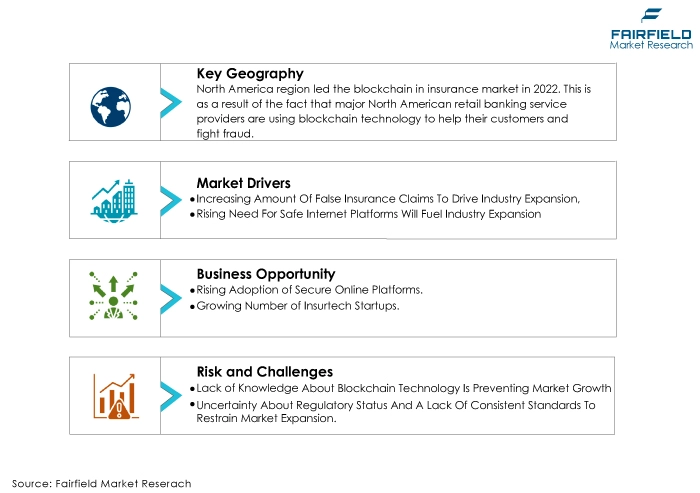
The insurance industry is among those most vulnerable to fraud and data theft. Blockchain use in insurance is one of the cutting-edge strategies to reduce fraud, lessen risks, and increase client satisfaction. The number of fraudulent practices in the insurance sector is rising.
It thus provides a strong justification for implementing blockchain technology in its processes. In order to effectively prevent fraudulent claims, insurance companies must replace their outdated legacy systems that are incorporated into their insurance systems with modern ones.
A decentralised public ledger among numerous untrusted parties is another feature of blockchain technology. It can therefore be used to detect fraud and eliminate errors. As a result, blockchain technology enhances the effectiveness of fraud detection and prevention, and with the application of blockchain technology in insurance.
- Critically Rising Need for Safe and Secure Internet Platforms
The acceptance of safe online platforms is driving the growth of blockchain in the insurance industry, which is using digital technology more and more to streamline processes, increase client satisfaction, and enhance operations. As a result, the need for safe online platforms that provide consumers with a smooth and secure digital experience is rising.
The COVID-19 epidemic has also accelerated the shift to remote labour and remote access to services, such as insurance. As more people use insurance services online and work from home, there is an increasing need for safe online platforms that can provide consistent and secure access to data and services.
The insurance industry also has to abide by strict regulations on data security and privacy, since breaking these regulations can have disastrous consequences. As a result, there is an increased need for secure online platforms that meet these regulatory requirements.
Major Growth Barriers
- Lack of Knowledge About Blockchain Technology
The applications of blockchain technology are still in their infancy across several industry verticals. Even if the insurance sector has demonstrated a favourable trend in adopting technology, there is still more that needs to be done to raise awareness of the DLT and its many potential applications in the insurance sector.
One of the biggest problems is the lack of knowledge. Furthermore, the successful adoption of blockchain technology could help insurance companies handle their fraud, risk, compliance, and security concerns.
- Uncertainty About Regulatory Status, and Lack of Standardisation
Insurance industry utilisation of blockchain technology is continually changing. The current regulatory requirements are affected by these developments. However, because it is difficult for regulatory organisations to keep up with technical advances, this factor has an impact on how technology is used.
In light of these technical advancements, regulatory bodies must understand how the laws can impact the overall application of technology. As a result, the implementation of cryptocurrency transactions on blockchain technology in the insurance industry is hampered by unclear rules and a lack of common standards.
Key Trends and Opportunities to Look at
Blockchain use is anticipated to grow incredibly faster, especially in the BFSI industry. It's expected that the technological advancement will give blockchain service providers hitherto unheard-of alternatives for tailoring and making available to such banks their solutions.
Because of the stupendous rise in demand for BaaS, some of the biggest names in IT have begun integrating BaaS modules into their cloud computing platforms. These insurance-related factors are therefore motivating the growth of the blockchain in insurance business.
- Rising Preference for Secure Online Platforms
- Growing Number of Insurtech Start-ups
The rise of the blockchain in insurance is being driven by the adoption of secure online platforms, as the insurance industry is increasingly using digital technology to improve customer experience, speed up processes, and strengthen operations.
Consequently, there is an increasing need for safe online services that can give consumers easy access to the internet in a secure manner. The pandemic has also accelerated tendencies toward working from home and internet access to services, including insurance.
Innovative insurtech enterprises that use blockchain technology are starting to emerge, opening doors for cooperation and joint ventures with conventional insurance providers. These alliances have the potential to stimulate innovation and market expansion.
The development of new insurance services and products is also made possible by blockchain. For instance, parametric insurance gives new options for risk coverage because claims are automatically generated based on predetermined events that are recorded on the blockchain.
How Does the Regulatory Scenario Shape this Industry?
The regulatory environment has a significant impact on how blockchain technology is adopted and developed in the insurance sector. Insurance firms frequently must adhere to strict compliance standards set by regulatory bodies, which may include data security, privacy, and transparency obligations. By offering a tamper-proof and auditable record of transactions and data, blockchain technology can assist insurers in meeting these standards.
In addition, strict data protection rules are included in laws like the California Consumer Privacy Act (CCPA), and the General Data Protection Regulation (GDPR) of the European Union. Insurers can manage consumer data more securely since blockchain's capacity to encrypt data and limit access to it complies with these criteria.
Fairfield’s Ranking Board
Top Segments
The blockchain in insurance market saw a significant increase in the service category revenue share in 2022. This enables these businesses to provide insurance while prioritising the needs of the customer and increasing income.
Blockchain technology has a lot to offer insurance providers because it makes a number of essential activities easier, such gathering data on insured individuals.
The solution category is expected to grow significantly over the forecast period. This is explained by the potential of blockchain technology to change and streamline the insurance sector and effectively free it from archaic practices.
The reluctant but strong interest in blockchain in insurance solution developments is being driven by a rise in consumer mistrust of centralised financial institutions, which results in high underinsurance rates.
- Claims Management Category Presents the Largest Application Area
- Large Enterprises Take the Lead in Adoption
In 2022, the claims management category dominated the market, and it is predicted to grow significantly over the course of the forecast period because claims management software improves the claims process's efficiency, security on the blockchain, and transparency.
These programs make use of blockchain's immutable properties to safeguard data integrity, reduce the likelihood of fraud, and enable real-time tracking and claim verification. These cutting-edge capabilities significantly increase the accuracy, responsiveness, and dependability of managing insurance claims, enhancing client happiness and enhancing operational efficiency for insurance businesses.
During the forecasted years, the payment category is anticipated to grow at a significant rate. Blockchain payments in the insurance sector help to lower risks while also improving the speed and transparency of payment procedures. Banco Masventas (Argentina), MUFG, and Taipei Fubon Commercial Bank are just a few of the international institutions creating blockchain-based payment networks.
Moreover, a study by Accenture found that 90% of banks in North America are using blockchain technology for payment applications, illustrating the technology's explosive growth.
The large enterprise category held the majority of the market share because large-scale businesses have better infrastructure and financial resources, which enables them to invest in and employ blockchain technology more successfully. They can use blockchain technology to streamline insurance processe including claims processing, underwriting, and policy administration.
In addition, this kind of payment contract can be carried out without a human being getting involved thanks to the use of smart contracts on blockchain technology. With the contract's automation, this powerful technology can help large organisations.
Furthermore, the small and medium-sized enterprises category is expected to expand significantly. Small and medium-sized businesses (SMEs) are crucial to the insurance industry's use of blockchain technology. Blockchain can support SMEs by streamlining operations, lowering administrative expenses, and automating procedures. By doing this, SMEs may be able to manage policies, claims, and client data more affordably.
Blockchain can be used by SMEs to improve fraud prevention and detection. Blockchain can assist SME insurers in more efficiently identifying and mitigating fraudulent claims by establishing a transparent and immutable ledger.
Regional Frontrunners
North America Jumps in the Bandwagon
The region with the biggest market share for blockchain in insurance is expected to be North America during that forecast period. The region's growing investment in blockchain technology and the quick development of management solutions to enable data confidentiality, prevent cyberattacks, and ensure data security and privacy are largely responsible for the region's revenue growth.
A bigger demand is also created in this area by the introduction of cutting-edge and creative technology features. A focus on blockchain technology is also being made in the financial industry, which includes banking, financial services, and insurance. For instance, the majority of the banks in North America are making investments in blockchain technology, including JPMorgan, the Royal Bank of Canada, and Bank of America.
Market Awaits Notable Grwth in Asia Pacific
The market for blockchain in insurance is expanding at the fastest rate in Asia Pacific, which presents a significant opportunity for the industry. The primary reasons propelling the Asia Pacific market growth include the rise in disposable income, acceptance of internet services, and implementation of blockchain technology by enterprises.
Growth of market in Asia Pacific is further aided by the insurance sector's unrivaled opportunity to experiment with low-cost, creative, and open regulatory systems built on blockchain technology.
Additionally, the expansion is the result of technology developments like cloud computing, big data analysis, IoT device integration, and cyber security risks, which have raised awareness of these technologies among the region's insurance businesses.
Fairfield’s Competitive Landscape Analysis
Both established businesses and start-ups are vying for market share in the fiercely competitive blockchain in insurance sector. Leading market participants provide blockchain solutions for the insurance sector, including smart contracts, claims processing, identity verification, and fraud detection.
Who are the Leaders in Global Blockchain in Insurance Space?
- CONSENSYS
- IntellectEU, Inc.
- ChainThat
- Etherisc
- IBM Corporation
- Guardtime
- Teambrella
- B3i
- Tierion
- Deloitte
Global Blockchain in Insurance Market is Segmented as Below:
By Provider
- Application and Solution Providers
- Middleware Providers
- Infrastructure Providers
- Consulting and Service Providers
By Application
- GRC Management
- Death & Claims Management
- Identity Management & Fraud Detection
- Payments
- Smart Contracts
By Organization Size
- Large Enterprises
- SMEs
By Region
- North America
- Europe
- Asia Pacific
- Latin America
- Middle East & Africa
- Executive Summary
- Global Blockchain in Insurance Market Snapshot
- Future Projections
- Key Market Trends
- Regional Snapshot, by Value, 2026
- Analyst Recommendations
- Market Overview
- Market Definitions and Segmentations
- Market Dynamics
- Drivers
- Restraints
- Market Opportunities
- Value Chain Analysis
- COVID-19 Impact Analysis
- Porter's Five Forces Analysis
- Impact of Russia-Ukraine Conflict
- PESTLE Analysis
- Regulatory Analysis
- Price Trend Analysis
- Current Prices and Future Projections, 2025-2033
- Price Impact Factors
- Global Blockchain in Insurance Market Outlook, 2020 - 2033
- Global Blockchain in Insurance Market Outlook, by Provider, Value (US$ Bn), 2020-2033
- Application & Solution Providers
- Middleware Providers
- Infrastructure Providers
- Global Blockchain in Insurance Market Outlook, by Application, Value (US$ Bn), 2020-2033
- GRC Management
- Death & Claims Management
- Identity Management & Fraud Detection
- Payments
- Smart Contracts
- Global Blockchain in Insurance Market Outlook, by Organization Size, Value (US$ Bn), 2020-2033
- Large Enterprises
- SMEs
- Global Blockchain in Insurance Market Outlook, by Region, Value (US$ Bn), 2020-2033
- North America
- Europe
- Asia Pacific
- Latin America
- Middle East & Africa
- Global Blockchain in Insurance Market Outlook, by Provider, Value (US$ Bn), 2020-2033
- North America Blockchain in Insurance Market Outlook, 2020 - 2033
- North America Blockchain in Insurance Market Outlook, by Provider, Value (US$ Bn), 2020-2033
- Application & Solution Providers
- Middleware Providers
- Infrastructure Providers
- North America Blockchain in Insurance Market Outlook, by Application, Value (US$ Bn), 2020-2033
- GRC Management
- Death & Claims Management
- Identity Management & Fraud Detection
- Payments
- Smart Contracts
- North America Blockchain in Insurance Market Outlook, by Organization Size, Value (US$ Bn), 2020-2033
- Large Enterprises
- SMEs
- North America Blockchain in Insurance Market Outlook, by Country, Value (US$ Bn), 2020-2033
- U.S. Blockchain in Insurance Market Outlook, by Provider, 2020-2033
- U.S. Blockchain in Insurance Market Outlook, by Application, 2020-2033
- U.S. Blockchain in Insurance Market Outlook, by Organization Size, 2020-2033
- Canada Blockchain in Insurance Market Outlook, by Provider, 2020-2033
- Canada Blockchain in Insurance Market Outlook, by Application, 2020-2033
- Canada Blockchain in Insurance Market Outlook, by Organization Size, 2020-2033
- BPS Analysis/Market Attractiveness Analysis
- North America Blockchain in Insurance Market Outlook, by Provider, Value (US$ Bn), 2020-2033
- Europe Blockchain in Insurance Market Outlook, 2020 - 2033
- Europe Blockchain in Insurance Market Outlook, by Provider, Value (US$ Bn), 2020-2033
- Application & Solution Providers
- Middleware Providers
- Infrastructure Providers
- Europe Blockchain in Insurance Market Outlook, by Application, Value (US$ Bn), 2020-2033
- GRC Management
- Death & Claims Management
- Identity Management & Fraud Detection
- Payments
- Smart Contracts
- Europe Blockchain in Insurance Market Outlook, by Organization Size, Value (US$ Bn), 2020-2033
- Large Enterprises
- SMEs
- Europe Blockchain in Insurance Market Outlook, by Country, Value (US$ Bn), 2020-2033
- Germany Blockchain in Insurance Market Outlook, by Provider, 2020-2033
- Germany Blockchain in Insurance Market Outlook, by Application, 2020-2033
- Germany Blockchain in Insurance Market Outlook, by Organization Size, 2020-2033
- Italy Blockchain in Insurance Market Outlook, by Provider, 2020-2033
- Italy Blockchain in Insurance Market Outlook, by Application, 2020-2033
- Italy Blockchain in Insurance Market Outlook, by Organization Size, 2020-2033
- France Blockchain in Insurance Market Outlook, by Provider, 2020-2033
- France Blockchain in Insurance Market Outlook, by Application, 2020-2033
- France Blockchain in Insurance Market Outlook, by Organization Size, 2020-2033
- U.K. Blockchain in Insurance Market Outlook, by Provider, 2020-2033
- U.K. Blockchain in Insurance Market Outlook, by Application, 2020-2033
- U.K. Blockchain in Insurance Market Outlook, by Organization Size, 2020-2033
- Spain Blockchain in Insurance Market Outlook, by Provider, 2020-2033
- Spain Blockchain in Insurance Market Outlook, by Application, 2020-2033
- Spain Blockchain in Insurance Market Outlook, by Organization Size, 2020-2033
- Russia Blockchain in Insurance Market Outlook, by Provider, 2020-2033
- Russia Blockchain in Insurance Market Outlook, by Application, 2020-2033
- Russia Blockchain in Insurance Market Outlook, by Organization Size, 2020-2033
- Rest of Europe Blockchain in Insurance Market Outlook, by Provider, 2020-2033
- Rest of Europe Blockchain in Insurance Market Outlook, by Application, 2020-2033
- Rest of Europe Blockchain in Insurance Market Outlook, by Organization Size, 2020-2033
- BPS Analysis/Market Attractiveness Analysis
- Europe Blockchain in Insurance Market Outlook, by Provider, Value (US$ Bn), 2020-2033
- Asia Pacific Blockchain in Insurance Market Outlook, 2020 - 2033
- Asia Pacific Blockchain in Insurance Market Outlook, by Provider, Value (US$ Bn), 2020-2033
- Application & Solution Providers
- Middleware Providers
- Infrastructure Providers
- Asia Pacific Blockchain in Insurance Market Outlook, by Application, Value (US$ Bn), 2020-2033
- GRC Management
- Death & Claims Management
- Identity Management & Fraud Detection
- Payments
- Smart Contracts
- Asia Pacific Blockchain in Insurance Market Outlook, by Organization Size, Value (US$ Bn), 2020-2033
- Large Enterprises
- SMEs
- Asia Pacific Blockchain in Insurance Market Outlook, by Country, Value (US$ Bn), 2020-2033
- China Blockchain in Insurance Market Outlook, by Provider, 2020-2033
- China Blockchain in Insurance Market Outlook, by Application, 2020-2033
- China Blockchain in Insurance Market Outlook, by Organization Size, 2020-2033
- Japan Blockchain in Insurance Market Outlook, by Provider, 2020-2033
- Japan Blockchain in Insurance Market Outlook, by Application, 2020-2033
- Japan Blockchain in Insurance Market Outlook, by Organization Size, 2020-2033
- South Korea Blockchain in Insurance Market Outlook, by Provider, 2020-2033
- South Korea Blockchain in Insurance Market Outlook, by Application, 2020-2033
- South Korea Blockchain in Insurance Market Outlook, by Organization Size, 2020-2033
- India Blockchain in Insurance Market Outlook, by Provider, 2020-2033
- India Blockchain in Insurance Market Outlook, by Application, 2020-2033
- India Blockchain in Insurance Market Outlook, by Organization Size, 2020-2033
- Southeast Asia Blockchain in Insurance Market Outlook, by Provider, 2020-2033
- Southeast Asia Blockchain in Insurance Market Outlook, by Application, 2020-2033
- Southeast Asia Blockchain in Insurance Market Outlook, by Organization Size, 2020-2033
- Rest of SAO Blockchain in Insurance Market Outlook, by Provider, 2020-2033
- Rest of SAO Blockchain in Insurance Market Outlook, by Application, 2020-2033
- Rest of SAO Blockchain in Insurance Market Outlook, by Organization Size, 2020-2033
- BPS Analysis/Market Attractiveness Analysis
- Asia Pacific Blockchain in Insurance Market Outlook, by Provider, Value (US$ Bn), 2020-2033
- Latin America Blockchain in Insurance Market Outlook, 2020 - 2033
- Latin America Blockchain in Insurance Market Outlook, by Provider, Value (US$ Bn), 2020-2033
- Application & Solution Providers
- Middleware Providers
- Infrastructure Providers
- Latin America Blockchain in Insurance Market Outlook, by Application, Value (US$ Bn), 2020-2033
- GRC Management
- Death & Claims Management
- Identity Management & Fraud Detection
- Payments
- Smart Contracts
- Latin America Blockchain in Insurance Market Outlook, by Organization Size, Value (US$ Bn), 2020-2033
- Large Enterprises
- SMEs
- Latin America Blockchain in Insurance Market Outlook, by Country, Value (US$ Bn), 2020-2033
- Brazil Blockchain in Insurance Market Outlook, by Provider, 2020-2033
- Brazil Blockchain in Insurance Market Outlook, by Application, 2020-2033
- Brazil Blockchain in Insurance Market Outlook, by Organization Size, 2020-2033
- Mexico Blockchain in Insurance Market Outlook, by Provider, 2020-2033
- Mexico Blockchain in Insurance Market Outlook, by Application, 2020-2033
- Mexico Blockchain in Insurance Market Outlook, by Organization Size, 2020-2033
- Argentina Blockchain in Insurance Market Outlook, by Provider, 2020-2033
- Argentina Blockchain in Insurance Market Outlook, by Application, 2020-2033
- Argentina Blockchain in Insurance Market Outlook, by Organization Size, 2020-2033
- Rest of LATAM Blockchain in Insurance Market Outlook, by Provider, 2020-2033
- Rest of LATAM Blockchain in Insurance Market Outlook, by Application, 2020-2033
- Rest of LATAM Blockchain in Insurance Market Outlook, by Organization Size, 2020-2033
- BPS Analysis/Market Attractiveness Analysis
- Latin America Blockchain in Insurance Market Outlook, by Provider, Value (US$ Bn), 2020-2033
- Middle East & Africa Blockchain in Insurance Market Outlook, 2020 - 2033
- Middle East & Africa Blockchain in Insurance Market Outlook, by Provider, Value (US$ Bn), 2020-2033
- Application & Solution Providers
- Middleware Providers
- Infrastructure Providers
- Middle East & Africa Blockchain in Insurance Market Outlook, by Application, Value (US$ Bn), 2020-2033
- GRC Management
- Death & Claims Management
- Identity Management & Fraud Detection
- Payments
- Smart Contracts
- Middle East & Africa Blockchain in Insurance Market Outlook, by Organization Size, Value (US$ Bn), 2020-2033
- Large Enterprises
- SMEs
- Middle East & Africa Blockchain in Insurance Market Outlook, by Country, Value (US$ Bn), 2020-2033
- GCC Blockchain in Insurance Market Outlook, by Provider, 2020-2033
- GCC Blockchain in Insurance Market Outlook, by Application, 2020-2033
- GCC Blockchain in Insurance Market Outlook, by Organization Size, 2020-2033
- South Africa Blockchain in Insurance Market Outlook, by Provider, 2020-2033
- South Africa Blockchain in Insurance Market Outlook, by Application, 2020-2033
- South Africa Blockchain in Insurance Market Outlook, by Organization Size, 2020-2033
- Egypt Blockchain in Insurance Market Outlook, by Provider, 2020-2033
- Egypt Blockchain in Insurance Market Outlook, by Application, 2020-2033
- Egypt Blockchain in Insurance Market Outlook, by Organization Size, 2020-2033
- Nigeria Blockchain in Insurance Market Outlook, by Provider, 2020-2033
- Nigeria Blockchain in Insurance Market Outlook, by Application, 2020-2033
- Nigeria Blockchain in Insurance Market Outlook, by Organization Size, 2020-2033
- Rest of Middle East Blockchain in Insurance Market Outlook, by Provider, 2020-2033
- Rest of Middle East Blockchain in Insurance Market Outlook, by Application, 2020-2033
- Rest of Middle East Blockchain in Insurance Market Outlook, by Organization Size, 2020-2033
- BPS Analysis/Market Attractiveness Analysis
- Middle East & Africa Blockchain in Insurance Market Outlook, by Provider, Value (US$ Bn), 2020-2033
- Competitive Landscape
- Company Vs Segment Heatmap
- Company Market Share Analysis, 2025
- Competitive Dashboard
- Company Profiles
- CONSENSYS
- Company Overview
- Product Portfolio
- Financial Overview
- Business Strategies and Developments
- IntellectEU, Inc.
- ChainThat
- Etherisc
- IBM Corporation
- Guardtime
- Teambrella
- B3i
- Tierion
- Deloitte
- CONSENSYS
- Appendix
- Research Methodology
- Report Assumptions
- Acronyms and Abbreviations
|
BASE YEAR |
HISTORICAL DATA |
FORECAST PERIOD |
UNITS |
|||
 |
2025 |
 |
2020 - 2025 |
 |
2026 - 2033 |
Value: US$ Billion |
Our Research Methodology
Considering the volatility of business today, traditional approaches to strategizing a game plan can be unfruitful if not detrimental. True ambiguity is no way to determine a forecast. A myriad of predetermined factors must be accounted for such as the degree of risk involved, the magnitude of circumstances, as well as conditions or consequences that are not known or unpredictable. To circumvent binary views that cast uncertainty, the application of market research intelligence to strategically posture, move, and enable actionable outcomes is necessary.
View Methodology
Quality Assured
Rigorous Validation Process

Confidentiality Assured
End-to-end Data Security

Custom Research Services
Tailored To Your Objectives
FAQs
The Blockchain in Insurance market is expected to reach USD 2.8 Billion in 2026.
The Blockchain in Insurance market is projected to expand at a 34.7% CAGR through 2033.
The Blockchain in Insurance market growth is driven by increasing fraudulent insurance claims, rising adoption of secure online platforms, and growing use of cutting-edge software platforms.
North America is the dominant regional market for the Blockchain in Insurance market.
IBM Corporation, ConsenSys, Deloitte, Guardtime, and Etherisc are some leading industry players in the Blockchain in Insurance market.
Related Reports
Global AR Glasses Industry Analysis, Size, Share, Growth, Trends, Regional Outlook, and Forecast 2021-2025 - (By Type Coverage, By Industry Coverage, By Geography, By Company)
AR Glasses Market to grow from USD 2.4 Bn in 2026 to USD 38.2 Bn by 2033, registering a remarkable CAGR of 48.5% during the forecast period
Mentoring Software Market Insights, Competitive Landscape, and Market Forecast - 2033
Mentoring Software Market to grow from USD 981.3 Mn in 2026 to USD 2,790.1 Mn by 2033, registering a strong CAGR of 16.1%.
Micro-Fulfillment Market Insights, Competitive Landscape, and Market Forecast - 2033
The micro-fulfillment market to grow from USD 9.3 Bn in 2026 to USD 67.7 Bn by 2033, registering a robust CAGR of 32.8%
Electrical Control Panel Market Insights, Competitive Landscape, and Market Forecast - 2033
Electrical Control Panel Market to grow from USD 7.4 Bn in 2026 to USD 11.3 Bn by 2033, registering a CAGR of 6.2% during the forecast period
Video Conferencing Market Insights, Competitive Landscape, and Market Forecast - 2033
Video Conferencing Market to grow from USD 13.9 Bn in 2026 to USD 22.8 Bn by 2033, registering a 7.3% CAGR during the 2026–2033 forecast period.
Commercial Property Insurance Market Insights, Competitive Landscape, and Market Forecast - 2033
The commercial property insurance market is projected to reach USD 734.4 Bn by 2033, growing at a 10.8% CAGR during 2026–2033, driven by rising property risk.