



Biofilm Treatment Market
Biofilm Treatment Market Insights, Competitive Landscape, and Market Forecast - 2033
Global Biofilm Treatment Market Forecast
The Biofilm Treatment Market is expected to grow from USD 2.5 Billion in 2026 to USD 4.4 Billion by 2033, reflecting strong industry expansion and registering a CAGR of 8.5% during the forecast period from 2026 to 2033.
Quick Report Digest
A Look Back and a Look Forward - Comparative Analysis
The global biofilm treatment market is experiencing robust growth, fueled by several key factors. The increasing demand for environmentally friendly packaging solutions, particularly biodegradable carton-board packaging, is a significant driver.
Biofilm treatment is in high demand, with the side load category dominating in 2022, offering enhanced packaging output and versatility. The market is benefiting from the expansion of the FMCG industry and the pharmaceutical and food and beverage sectors, indicating a diverse and expanding consumer base.
Looking at the historical market scenario, 2022 witnessed the dominance of the side load category, reflecting an industry shift towards more efficient and automated packaging solutions. The 10 to 25 CPM category played a crucial role in industries with moderate production quantities, finding a balance between speed and precision.
Automation in confectionery packaging has become a prevalent trend, contributing to market growth. The automatic segment's ascendancy globally has further strengthened the market's position, driven by increased productivity, cost-effectiveness, and improved product quality and safety.
In the future market scenario, the biofilm treatment market is poised for sustained growth. The Asia Pacific region is anticipated to maintain its leadership, driven by the expanding food industry, government initiatives promoting sustainable packaging, and continued advancements in packaging technology.
North America is expected to witness further expansion, driven by heightened packaging needs in the food and beverage, pharmaceutical, and cosmetics industries. The market's future trajectory suggests a continued emphasis on environmentally conscious packaging solutions and increased automation across various industries.
Key Growth Determinants
- The Growing Boom Around Environmental Sustainability and Biodegradability
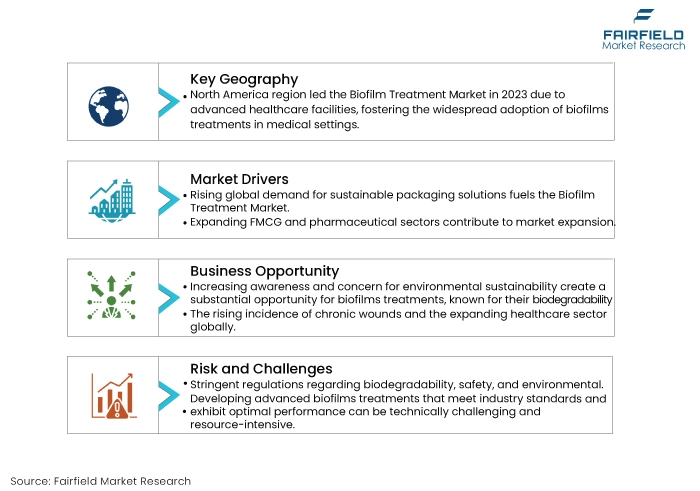
The increasing global focus on environmental sustainability is a primary driver propelling the biofilm treatment market. The demand for packaging solutions that are environmentally friendly and contribute to waste reduction has led to a surge in the adoption of biofilm treatment.
The preference for biodegradable carton-board packaging is especially on the rise due to its total biodegradability. This aligns with consumer preferences for eco-friendly products and regulatory initiatives promoting sustainable practices. Biofilm treatment, with its ability to offer effective and sustainable packaging solutions, is thus positioned at the forefront of this growing market.
- FMCG Expansion
The rapid expansion of the FMCG industry serves as a significant driver for the biofilm treatment market. The FMCG sector, encompassing products with a short shelf life and high consumer demand, necessitates efficient and reliable packaging solutions.
Biofilm treatment finds extensive application in this industry, providing solutions that cater to diverse packaging needs. The market benefits from the constant demand for packaged goods in the FMCG sector, positioning Biofilm Treatment as a crucial component in supporting the growth and evolution of this dynamic industry.
- Technological Advancements, and Automation
Technological advancements and the increasing trend towards automation represent a key driver shaping the biofilm treatment market. The industry has witnessed a shift towards automatic biofilm treatment, driven by the advantages of enhanced productivity, lower costs, and improved product quality and safety.
Automation, particularly in the 10 to 25 CPM category, has proven essential for industries with moderate production quantities seeking a balance between speed and precision in case packing. As manufacturers across various sectors prioritise efficiency and operational excellence, the demand for technologically advanced and automated Biofilm Treatment is expected to continue driving market growth.
Major Growth Barriers
- Technological Complexity, and Implementation Challenges
The biofilm treatment market faces restraint due to the technological complexity of advanced treatments. Implementing these sophisticated solutions may pose challenges for companies, requiring substantial investments in training and system integration.
Smaller businesses, in particular, may find it challenging to navigate these complexities, limiting widespread adoption. Overcoming these implementation hurdles is crucial to unlocking the full potential of biofilm treatment in diverse industries.
- Regulatory Compliance and Certification Barriers
Stringent regulatory compliance and certification requirements act as significant restraints in the biofilm treatment market. Meeting standards for bio-based and biodegradable packaging demands rigorous testing and verification processes.
Navigating these regulatory landscapes can be time-consuming and costly, potentially hindering market growth. Streamlining certification processes and establishing clear industry standards will be essential to mitigate these challenges and foster a more conducive environment for biofilm treatment.
Key Trends and Opportunities to Look at
The global trend toward sustainable packaging is robust, with biofilm treatment gaining prominence for their biodegradability. This trend is universally popular, driven by environmental consciousness. Key companies are developing bio-based solutions, and industry leaders are investing in eco-friendly initiatives.
Brands are likely to leverage sustainable packaging to enhance their environmental credentials, meeting the rising consumer demand for green and responsible products across diverse regions.
- Smart Packaging Integration
- Customisation and Versatility Trend
The integration of smart technologies within biofilm treatment is experiencing rapid growth worldwide. This trend is pervasive across regions, with companies incorporating sensors and QR codes for enhanced functionality. Key developments include packaging innovations that improve traceability and quality control.
Brands are poised to leverage smart packaging for heightened supply chain visibility, product authenticity, and improved consumer engagement, responding to the global demand for intelligent and connected packaging solutions.
The trend towards customisation and versatility in biofilm treatment is gaining momentum globally. Companies are developing treatments that address diverse packaging requirements, with popularity across different regions.
Key developments include flexible solutions adaptable to changing market demands. Brands are expected to leverage customisation to differentiate their products, cater to specific consumer preferences, and maintain agility in responding to evolving market dynamics on a global scale.
How Does the Regulatory Scenario Shape this Industry?
The global biofilm treatment market operates within a regulatory framework shaped by various entities and guidelines to ensure the safety, efficacy, and environmental sustainability of bio-based packaging solutions. In the US, the Food and Drug Administration (FDA) oversees the safety and labeling of food packaging materials, including biofilm treatment.
The FDA guides substances that can be used in packaging and ensures compliance with the Federal Food, Drug, and Cosmetic Act. In the European Union, the European Food Safety Authority (EFSA) plays a crucial role in evaluating the safety of food contact materials, including bio-based packaging. The EU's Regulation (EC) No 1935/2004 establishes general safety requirements for materials intended to come into contact with food.
Region-specific regulatory changes impact the adoption and market dynamics of biofilm treatment. For instance, the EU's Single-Use Plastics Directive aims to reduce the environmental impact of certain plastic products, potentially driving the demand for bio-based and biodegradable alternatives. In Asia Pacific, countries like India are increasingly focusing on sustainable packaging, with regulatory bodies emphasizing the need for eco-friendly solutions, influencing market trends.
The influence of regulatory entities extends beyond safety considerations; they also guide the industry toward more sustainable practices. For instance, the Circular Economy Action Plan in the EU encourages the use of bio-based materials, fostering a regulatory environment conducive to the growth of the biofilm treatment market.
Fairfield’s Ranking Board
Top Segments
The dressings segment is the dominant category, showcasing their versatility and indispensability across various healthcare settings. Advanced wound dressings have become the cornerstone of effective wound management, offering a comprehensive array of specialised functionalities.
From regulating moisture levels and absorbing exudate to providing crucial protection against infections, these dressings play a vital role in promoting optimal wound healing outcomes. Their widespread use in hospitals, wound care centres, and home care settings underscores their universal applicability and trustworthiness among healthcare professionals and patients alike.
The gels are rapidly emerging as the fastest-growing category within the wound care market, driven by their unique attributes and efficacy in addressing biofilm-related wounds. With biofilms posing significant challenges to wound healing processes, especially in chronic and complex wounds, the demand for innovative solutions has surged.
Gel formulations, particularly those enriched with antimicrobial agents or biofilm disruptors, offer a promising avenue for combating biofilm-associated pathogens effectively. Their ability to penetrate wound beds and target biofilm structures directly enhances their therapeutic potential, making them increasingly favoured by healthcare providers seeking advanced wound care solutions.
As the understanding of biofilm-related wound management continues to evolve, gels are poised to play a pivotal role in shaping the future of wound care, driving innovation and improving patient outcomes in the process.
- Traumatic and Surgical Wounds Surge Ahead
- Hospitals Spearhead Adoption
Traumatic and surgical wounds emerge as the dominant category, driven by their prevalence and diverse origins. These wounds stem from various sources such as accidents, injuries, or surgical interventions, necessitating immediate and appropriate interventions to mitigate risks, prevent complications, and expedite the healing process.
Given their widespread occurrence and the critical need for prompt treatment, traumatic and surgical wounds hold a central position in wound care protocols across healthcare settings, demanding comprehensive and tailored approaches to address their diverse etiologies effectively.
Conversely, diabetic foot ulcers are witnessing the fastest growth within the wound care landscape, propelled by the escalating global incidence of diabetes. Diabetic foot ulcers pose unique challenges due to the underlying factors associated with diabetes, including neuropathy, vascular insufficiency, and impaired immune function, which predispose individuals to chronic wounds.
Moreover, diabetic foot ulcers are particularly susceptible to biofilm formation, complicating the healing process and increasing the risk of infections and chronicity. As a result, there is a burgeoning demand for specialised biofilm treatment strategies tailored explicitly to diabetic foot ulcers, emphasizing the critical need for innovative approaches and targeted interventions to address this burgeoning healthcare challenge effectively.
Hospitals stand out as the dominant end user in the realm of wound care, providing a broad spectrum of healthcare services, including specialised wound care, to a diverse patient population. As primary centres for acute care and wound management, hospitals serve as pivotal hubs for addressing a wide range of wounds, catering to the needs of both inpatients and outpatients.
The comprehensive facilities at hospitals, equipped with advanced medical technologies and skilled healthcare professionals, enable hospitals to deliver timely and effective wound care interventions, thereby playing a central role in promoting patient recovery and well-being.
Meanwhile, wound care centres are experiencing rapid growth and emerging as the fastest-growing category within the wound care landscape. These specialised facilities are dedicated to managing complex wounds and providing tailored treatment plans for challenging cases.
Offering multidisciplinary approaches to wound care, wound care centres integrate advanced treatments, specialised dressings, and expert consultations to address the diverse needs of patients with chronic or difficult-to-heal wounds. As awareness of the benefits of specialised wound care grows and the complexity of wound cases increases, wound care centres are increasingly sought after for their expertise and comprehensive services, positioning them as key players in the evolving landscape of wound management.
Regional Frontrunners
North America Enjoys the First Mover Advantage, Adoption of Advanced Wound Care Solutions Soars
North America stands as the largest regional market in the global biofilm treatment market. The region's dominance is attributed to its advanced healthcare infrastructure, high awareness levels regarding sustainable practices, and a significant prevalence of chronic diseases prompting the need for advanced wound care solutions.
The US plays a pivotal role, boasting robust research and development activities, substantial healthcare expenditure, and a strong presence of key industry players. Collaborations between market leaders and strategic initiatives contribute to North America's significant market share, making it a cornerstone in the global biofilm treatment landscape.
Asia Pacific Gears up for Fastest Growth
The Asia Pacific region emerges as the fastest growing market in the global biofilm treatment market. Factors driving this rapid growth include increasing healthcare investments, a burgeoning population with diverse healthcare needs, and heightened awareness of advanced wound care solutions. Government initiatives promoting sustainable packaging align with the market trends, fostering growth.
Key players are expanding their presence and adapting strategies to cater to the unique demands of the Asia Pacific market. With a dynamic healthcare landscape and rising demand for innovative treatments, the region showcases substantial growth potential, positioning itself as a key player in shaping the trajectory of the global biofilm treatment market.
Who are the Leaders in Global Biofilm Treatment Space?
• Ecolab
• SUEZ
• DuPont
• 3M
• Biofilm Control
• Medline Industries
• Hygiena
• Antimicrobial Solutions
Global Biofilm Treatment Market is Segmented as Below:
By Pathogen Type
• Bacterial Biofilms
• Fungal Biofilms
• Viral Biofilms
By Treatment Type
• Antimicrobial Therapy
• Bio-enzymatic Therapy
• Physical Disruption Methods
• Nanomedicine-Based Treatment
By End User
• Hospitals and Clinics
• Ambulatory Surgical Centers
• Research Institutes
• Industrial Applications
By Application
• Chronic Wound Treatment
• Device-associated Infections
• Medical Implant Infections
• Dental Infections
By Region
• North America
• Europe
• Asia Pacific
• Latin America
• Middle East & Africa
- Executive Summary
- Global Biofilm Treatment Market Snapshot
- Future Projections
- Key Market Trends
- Regional Snapshot, by Value, 2026
- Analyst Recommendations
- Market Overview
- Market Definitions and Segmentations
- Market Dynamics
- Drivers
- Restraints
- Market Opportunities
- Value Chain Analysis
- COVID-19 Impact Analysis
- Porter's Five Forces Analysis
- Impact of Russia-Ukraine Conflict
- PESTLE Analysis
- Regulatory Analysis
- Price Trend Analysis
- Current Prices and Future Projections, 2025-2033
- Price Impact Factors
- Global Biofilm Treatment Market Outlook, 2020 - 2033
- Global Biofilm Treatment Market Outlook, by Pathogen Type, Value (US$ Bn), 2020-2033
- Bacterial Biofilms
- Fungal Biofilms
- Viral Biofilms
- Global Biofilm Treatment Market Outlook, by Treatment Type, Value (US$ Bn), 2020-2033
- Antimicrobial Therapy
- Bio-enzymatic Therapy
- Physical Disruption Methods
- Nanomedicine-Based Treatment
- Global Biofilm Treatment Market Outlook, by End User, Value (US$ Bn), 2020-2033
- Hospitals and Clinics
- Ambulatory Surgical Centers
- Research Institutes
- Industrial Applications
- Global Biofilm Treatment Market Outlook, by Application, Value (US$ Bn), 2020-2033
- Chronic Wound Treatment
- Device-associated Infections
- Medical Implant Infections
- Dental Infections
- Global Biofilm Treatment Market Outlook, by Region, Value (US$ Bn), 2020-2033
- North America
- Europe
- Asia Pacific
- Latin America
- Middle East & Africa
- Global Biofilm Treatment Market Outlook, by Pathogen Type, Value (US$ Bn), 2020-2033
- North America Biofilm Treatment Market Outlook, 2020 - 2033
- North America Biofilm Treatment Market Outlook, by Pathogen Type, Value (US$ Bn), 2020-2033
- Bacterial Biofilms
- Fungal Biofilms
- Viral Biofilms
- North America Biofilm Treatment Market Outlook, by Treatment Type, Value (US$ Bn), 2020-2033
- Antimicrobial Therapy
- Bio-enzymatic Therapy
- Physical Disruption Methods
- Nanomedicine-Based Treatment
- North America Biofilm Treatment Market Outlook, by End User, Value (US$ Bn), 2020-2033
- Hospitals and Clinics
- Ambulatory Surgical Centers
- Research Institutes
- Industrial Applications
- North America Biofilm Treatment Market Outlook, by Application, Value (US$ Bn), 2020-2033
- Chronic Wound Treatment
- Device-associated Infections
- Medical Implant Infections
- Dental Infections
- North America Biofilm Treatment Market Outlook, by Country, Value (US$ Bn), 2020-2033
- U.S. Biofilm Treatment Market Outlook, by Pathogen Type, 2020-2033
- U.S. Biofilm Treatment Market Outlook, by Treatment Type, 2020-2033
- U.S. Biofilm Treatment Market Outlook, by End User, 2020-2033
- U.S. Biofilm Treatment Market Outlook, by Application, 2020-2033
- Canada Biofilm Treatment Market Outlook, by Pathogen Type, 2020-2033
- Canada Biofilm Treatment Market Outlook, by Treatment Type, 2020-2033
- Canada Biofilm Treatment Market Outlook, by End User, 2020-2033
- Canada Biofilm Treatment Market Outlook, by Application, 2020-2033
- BPS Analysis/Market Attractiveness Analysis
- North America Biofilm Treatment Market Outlook, by Pathogen Type, Value (US$ Bn), 2020-2033
- Europe Biofilm Treatment Market Outlook, 2020 - 2033
- Europe Biofilm Treatment Market Outlook, by Pathogen Type, Value (US$ Bn), 2020-2033
- Bacterial Biofilms
- Fungal Biofilms
- Viral Biofilms
- Europe Biofilm Treatment Market Outlook, by Treatment Type, Value (US$ Bn), 2020-2033
- Antimicrobial Therapy
- Bio-enzymatic Therapy
- Physical Disruption Methods
- Nanomedicine-Based Treatment
- Europe Biofilm Treatment Market Outlook, by End User, Value (US$ Bn), 2020-2033
- Hospitals and Clinics
- Ambulatory Surgical Centers
- Research Institutes
- Industrial Applications
- Europe Biofilm Treatment Market Outlook, by Application, Value (US$ Bn), 2020-2033
- Chronic Wound Treatment
- Device-associated Infections
- Medical Implant Infections
- Dental Infections
- Europe Biofilm Treatment Market Outlook, by Country, Value (US$ Bn), 2020-2033
- Germany Biofilm Treatment Market Outlook, by Pathogen Type, 2020-2033
- Germany Biofilm Treatment Market Outlook, by Treatment Type, 2020-2033
- Germany Biofilm Treatment Market Outlook, by End User, 2020-2033
- Germany Biofilm Treatment Market Outlook, by Application, 2020-2033
- Italy Biofilm Treatment Market Outlook, by Pathogen Type, 2020-2033
- Italy Biofilm Treatment Market Outlook, by Treatment Type, 2020-2033
- Italy Biofilm Treatment Market Outlook, by End User, 2020-2033
- Italy Biofilm Treatment Market Outlook, by Application, 2020-2033
- France Biofilm Treatment Market Outlook, by Pathogen Type, 2020-2033
- France Biofilm Treatment Market Outlook, by Treatment Type, 2020-2033
- France Biofilm Treatment Market Outlook, by End User, 2020-2033
- France Biofilm Treatment Market Outlook, by Application, 2020-2033
- U.K. Biofilm Treatment Market Outlook, by Pathogen Type, 2020-2033
- U.K. Biofilm Treatment Market Outlook, by Treatment Type, 2020-2033
- U.K. Biofilm Treatment Market Outlook, by End User, 2020-2033
- U.K. Biofilm Treatment Market Outlook, by Application, 2020-2033
- Spain Biofilm Treatment Market Outlook, by Pathogen Type, 2020-2033
- Spain Biofilm Treatment Market Outlook, by Treatment Type, 2020-2033
- Spain Biofilm Treatment Market Outlook, by End User, 2020-2033
- Spain Biofilm Treatment Market Outlook, by Application, 2020-2033
- Russia Biofilm Treatment Market Outlook, by Pathogen Type, 2020-2033
- Russia Biofilm Treatment Market Outlook, by Treatment Type, 2020-2033
- Russia Biofilm Treatment Market Outlook, by End User, 2020-2033
- Russia Biofilm Treatment Market Outlook, by Application, 2020-2033
- Rest of Europe Biofilm Treatment Market Outlook, by Pathogen Type, 2020-2033
- Rest of Europe Biofilm Treatment Market Outlook, by Treatment Type, 2020-2033
- Rest of Europe Biofilm Treatment Market Outlook, by End User, 2020-2033
- Rest of Europe Biofilm Treatment Market Outlook, by Application, 2020-2033
- BPS Analysis/Market Attractiveness Analysis
- Europe Biofilm Treatment Market Outlook, by Pathogen Type, Value (US$ Bn), 2020-2033
- Asia Pacific Biofilm Treatment Market Outlook, 2020 - 2033
- Asia Pacific Biofilm Treatment Market Outlook, by Pathogen Type, Value (US$ Bn), 2020-2033
- Bacterial Biofilms
- Fungal Biofilms
- Viral Biofilms
- Asia Pacific Biofilm Treatment Market Outlook, by Treatment Type, Value (US$ Bn), 2020-2033
- Antimicrobial Therapy
- Bio-enzymatic Therapy
- Physical Disruption Methods
- Nanomedicine-Based Treatment
- Asia Pacific Biofilm Treatment Market Outlook, by End User, Value (US$ Bn), 2020-2033
- Hospitals and Clinics
- Ambulatory Surgical Centers
- Research Institutes
- Industrial Applications
- Asia Pacific Biofilm Treatment Market Outlook, by Application, Value (US$ Bn), 2020-2033
- Chronic Wound Treatment
- Device-associated Infections
- Medical Implant Infections
- Dental Infections
- Asia Pacific Biofilm Treatment Market Outlook, by Country, Value (US$ Bn), 2020-2033
- China Biofilm Treatment Market Outlook, by Pathogen Type, 2020-2033
- China Biofilm Treatment Market Outlook, by Treatment Type, 2020-2033
- China Biofilm Treatment Market Outlook, by End User, 2020-2033
- China Biofilm Treatment Market Outlook, by Application, 2020-2033
- Japan Biofilm Treatment Market Outlook, by Pathogen Type, 2020-2033
- Japan Biofilm Treatment Market Outlook, by Treatment Type, 2020-2033
- Japan Biofilm Treatment Market Outlook, by End User, 2020-2033
- Japan Biofilm Treatment Market Outlook, by Application, 2020-2033
- South Korea Biofilm Treatment Market Outlook, by Pathogen Type, 2020-2033
- South Korea Biofilm Treatment Market Outlook, by Treatment Type, 2020-2033
- South Korea Biofilm Treatment Market Outlook, by End User, 2020-2033
- South Korea Biofilm Treatment Market Outlook, by Application, 2020-2033
- India Biofilm Treatment Market Outlook, by Pathogen Type, 2020-2033
- India Biofilm Treatment Market Outlook, by Treatment Type, 2020-2033
- India Biofilm Treatment Market Outlook, by End User, 2020-2033
- India Biofilm Treatment Market Outlook, by Application, 2020-2033
- Southeast Asia Biofilm Treatment Market Outlook, by Pathogen Type, 2020-2033
- Southeast Asia Biofilm Treatment Market Outlook, by Treatment Type, 2020-2033
- Southeast Asia Biofilm Treatment Market Outlook, by End User, 2020-2033
- Southeast Asia Biofilm Treatment Market Outlook, by Application, 2020-2033
- Rest of SAO Biofilm Treatment Market Outlook, by Pathogen Type, 2020-2033
- Rest of SAO Biofilm Treatment Market Outlook, by Treatment Type, 2020-2033
- Rest of SAO Biofilm Treatment Market Outlook, by End User, 2020-2033
- Rest of SAO Biofilm Treatment Market Outlook, by Application, 2020-2033
- BPS Analysis/Market Attractiveness Analysis
- Asia Pacific Biofilm Treatment Market Outlook, by Pathogen Type, Value (US$ Bn), 2020-2033
- Latin America Biofilm Treatment Market Outlook, 2020 - 2033
- Latin America Biofilm Treatment Market Outlook, by Pathogen Type, Value (US$ Bn), 2020-2033
- Bacterial Biofilms
- Fungal Biofilms
- Viral Biofilms
- Latin America Biofilm Treatment Market Outlook, by Treatment Type, Value (US$ Bn), 2020-2033
- Antimicrobial Therapy
- Bio-enzymatic Therapy
- Physical Disruption Methods
- Nanomedicine-Based Treatment
- Latin America Biofilm Treatment Market Outlook, by End User, Value (US$ Bn), 2020-2033
- Hospitals and Clinics
- Ambulatory Surgical Centers
- Research Institutes
- Industrial Applications
- Latin America Biofilm Treatment Market Outlook, by Application, Value (US$ Bn), 2020-2033
- Chronic Wound Treatment
- Device-associated Infections
- Medical Implant Infections
- Dental Infections
- Latin America Biofilm Treatment Market Outlook, by Country, Value (US$ Bn), 2020-2033
- Brazil Biofilm Treatment Market Outlook, by Pathogen Type, 2020-2033
- Brazil Biofilm Treatment Market Outlook, by Treatment Type, 2020-2033
- Brazil Biofilm Treatment Market Outlook, by End User, 2020-2033
- Brazil Biofilm Treatment Market Outlook, by Application, 2020-2033
- Mexico Biofilm Treatment Market Outlook, by Pathogen Type, 2020-2033
- Mexico Biofilm Treatment Market Outlook, by Treatment Type, 2020-2033
- Mexico Biofilm Treatment Market Outlook, by End User, 2020-2033
- Mexico Biofilm Treatment Market Outlook, by Application, 2020-2033
- Argentina Biofilm Treatment Market Outlook, by Pathogen Type, 2020-2033
- Argentina Biofilm Treatment Market Outlook, by Treatment Type, 2020-2033
- Argentina Biofilm Treatment Market Outlook, by End User, 2020-2033
- Argentina Biofilm Treatment Market Outlook, by Application, 2020-2033
- Rest of LATAM Biofilm Treatment Market Outlook, by Pathogen Type, 2020-2033
- Rest of LATAM Biofilm Treatment Market Outlook, by Treatment Type, 2020-2033
- Rest of LATAM Biofilm Treatment Market Outlook, by End User, 2020-2033
- Rest of LATAM Biofilm Treatment Market Outlook, by Application, 2020-2033
- BPS Analysis/Market Attractiveness Analysis
- Latin America Biofilm Treatment Market Outlook, by Pathogen Type, Value (US$ Bn), 2020-2033
- Middle East & Africa Biofilm Treatment Market Outlook, 2020 - 2033
- Middle East & Africa Biofilm Treatment Market Outlook, by Pathogen Type, Value (US$ Bn), 2020-2033
- Bacterial Biofilms
- Fungal Biofilms
- Viral Biofilms
- Middle East & Africa Biofilm Treatment Market Outlook, by Treatment Type, Value (US$ Bn), 2020-2033
- Antimicrobial Therapy
- Bio-enzymatic Therapy
- Physical Disruption Methods
- Nanomedicine-Based Treatment
- Middle East & Africa Biofilm Treatment Market Outlook, by End User, Value (US$ Bn), 2020-2033
- Hospitals and Clinics
- Ambulatory Surgical Centers
- Research Institutes
- Industrial Applications
- Middle East & Africa Biofilm Treatment Market Outlook, by Application, Value (US$ Bn), 2020-2033
- Chronic Wound Treatment
- Device-associated Infections
- Medical Implant Infections
- Dental Infections
- Middle East & Africa Biofilm Treatment Market Outlook, by Country, Value (US$ Bn), 2020-2033
- GCC Biofilm Treatment Market Outlook, by Pathogen Type, 2020-2033
- GCC Biofilm Treatment Market Outlook, by Treatment Type, 2020-2033
- GCC Biofilm Treatment Market Outlook, by End User, 2020-2033
- GCC Biofilm Treatment Market Outlook, by Application, 2020-2033
- South Africa Biofilm Treatment Market Outlook, by Pathogen Type, 2020-2033
- South Africa Biofilm Treatment Market Outlook, by Treatment Type, 2020-2033
- South Africa Biofilm Treatment Market Outlook, by End User, 2020-2033
- South Africa Biofilm Treatment Market Outlook, by Application, 2020-2033
- Egypt Biofilm Treatment Market Outlook, by Pathogen Type, 2020-2033
- Egypt Biofilm Treatment Market Outlook, by Treatment Type, 2020-2033
- Egypt Biofilm Treatment Market Outlook, by End User, 2020-2033
- Egypt Biofilm Treatment Market Outlook, by Application, 2020-2033
- Nigeria Biofilm Treatment Market Outlook, by Pathogen Type, 2020-2033
- Nigeria Biofilm Treatment Market Outlook, by Treatment Type, 2020-2033
- Nigeria Biofilm Treatment Market Outlook, by End User, 2020-2033
- Nigeria Biofilm Treatment Market Outlook, by Application, 2020-2033
- Rest of Middle East Biofilm Treatment Market Outlook, by Pathogen Type, 2020-2033
- Rest of Middle East Biofilm Treatment Market Outlook, by Treatment Type, 2020-2033
- Rest of Middle East Biofilm Treatment Market Outlook, by End User, 2020-2033
- Rest of Middle East Biofilm Treatment Market Outlook, by Application, 2020-2033
- BPS Analysis/Market Attractiveness Analysis
- Middle East & Africa Biofilm Treatment Market Outlook, by Pathogen Type, Value (US$ Bn), 2020-2033
- Competitive Landscape
- Company Vs Segment Heatmap
- Company Market Share Analysis, 2025
- Competitive Dashboard
- Company Profiles
- Ecolab
- Company Overview
- Product Portfolio
- Financial Overview
- Business Strategies and Developments
- SUEZ
- DuPont
- 3M
- Biofilm Control
- Medline Industries
- Hygiena
- Antimicrobial Solutions
- Ecolab
- Appendix
- Research Methodology
- Report Assumptions
- Acronyms and Abbreviations
|
BASE YEAR |
HISTORICAL DATA |
FORECAST PERIOD |
UNITS |
|||
 |
2025 |
 |
2020 - 2025 |
 |
2026 - 2033 |
Value: US$ Million |
Our Research Methodology
Considering the volatility of business today, traditional approaches to strategizing a game plan can be unfruitful if not detrimental. True ambiguity is no way to determine a forecast. A myriad of predetermined factors must be accounted for such as the degree of risk involved, the magnitude of circumstances, as well as conditions or consequences that are not known or unpredictable. To circumvent binary views that cast uncertainty, the application of market research intelligence to strategically posture, move, and enable actionable outcomes is necessary.
View Methodology
Quality Assured
Rigorous Validation Process

Confidentiality Assured
End-to-end Data Security

Custom Research Services
Tailored To Your Objectives
FAQs
The Biofilm Treatment market is expected to reach USD 2.5 billion in 2026.
The Biofilm Treatment market is projected to grow at an 8.5% CAGR through 2033.
The Biofilm Treatment market growth is driven by rising adoption of advanced wound care solutions, increasing prevalence of chronic wounds and biofilm-related infections, and growing demand for innovative antimicrobial therapies.
North America is the dominant regional market for Biofilm Treatment.
Ecolab, SUEZ, DuPont, 3M, and Medline Industries are some of the leading industry players in the Biofilm Treatment market.
Related Reports
Fructosamine Test Market Insights, Competitive Landscape, and Market Forecast - 2033
The Fructosamine Test Market is projected to grow from USD 382.2 Million in 2026 to USD 545 Million by 2033, at a CAGR of 5.2%
Urothelial Carcinoma Diagnostics Market Insights, Competitive Landscape, and Market Forecast - 2033
The Urothelial Carcinoma Diagnostics Market is expected to grow from USD 2.1 Billion in 2026 to USD 4 Billion by 2033, registering a CAGR of 9.8%
Prefilled Syringes Market Insights, Competitive Landscape, and Market Forecast - 2033
The Prefilled Syringes Market is expected to grow from USD 2.8 Billion in 2026 to USD 5.1 Billion by 2033, registering a CAGR of 8.8%
Elastomeric Infusion Pumps Market Insights, Competitive Landscape, and Market Forecast - 2033
The Elastomeric Infusion Pumps Market is expected to grow from USD 1.3 Billion in 2026 to USD 2.1 Billion by 2033, registering a CAGR of 7.3%
Peripheral Stent Implants Market Insights, Competitive Landscape, and Market Forecast - 2033
The Peripheral Stent Implants Market is expected to grow from USD 4.2 Billion in 2026 to USD 6.6 Billion by 2033, registering a CAGR of 6.7%
Volumetric Infusion Pumps Market Insights, Competitive Landscape, and Market Forecast - 2033
The Volumetric Infusion Pumps Market is projected to grow from USD 1.82 Bn in 2026 to USD 2.70 Bn by 2033, registering a 5.8% CAGR during the forecast period