



Fructosamine Test Market
Fructosamine Test Market Insights, Competitive Landscape, and Market Forecast - 2033
Global Fructosamine Test Market Forecast
The Fructosamine Test Market is expected to grow from USD 382.2 Million in 2026 to USD 545 Million by 2033, reflecting strong industry expansion and registering a CAGR of 5.2% during the forecast period from 2026 to 2033.
Executive Summary & Key Highlights
- The global fructosamine test market reached approximately US$290 million in 2025 and is projected to grow to US$381.6 million by 2032, reflecting a CAGR of about 4%. This indicates a mature market, supported by steady, reliable demand rather than rapid or disruptive growth.
- Type II Diabetes leads the Disease Indication segment with a dominant 55% share in 2025, driving strong fructosamine adoption across Hospitals and Specialty Clinics globally.
- Blood Serum remains the leading sample Type with 81% market share by 2025 due to established laboratory workflows across North America and Europe.
- Blood Plasma is the fastest-growing sample Type, expanding steadily through 2032 as distributed and Point-of-Care testing gains adoption in emerging Asia and Latin America.
- Clinical Diagnostics for Human applications dominate with 56% market value in 2025, driven by routine diabetes management in inpatient and outpatient settings.
- Clinical Diagnostics for Animals market growth is attributed to the overall market as companion animal diabetes and veterinary laboratory capabilities expanding in Western Europe and North America.
- Hospitals lead the End-User landscape with 30% share, reflecting high-volume automated testing and centralized procurement structures.
- Asia Pacific is the fastest-growing region, projected to contribute nearly 30% of global market growth in 2032, fueled by China’s 90M and India’s 70M diabetic populations.
Market Dynamics: Drivers, Restraints, and Opportunities Analysis
Market Drivers
- Technological Advancement in Laboratory Automation and Point-of-Care Testing
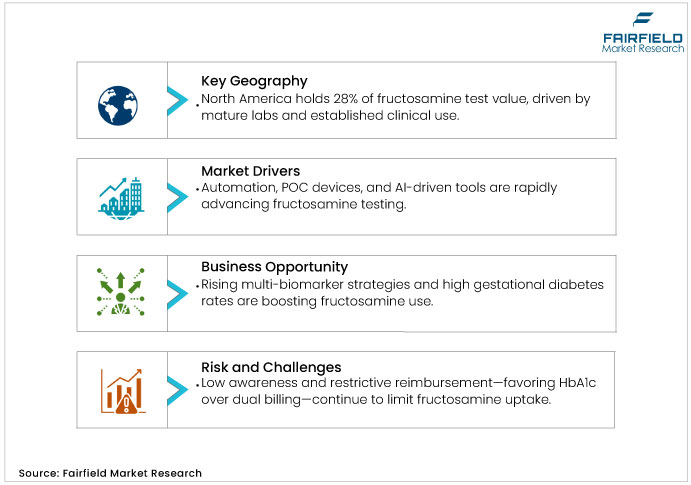
Technological innovation is reshaping the Fructosamine Test Market as automated immunoassay platforms and enzymatic assay methodologies enhance specificity, analytical throughput, and turnaround times versus colorimetric methods. The rise of portable point-of-care devices, supported by regulatory easing for POC approvals, is accelerating decentralized testing adoption. AI and machine learning integration is also improving diagnostic precision and clinician decision-making.
Siemens Healthcare's automated fructosamine assays for ADVIA Chemistry systems and Randox Laboratories’ enzymatic test kits reflect this technological progress. These advancements reduce manual intervention, boost analytical reliability, and improve EHR workflow integration across diabetes clinics and diagnostic centers. Sustained R&D investments continue to reinforce this structural driver within diabetes diagnostics innovation.
- Expansion of Healthcare Infrastructure and Diagnostic Testing Accessibility in Emerging Markets
Asia-Pacific fructosamine test markets are witnessing rapid healthcare investment and diagnostic expansion, especially in China and India. China’s fructosamine test market expanded significantly in 2025 and is projected to grow steadily, supported by rising diabetes incidence and strengthened laboratory infrastructure. India reflects similarly fast-growing dynamics driven by urbanization, lifestyle shifts, and government-backed healthcare access programs.
World Bank and OECD data show sustained healthcare spending increases across emerging economies, boosting diagnostic infrastructure and reshaping global competitiveness. Regional manufacturers are expanding production and distribution capabilities for both domestic and export markets, attracting companies deploying capital into emerging regions. However, success requires navigating diverse regulatory systems, reimbursement variations, and infrastructure development complexities.
Market Restraints
- Limited Clinical Awareness and Reimbursement Uncertainty
Fructosamine testing adoption remains limited due to low clinical awareness in certain segments and emerging markets. Reimbursement policies often prohibit concurrent billing of fructosamine and HbA1c, with Medicare and commercial insurers prioritizing HbA1c as the primary biomarker. This restricts testing volume in price-sensitive systems and limits provider incentives.
Reimbursement uncertainty is estimated to restrain fructosamine test market growth, with the strongest impact in North America and Western Europe where policies are most stringent. Diagnostic providers can mitigate this restraint through outcome-driven evidence and health economic studies. Such initiatives can support future reimbursement policy evolution and broader adoption.
- Competition from Alternative Glycemic Monitoring Methodologies
HbA1c remains the dominant standard for long-term glycemic monitoring, while CGM technologies are emerging with real-time glucose insights that appeal to specific patient groups. Additional alternatives such as OGTT, fasting plasma glucose, and hemoglobin-variant specific assays further fragment the testing landscape. This collective competition suppresses fructosamine adoption by reducing clinical reliance on multi-analyte strategies.
Fructosamine test market consolidation around high-volume modalities creates switching barriers that slow fructosamine uptake. Manufacturers can offset this challenge through clinical differentiation focused on scenarios such as hemoglobinopathy management, renal disease monitoring, and pregnancy-related glucose assessment. These areas highlight unique, documented advantages of fructosamine testing.
Market Opportunities
- Integration of Fructosamine Testing into Comprehensive Diabetes Management Protocols
Growing emphasis on multi-biomarker diabetes assessment is creating new opportunities for fructosamine integration within diagnostic algorithms. Gestational diabetes is a key underserved segment where fructosamine provides clear advantages, avoiding interference from hemoglobin variants or CKD. With gestational diabetes affecting roughly one in five pregnancies globally and showing 11–25% prevalence in select emerging regions, the addressable demand is significant.
International Diabetes Federation recommendations for gestational diabetes and early-onset Type I pediatric diabetes further expand targeted deployment potential. Realizing this opportunity requires guideline updates, workflow redesign for multi-analyte testing, and EHR integration to support clinical decision-making.
- Point-of-Care and Home-Based Fructosamine Testing Expansion
The shift toward decentralized care and patient-directed monitoring is opening strong opportunities for POC and home-based fructosamine testing. Current penetration is modest and largely limited to specialized diabetes clinics and research settings. User-friendly, rapid-turnaround POC platforms could expand adoption across primary care, remote care, and home environments, especially in emerging markets with limited lab infrastructure.
The addressable market value for POC fructosamine testing is expected to expand significantly through 2032 if adoption accelerates. Success depends on generating evidence of POC reliability comparable to central labs, securing FDA/CE approvals, and integrating workflows into healthcare systems. Companies achieving early entry into POC fructosamine platforms stand to capture substantial market share.
Regional Market Assessment: Strategic Geography Analysis
- North America: Mature Market with Technology Leadership
North America, led by the U.S., accounts for 28% of global fructosamine test market value in 2025, with the U.S. market growing at a modest single-digit CAGR through 2032. This maturity reflects advanced infrastructure, strong laboratory networks, and established clinical use in hemoglobin-related conditions and intensive insulin therapy. Reimbursement expansion continues slowly as supporting clinical evidence increases.
FDA and CLIA regulations shape a competitive environment centered on validation, quality, and performance standards. Innovation driven by Abbott and Siemens Healthineers advances immunoassay automation across major urban hubs. As healthcare consolidation centralizes procurement in large IDNs, differentiation increasingly depends on system integration and value-based service models rather than standalone product innovation.
- Europe: Regulatory Harmonization and Differentiated Market Dynamics
Europe shows wide variation in fructosamine test market dynamics, with Germany and the United Kingdom together representing 10–15% of regional fructosamine testing demand. CE marking and IVD Regulation 2017/746 create harmonized compliance standards, though reimbursement policies still vary nationally. Sustainability, data security, and advanced diagnostic adoption are increasingly shaping competitive positioning.
Growth is driven by expanding diabetes screening programs in Western and Nordic countries, alongside emerging adoption in Central and Eastern Europe. Successful expansion requires navigating country-specific reimbursement systems, procurement pathways, and clinical adoption timelines. Moderate long-term growth through 2032 is supported by healthcare investment and aging demographics, with differentiation tied to integration capabilities and IVD regulatory compliance.
- Asia-Pacific: Differential Growth and Competitive Positioning
Asia-Pacific is the fastest-growing region, projected to reach US$115 million by 2032 and account for nearly 30% of global fructosamine test market growth acceleration. China contributes 10–15% of regional value, supported by 90 million diabetics (2021) and major healthcare modernization. India is the fastest-growing market, with over 70 million diabetics (2021) and strong expansion driven by urbanization and rising incomes.
Regional manufacturing strength, supply chain depth, and innovation capability are reshaping global competitiveness. Investment strategies must account for country-specific growth rates, regulatory environments, healthcare maturity, and reimbursement complexity. Expanding diagnostic infrastructure, especially in emerging markets will sustain Asia-Pacific growth above global averages through 2032, benefiting manufacturers with strong distribution and localized development.
Segmentation Analysis: Category-Wise Strategic Assessment
- Disease Indication Segment Analysis
Type II diabetes holds 55% of the fructosamine test market share in 2025, driven by rising global incidence linked to obesity, sedentary lifestyles, and aging populations. Fructosamine is increasingly used when HbA1c is unreliable, such as in anemia or hemoglobinopathy. Providers also adopt it for patients requiring frequent monitoring or showing unstable glucose control.
Type I diabetes remains smaller but is growing as intensive insulin therapy requires rapid fructosamine-based assessment. Gestational diabetes is still underpenetrated despite strong clinical need, though protocol integration and evidence generation may expand adoption through 2032. Both segments show rising potential as guidelines emphasize more frequent glycemic monitoring.
- Sample Type Segment Analysis
Blood serum sampling leads the fructosamine test market with 80% share by 2025, supported by long-established clinical protocols, strong lab infrastructure compatibility, and proven performance in automated systems. Its dominance reflects organizational and technological lock-in across workflows and quality assurance. Manufacturers focus on improving enzymatic assay specificity, reducing turnaround times, and enhancing automation integration.
Blood plasma is an emerging alternative, growing at a sustainable CAGR through 2032, supported by evidence of comparable performance and advantages for certain patient groups. Plasma-based assays offer differentiation in outpatient and distributed testing where serum processing is limited. The segment shows steady technology-driven expansion and moderate adoption through the forecast period.
- Application Segment Analysis
Clinical diagnostics for human patients leads the market with 56% of global fructosamine test market value by 2025, driven by routine diabetes management across inpatient and outpatient settings. Growth depends on protocol adoption, clinical efficacy validation, and reimbursement support. Competitive dynamics center on provider relationships and navigation of healthcare payment systems.
Animal clinical diagnostics is expanding rapidly, due to rising companion animal diabetes testing and veterinary lab development. The segment remains underpenetrated but offers strong potential through 2032. Firms with veterinary-specific assay formats and reference lab distribution can capture above-market growth.
- End-User Segment Analysis
Hospitals lead the end-user landscape with 30% of the fructosamine test market value in 2025, driven by centralized procurement, automated testing infrastructure, and integrated diabetes protocols. High-throughput hospital laboratories concentrate testing volumes within major central lab networks. This structure favors manufacturers offering automation-ready platforms and volume-based commercial models.
Specialty clinics are a fast-growing segment as endocrinology, metabolic centers, and diabetes clinics expand fructosamine use for treatment optimization. Ambulatory surgical centers and long-term care facilities show emerging adoption for perioperative and geriatric glucose monitoring. The fragmented multi-end-user mix requires tailored commercial strategies aligned with varied workflows and procurement patterns.
Prominent Players in Global Fructosamine Test Market
• Randox Laboratories Ltd. (U.K.)
• Weldon Biotech, Inc. (India)
• Abbexa (U.K.)
• Hoffmann-La Roche Ltd. (Switzerland)
• Eurolyser Diagnostica GmbH (Austria)
• LifeSpan BioSciences, Inc. (U.S.)
• Fortress Diagnostics (U.K.)
• Abcam Limited (U.K.)
The Global Fructosamine Test Market is Segmented as Below
Application
• Type 1 Diabetes
• Type 2 Diabetes
By Sample
• Blood Serum
• Blood Plasma
By End User
• Hospital & Clinics
• Diagnostic Laboratories
By Region
• North America
• Europe
• Asia Pacific
• Latin America
• Middle East & Africa
- Executive Summary
- Global Fructosamine Test Market Snapshot
- Future Projections
- Key Market Trends
- Regional Snapshot, by Value, 2026
- Analyst Recommendations
- Market Overview
- Market Definitions and Segmentations
- Market Dynamics
- Drivers
- Restraints
- Market Opportunities
- Value Chain Analysis
- COVID-19 Impact Analysis
- Porter's Five Forces Analysis
- Impact of Russia-Ukraine Conflict
- PESTLE Analysis
- Regulatory Analysis
- Price Trend Analysis
- Current Prices and Future Projections, 2025-2033
- Price Impact Factors
- Global Fructosamine Test Market Outlook, 2020 - 2033
- Global Fructosamine Test Market Outlook, by Application, Value (US$ Mn), 2020-2033
- Type 1 Diabetes
- Type 2 Diabetes
- Global Fructosamine Test Market Outlook, by By Sample, Value (US$ Mn), 2020-2033
- Blood Serum
- Blood Serum
- Global Fructosamine Test Market Outlook, by By End User, Value (US$ Mn), 2020-2033
- Hospital & Clinics
- Diagnostic Laboratories
- Global Fructosamine Test Market Outlook, by Region, Value (US$ Mn), 2020-2033
- North America
- Europe
- Asia Pacific
- Latin America
- Middle East & Africa
- Global Fructosamine Test Market Outlook, by Application, Value (US$ Mn), 2020-2033
- North America Fructosamine Test Market Outlook, 2020 - 2033
- North America Fructosamine Test Market Outlook, by Application, Value (US$ Mn), 2020-2033
- Type 1 Diabetes
- Type 2 Diabetes
- North America Fructosamine Test Market Outlook, by By Sample, Value (US$ Mn), 2020-2033
- Blood Serum
- Blood Serum
- North America Fructosamine Test Market Outlook, by By End User, Value (US$ Mn), 2020-2033
- Hospital & Clinics
- Diagnostic Laboratories
- North America Fructosamine Test Market Outlook, by Country, Value (US$ Mn), 2020-2033
- U.S. Fructosamine Test Market Outlook, by Application, 2020-2033
- U.S. Fructosamine Test Market Outlook, by By Sample, 2020-2033
- U.S. Fructosamine Test Market Outlook, by By End User, 2020-2033
- Canada Fructosamine Test Market Outlook, by Application, 2020-2033
- Canada Fructosamine Test Market Outlook, by By Sample, 2020-2033
- Canada Fructosamine Test Market Outlook, by By End User, 2020-2033
- BPS Analysis/Market Attractiveness Analysis
- North America Fructosamine Test Market Outlook, by Application, Value (US$ Mn), 2020-2033
- Europe Fructosamine Test Market Outlook, 2020 - 2033
- Europe Fructosamine Test Market Outlook, by Application, Value (US$ Mn), 2020-2033
- Type 1 Diabetes
- Type 2 Diabetes
- Europe Fructosamine Test Market Outlook, by By Sample, Value (US$ Mn), 2020-2033
- Blood Serum
- Blood Serum
- Europe Fructosamine Test Market Outlook, by By End User, Value (US$ Mn), 2020-2033
- Hospital & Clinics
- Diagnostic Laboratories
- Europe Fructosamine Test Market Outlook, by Country, Value (US$ Mn), 2020-2033
- Germany Fructosamine Test Market Outlook, by Application, 2020-2033
- Germany Fructosamine Test Market Outlook, by By Sample, 2020-2033
- Germany Fructosamine Test Market Outlook, by By End User, 2020-2033
- Italy Fructosamine Test Market Outlook, by Application, 2020-2033
- Italy Fructosamine Test Market Outlook, by By Sample, 2020-2033
- Italy Fructosamine Test Market Outlook, by By End User, 2020-2033
- France Fructosamine Test Market Outlook, by Application, 2020-2033
- France Fructosamine Test Market Outlook, by By Sample, 2020-2033
- France Fructosamine Test Market Outlook, by By End User, 2020-2033
- U.K. Fructosamine Test Market Outlook, by Application, 2020-2033
- U.K. Fructosamine Test Market Outlook, by By Sample, 2020-2033
- U.K. Fructosamine Test Market Outlook, by By End User, 2020-2033
- Spain Fructosamine Test Market Outlook, by Application, 2020-2033
- Spain Fructosamine Test Market Outlook, by By Sample, 2020-2033
- Spain Fructosamine Test Market Outlook, by By End User, 2020-2033
- Russia Fructosamine Test Market Outlook, by Application, 2020-2033
- Russia Fructosamine Test Market Outlook, by By Sample, 2020-2033
- Russia Fructosamine Test Market Outlook, by By End User, 2020-2033
- Rest of Europe Fructosamine Test Market Outlook, by Application, 2020-2033
- Rest of Europe Fructosamine Test Market Outlook, by By Sample, 2020-2033
- Rest of Europe Fructosamine Test Market Outlook, by By End User, 2020-2033
- BPS Analysis/Market Attractiveness Analysis
- Europe Fructosamine Test Market Outlook, by Application, Value (US$ Mn), 2020-2033
- Asia Pacific Fructosamine Test Market Outlook, 2020 - 2033
- Asia Pacific Fructosamine Test Market Outlook, by Application, Value (US$ Mn), 2020-2033
- Type 1 Diabetes
- Type 2 Diabetes
- Asia Pacific Fructosamine Test Market Outlook, by By Sample, Value (US$ Mn), 2020-2033
- Blood Serum
- Blood Serum
- Asia Pacific Fructosamine Test Market Outlook, by By End User, Value (US$ Mn), 2020-2033
- Hospital & Clinics
- Diagnostic Laboratories
- Asia Pacific Fructosamine Test Market Outlook, by Country, Value (US$ Mn), 2020-2033
- China Fructosamine Test Market Outlook, by Application, 2020-2033
- China Fructosamine Test Market Outlook, by By Sample, 2020-2033
- China Fructosamine Test Market Outlook, by By End User, 2020-2033
- Japan Fructosamine Test Market Outlook, by Application, 2020-2033
- Japan Fructosamine Test Market Outlook, by By Sample, 2020-2033
- Japan Fructosamine Test Market Outlook, by By End User, 2020-2033
- South Korea Fructosamine Test Market Outlook, by Application, 2020-2033
- South Korea Fructosamine Test Market Outlook, by By Sample, 2020-2033
- South Korea Fructosamine Test Market Outlook, by By End User, 2020-2033
- India Fructosamine Test Market Outlook, by Application, 2020-2033
- India Fructosamine Test Market Outlook, by By Sample, 2020-2033
- India Fructosamine Test Market Outlook, by By End User, 2020-2033
- Southeast Asia Fructosamine Test Market Outlook, by Application, 2020-2033
- Southeast Asia Fructosamine Test Market Outlook, by By Sample, 2020-2033
- Southeast Asia Fructosamine Test Market Outlook, by By End User, 2020-2033
- Rest of SAO Fructosamine Test Market Outlook, by Application, 2020-2033
- Rest of SAO Fructosamine Test Market Outlook, by By Sample, 2020-2033
- Rest of SAO Fructosamine Test Market Outlook, by By End User, 2020-2033
- BPS Analysis/Market Attractiveness Analysis
- Asia Pacific Fructosamine Test Market Outlook, by Application, Value (US$ Mn), 2020-2033
- Latin America Fructosamine Test Market Outlook, 2020 - 2033
- Latin America Fructosamine Test Market Outlook, by Application, Value (US$ Mn), 2020-2033
- Type 1 Diabetes
- Type 2 Diabetes
- Latin America Fructosamine Test Market Outlook, by By Sample, Value (US$ Mn), 2020-2033
- Blood Serum
- Blood Serum
- Latin America Fructosamine Test Market Outlook, by By End User, Value (US$ Mn), 2020-2033
- Hospital & Clinics
- Diagnostic Laboratories
- Latin America Fructosamine Test Market Outlook, by Country, Value (US$ Mn), 2020-2033
- Brazil Fructosamine Test Market Outlook, by Application, 2020-2033
- Brazil Fructosamine Test Market Outlook, by By Sample, 2020-2033
- Brazil Fructosamine Test Market Outlook, by By End User, 2020-2033
- Mexico Fructosamine Test Market Outlook, by Application, 2020-2033
- Mexico Fructosamine Test Market Outlook, by By Sample, 2020-2033
- Mexico Fructosamine Test Market Outlook, by By End User, 2020-2033
- Argentina Fructosamine Test Market Outlook, by Application, 2020-2033
- Argentina Fructosamine Test Market Outlook, by By Sample, 2020-2033
- Argentina Fructosamine Test Market Outlook, by By End User, 2020-2033
- Rest of LATAM Fructosamine Test Market Outlook, by Application, 2020-2033
- Rest of LATAM Fructosamine Test Market Outlook, by By Sample, 2020-2033
- Rest of LATAM Fructosamine Test Market Outlook, by By End User, 2020-2033
- BPS Analysis/Market Attractiveness Analysis
- Latin America Fructosamine Test Market Outlook, by Application, Value (US$ Mn), 2020-2033
- Middle East & Africa Fructosamine Test Market Outlook, 2020 - 2033
- Middle East & Africa Fructosamine Test Market Outlook, by Application, Value (US$ Mn), 2020-2033
- Type 1 Diabetes
- Type 2 Diabetes
- Middle East & Africa Fructosamine Test Market Outlook, by By Sample, Value (US$ Mn), 2020-2033
- Blood Serum
- Blood Serum
- Middle East & Africa Fructosamine Test Market Outlook, by By End User, Value (US$ Mn), 2020-2033
- Hospital & Clinics
- Diagnostic Laboratories
- Middle East & Africa Fructosamine Test Market Outlook, by Country, Value (US$ Mn), 2020-2033
- GCC Fructosamine Test Market Outlook, by Application, 2020-2033
- GCC Fructosamine Test Market Outlook, by By Sample, 2020-2033
- GCC Fructosamine Test Market Outlook, by By End User, 2020-2033
- South Africa Fructosamine Test Market Outlook, by Application, 2020-2033
- South Africa Fructosamine Test Market Outlook, by By Sample, 2020-2033
- South Africa Fructosamine Test Market Outlook, by By End User, 2020-2033
- Egypt Fructosamine Test Market Outlook, by Application, 2020-2033
- Egypt Fructosamine Test Market Outlook, by By Sample, 2020-2033
- Egypt Fructosamine Test Market Outlook, by By End User, 2020-2033
- Nigeria Fructosamine Test Market Outlook, by Application, 2020-2033
- Nigeria Fructosamine Test Market Outlook, by By Sample, 2020-2033
- Nigeria Fructosamine Test Market Outlook, by By End User, 2020-2033
- Rest of Middle East Fructosamine Test Market Outlook, by Application, 2020-2033
- Rest of Middle East Fructosamine Test Market Outlook, by By Sample, 2020-2033
- Rest of Middle East Fructosamine Test Market Outlook, by By End User, 2020-2033
- BPS Analysis/Market Attractiveness Analysis
- Middle East & Africa Fructosamine Test Market Outlook, by Application, Value (US$ Mn), 2020-2033
- Competitive Landscape
- Company Vs Segment Heatmap
- Company Market Share Analysis, 2025
- Competitive Dashboard
- Company Profiles
- Randox Laboratories Ltd. (U.K.)
- Company Overview
- Product Portfolio
- Financial Overview
- Business Strategies and Developments
- Weldon Biotech, Inc. (India)
- Abbexa (U.K.)
- Hoffmann-La Roche Ltd. (Switzerland)
- Eurolyser Diagnostica GmbH (Austria)
- LifeSpan BioSciences, Inc. (U.S.)
- Fortress Diagnostics (U.K.)
- Abcam Limited (U.K.)
- Randox Laboratories Ltd. (U.K.)
- Appendix
- Research Methodology
- Report Assumptions
- Acronyms and Abbreviations
|
BASE YEAR |
HISTORICAL DATA |
FORECAST PERIOD |
UNITS |
|||
 |
2025 |
 |
2020 - 2025 |
 |
2026 - 2033 |
Value: US$ Million |
Our Research Methodology
Considering the volatility of business today, traditional approaches to strategizing a game plan can be unfruitful if not detrimental. True ambiguity is no way to determine a forecast. A myriad of predetermined factors must be accounted for such as the degree of risk involved, the magnitude of circumstances, as well as conditions or consequences that are not known or unpredictable. To circumvent binary views that cast uncertainty, the application of market research intelligence to strategically posture, move, and enable actionable outcomes is necessary.
View Methodology
Quality Assured
Rigorous Validation Process

Confidentiality Assured
End-to-end Data Security

Custom Research Services
Tailored To Your Objectives
FAQs
The Fructosamine Test market size is USD 382.2 Million in 2026.
The Fructosamine Test market is projected to grow at a 5.2% CAGR by 2033.
The Fructosamine Test market growth drivers include advancements in laboratory automation and point-of-care testing, expanding healthcare infrastructure in emerging markets, and rising diabetes prevalence.
North America is the dominating region for the Fructosamine Test market.
Randox Laboratories Ltd., Hoffmann-La Roche Ltd., Eurolyser Diagnostica GmbH, Fortress Diagnostics, and Abcam Limited are some leading industry players in the Fructosamine Test market.
Related Reports
Urothelial Carcinoma Diagnostics Market Insights, Competitive Landscape, and Market Forecast - 2033
The Urothelial Carcinoma Diagnostics Market is expected to grow from USD 2.1 Billion in 2026 to USD 4 Billion by 2033, registering a CAGR of 9.8%
Prefilled Syringes Market Insights, Competitive Landscape, and Market Forecast - 2033
The Prefilled Syringes Market is expected to grow from USD 2.8 Billion in 2026 to USD 5.1 Billion by 2033, registering a CAGR of 8.8%
Biofilm Treatment Market Insights, Competitive Landscape, and Market Forecast - 2033
The Biofilm Treatment Market is expected to grow from USD 2.5 Billion in 2026 to USD 4.4 Billion by 2033, registering a CAGR of 8.5%
Elastomeric Infusion Pumps Market Insights, Competitive Landscape, and Market Forecast - 2033
The Elastomeric Infusion Pumps Market is expected to grow from USD 1.3 Billion in 2026 to USD 2.1 Billion by 2033, registering a CAGR of 7.3%
Peripheral Stent Implants Market Insights, Competitive Landscape, and Market Forecast - 2033
The Peripheral Stent Implants Market is expected to grow from USD 4.2 Billion in 2026 to USD 6.6 Billion by 2033, registering a CAGR of 6.7%
Volumetric Infusion Pumps Market Insights, Competitive Landscape, and Market Forecast - 2033
The Volumetric Infusion Pumps Market is projected to grow from USD 1.82 Bn in 2026 to USD 2.70 Bn by 2033, registering a 5.8% CAGR during the forecast period