



Commercial Property Insurance Market
Commercial Property Insurance Market Insights, Competitive Landscape, and Market Forecast - 2033
Global Commercial Property Insurance Market Forecast
The Commercial Property Insurance Market is expected to grow from USD 358.2 Billion in 2026 to USD 734.4 Billion by 2033, reflecting strong industry expansion and registering a CAGR of 10.8% during the forecast period from 2026 to 2033.
Quick Report Digest
A Look Back and a Look Forward - Comparative Analysis
The market for commercial property insurance has grown in popularity as a result of factors such as urbanisation, rising property values, and an increase in natural disasters are all contributing factors to the worldwide commercial property insurance market's continued expansion. Additionally, the integration of technologies like blockchain, data analytics, and artificial intelligence is speeding up the underwriting process, improving risk assessment, and enabling customised insurance products for customers.
The market witnessed staggered growth during the historical period 2018 – 2022. This is due to the Globalisation and technological integration significantly increased in the late 20th and early 21st centuries. Natural disasters and significant occurrences, including the 9/11 attacks and financial crises, have impacted underwriting strategies and risk evaluations. The risk environment has changed, and insurance companies have continually adjusted. Historical occurrences have prompted updated policy frameworks, coverage expansions, and a stronger emphasis on new concerns like cyber threats and climate change.
Advanced technologies like artificial intelligence, machine learning, and blockchain will underpin operations, enabling real-time risk assessment, tailored policy offerings, and faster claims processing. Climate change will drive a fundamental reshaping of risk models, necessitating innovative insurance solutions for extreme weather events and sustainable practices.
The rise of smart buildings and interconnected infrastructure will introduce new risks related to cyber threats and data privacy, demanding specialised coverage and risk management strategies. Moreover, evolving regulatory landscapes, especially regarding environmental and social governance, will push the industry towards more sustainable and responsible insurance practices.
Key Growth Determinants
- Open Perils, and Named Perils in a Variety of Industries
The global market for commercial property insurance is expected to experience significant expansion as a result of the rising demand for both open perils and named perils coverage choices across numerous industries. Because it provides comprehensive protection and covers a wide range of risks unless specifically excluded, open perils coverage, also known as all-risk coverage, is growing in favour.
Contrarily, named hazard coverage offers specialised defence against clearly defined risks, lining up with the risk preferences and requirements of certain enterprises. Industries that are aware of their main risk exposures prefer this focused strategy since it enables them to customise their insurance to their unique risk profiles.
- Expanding Presence of Agents and Brokers
The market for commercial property insurance is expected to increase significantly as a result of the growth of agents, and brokers. As key links between insurers and companies looking for insurance coverage, agents and brokers play a crucial role. They play a vital role in guiding businesses through the confusing world of commercial property insurance by providing information, guidance, and support.
These specialists can effectively engage with a wider range of firms, especially small and medium-sized enterprises (SMEs) that might need more dedicated risk management teams, as they broaden their reach and employ cutting-edge technical technologies.
In addition to increasing market penetration, this outreach also creates a better awareness of the insurance requirements of various industries, which ultimately results in a spike in policy sales.
- Technological Advancements
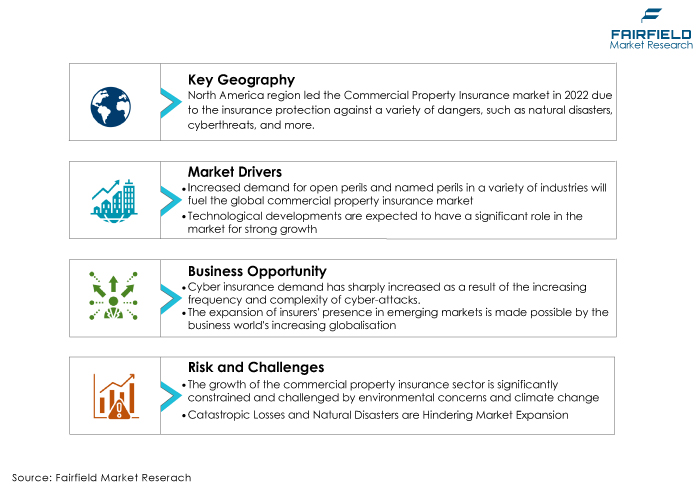
Technological developments are expected to have a significant role in the market for commercial property insurance's strong growth. The industry is undergoing a revolution thanks to the incorporation of cutting-edge technologies like Blockchain, Artificial Intelligence, machine learning, and data analytics. These developments are improving underwriting procedures, risk assessment precision, claims handling effectiveness, and operational agility in general.
By quickly analysing massive volumes of data to identify hazards, AI and machine learning algorithms enable insurers to customise policies and pricing based on accurate risk assessments. Digital platforms and IoT devices are also offering real-time property monitoring, enabling proactive risk management and allowing insurers to provide more flexible coverage alternatives.
Major Growth Barriers
- Climate Change, and Increasing Environmental Risks
The growth of the commercial property insurance sector is significantly constrained and challenged by environmental concerns and climate change. Extreme weather occurrences, such as hurricanes, floods, wildfires, and storms, are becoming more common and more severe, increasing the number and severity of insurance claims.
The capacity of insurers to offer coverage and preserve profitability is impacted by the greater payouts and probable financial losses brought on by this heightened risk. Furthermore, the long-term effects of climate change, such as sea level rise and altered weather patterns, are modifying risk assessment models, making it challenging to predict and value hazards.
- Catastrophic Losses, and Natural Disasters
Significant obstacles and limitations prevent the growth of the commercial property insurance market, including catastrophic losses and the rising frequency and severity of natural disasters. Events like hurricanes, earthquakes, floods, and wildfires cause an increase in insurance claims, which puts pressure on insurers' cash reserves and capability.
Large payouts from catastrophic occurrences may have an adverse effect on the viability and profitability of insurance providers, possibly resulting in stricter underwriting guidelines and higher premiums to cover losses. Additionally, insurers need more time to effectively estimate and price the risks due to the unpredictable nature of catastrophic failures and the rising costs associated with them, which restrains market expansion.
Key Trends and Opportunities to Look at
Cyber insurance demand has sharply increased as a result of the increasing frequency and complexity of cyber-attacks. Businesses from a variety of industries understand how crucial it is to protect their digital assets, sensitive data, and operations against cyber threats. As a result, insurance companies have a fantastic opportunity to diversify their product lines and build up thorough cyber risk coverage.
A variety of safeguards are included in cyber insurance, such as coverage for data breaches, ransomware attacks, business interruptions brought on by cyber catastrophes, legal costs, and administrative penalties. Insurance companies have the ability to design specialised policies that address certain sector risks and cyber threat environments.
- Global Expansion, and Emerging Markets
- Personalised and Usage-based Insurance Gains Traction
The expansion of insurers' presence in emerging markets is made possible by the business world's increasing globalisation. Businesses that grow globally confront a variety of hazards that call for specialised insurance coverage. The possibility for insurers to provide specialised insurance solutions that handle the distinct risks and problems related to doing business in various locations and nations.
Businesses frequently face unique risks in emerging markets due to political unpredictability, regulatory changes, currency volatility, and other region-specific issues. Insurance providers may create extensive coverage choices that reduce these risks, giving businesses the security they need to grow.
A tremendous opportunity for insurers to completely transform the way they deliver insurance solutions is presented by the integration of data analytics and IoT technologies. The adoption of use-based or behavior-based insurance models, where premiums are set in accordance with actual risk exposure and consumption patterns, is possible for insurers by utilising these technologies.
By better matching tips to substantial risk and usage, this change will ultimately benefit both the insurer and the insured. Insurance companies may gather a plethora of information on behavior, habits, and current conditions using IoT devices like telematics in cars, smart sensors in buildings, or wearables. The data can then be processed by advanced data analytics to reveal important information about the risk profile of a person or organisation.
How Does the Regulatory Scenario Shape this Industry?
Over the last three years, The regulatory environment has had a significant impact on how the commercial property insurance market develops. In order to ensure that insurers adhere to particular standards of financial stability, customer protection, and operational conduct, governing bodies produce regulations that specify the terms, conditions, and coverage needs of insurers.
To influence product offers, pricing, underwriting procedures, and risk assessment methodology, compliance with these regulations is essential. Additionally, by requiring new compliance standards, regulatory changes have a direct impact on insurers' ability to respond to emerging risks like climate change, cyber threats, or global health catastrophes.
Environmental, social, and governance (ESG) concerns are being incorporated by insurers into their operations and product offerings as rules supporting sustainable practices and socially conscious investing grow more prevalent.
Fairfield’s Ranking Board
Top Segments
Buildings insurance primarily covers the physical structure of commercial properties. Since the building itself is a substantial and valuable asset, insuring it against various risks such as fire, natural disasters, vandalism, and other perils is crucial. The high value of commercial buildings contributes to the prominence of buildings insurance.
For businesses, the commercial property, including the building, is often a core asset. It houses operations, inventory, equipment, and sometimes even intellectual property. Protecting this asset is a fundamental concern for businesses, and buildings insurance provides financial protection in the event of damage or destruction.
Many lenders require businesses to have buildings insurance as a condition for obtaining a mortgage or other forms of financing. Lenders want to ensure that their investment is protected, and buildings insurance helps mitigate the financial risk associated with property damage.
- The Open Perils Category Takes the Charge, Specialised Coverage in Demand
- SMEs Continue to Register the Topmost Consumer Sector
- The IT and Telecom Industry Maintains a Dominant Share
In the insurance market, the open dangers category still dominates the named perils divisions. Open perils, also known as all-risk coverage, provide a greater and more thorough level of protection by including a wide variety of risks unless specifically excluded by the policy. Because it offers protection against unanticipated disasters that a specified perils policy might not cover, this flexibility is very appealing to businesses and property owners.
Alternatively, designated perils coverage expressly covers a specific risk, offering a more focused but less adaptable strategy. The desire for open perils persists despite organisations' growing awareness of the necessity of complete coverage and adaptability to changing hazards. Furthermore, the named perils category is projected to experience the fastest market growth. Named hazard insurance, which specifically covers certain risks, is becoming more popular for a number of reasons.
Businesses are becoming more risk-aware and are looking for specialised insurance coverage for dangers that have been recognised, such as cyberattacks, natural catastrophes, or other perils. With this focused approach, they can customise their insurance to their unique risk profiles and lower premiums by omitting hazards they believe to be less important.
The small and medium enterprises segment dominated the market in 2022. SMEs often need specialised, specialised insurance solutions to fully safeguard their operations and assets because of their size and resources. The number of SMEs rises as economies expand and entrepreneurship flourishes, which helps to fuel a growth in demand for commercial property insurance.
As a result of realising this trend, insurers have created specialised products that are tailored to the varying risk profiles and financial limits of SMEs. Additionally, SMEs are forced to seek insurance coverage as a result of changing regulatory environments that need specific insurance for firms to operate legally, which is fueling the expansion of this market sector.
The large enterprises category is expected to experience the fastest growth within the forecast time frame. Large enterprises often have complex operations, substantial assets, and a wide range of risks to manage. As these businesses recognise the importance of comprehensive insurance coverage to safeguard their extensive investments, they are increasingly seeking specialised and tailored insurance solutions.
In 2022, the IT and telecom category led the market growth. The IT and telecom industry is at the forefront of technical development and digitisation, which comes with a distinct set of hazards. This industry has sophisticated infrastructure and priceless digital assets and is very vulnerable to cyber threats and business interruptions.
Businesses in the IT and telecom sectors are becoming increasingly aware of the pressing need for comprehensive insurance coverage as a result of the frequency and sophistication of cyber-attacks.
Moreover, the healthcare category is expected to grow fastest in the commercial property insurance market during the forecast period. The healthcare industry, marked by its critical role in society and the ever-evolving landscape, necessitates tailored insurance solutions to address specific risks associated with medical facilities, equipment, and patient care.
Regional Frontrunners
North America Retains Supremacy on Account of an Established Enterprise Culture of Insurance Protection
In the industries, commercial property insurance adoption is anticipated to dominate in the North American region. A number of reasons contribute to the region's supremacy in income generation, including a thriving insurance market with a broad range of insurers providing specialised commercial property insurance products.
Furthermore, North American companies frequently have intricate operations and priceless assets, necessitating thorough insurance protection against a variety of dangers, such as natural disasters, cyber threats, and more. Additionally, North American legislative frameworks frequently require or encourage enterprises to carry insurance, which raises the price of commercial property insurance. The size of the market is significant in part because of the region's increased risk awareness, and culture of risk reduction.
IT Industry’s Explosion Uplifts Long-term Growth Outlook of Asia Pacific
The region of Asia Pacific is expected to experience tremendous growth in the IT and telecom sectors during the projection period, and this expectation is well-founded. Asia Pacific has become a hotspot for technology advancement, digital change, and quick urbanisation on a global scale.
The need for cutting-edge technical products, internet access, and IT services is being driven by the region's expanding middle class, which has growing purchasing power. The development of the IT and telecom sector is also being fueled by government programs and investments in digital infrastructure, smart cities, and Industry 4.0 technology.
Fairfield’s Competitive Landscape Analysis
The global commercial property insurance market is a consolidated market with fewer major players present across the globe. The key players are introducing new products as well as working on the distribution channels to enhance their worldwide presence. Moreover, Fairfield Market Research is expecting the market to witness more consolidation over the coming years.
Who are the Leaders in the Global Commercial Property Insurance Space?
- Aegon Life Insurance Company Limited
- Allianz SE
- Aviva plc
- Axa S.A.
- Insureon (HUB International Limited)
- Nationwide Mutual Insurance Company
- Prudential Financial Inc.
- State Farm Mutual Automobile Insurance Company
- The Hartford Financial Services Group Inc.
Global Commercial Property Insurance Market is Segmented as Below:
By Type
- Buildings Insurance
- Contents Insurance
- Flood Insurance
- Earthquake Insurance
- Others
By Enterprise Size
- Small and Medium-sized Enterprises
- Large-Scale Enterprise
By Application
- Open Perils
- Named Perils
By Region
- North America
- Europe
- Asia Pacific
- Latin America
- Middle East & Africa
- Executive Summary
- Global Commercial Property Insurance Market Snapshot
- Future Projections
- Key Market Trends
- Regional Snapshot, by Value, 2026
- Analyst Recommendations
- Market Overview
- Market Definitions and Segmentations
- Market Dynamics
- Drivers
- Restraints
- Market Opportunities
- Value Chain Analysis
- COVID-19 Impact Analysis
- Porter's Five Forces Analysis
- Impact of Russia-Ukraine Conflict
- PESTLE Analysis
- Regulatory Analysis
- Price Trend Analysis
- Current Prices and Future Projections, 2025-2033
- Price Impact Factors
- Global Commercial Property Insurance Market Outlook, 2020 - 2033
- Global Commercial Property Insurance Market Outlook, by Type, Value (US$ Bn), 2020-2033
- Buildings Insurance
- Contents Insurance
- Flood Insurance
- Earthquake Insurance
- Global Commercial Property Insurance Market Outlook, by Enterprise Size, Value (US$ Bn), 2020-2033
- Small and Medium-sized Enterprises
- Large-Scale Enterprise
- Global Commercial Property Insurance Market Outlook, by Application, Value (US$ Bn), 2020-2033
- Open Perils
- Named Perils
- Global Commercial Property Insurance Market Outlook, by Region, Value (US$ Bn), 2020-2033
- North America
- Europe
- Asia Pacific
- Latin America
- Middle East & Africa
- Global Commercial Property Insurance Market Outlook, by Type, Value (US$ Bn), 2020-2033
- North America Commercial Property Insurance Market Outlook, 2020 - 2033
- North America Commercial Property Insurance Market Outlook, by Type, Value (US$ Bn), 2020-2033
- Buildings Insurance
- Contents Insurance
- Flood Insurance
- Earthquake Insurance
- North America Commercial Property Insurance Market Outlook, by Enterprise Size, Value (US$ Bn), 2020-2033
- Small and Medium-sized Enterprises
- Large-Scale Enterprise
- North America Commercial Property Insurance Market Outlook, by Application, Value (US$ Bn), 2020-2033
- Open Perils
- Named Perils
- North America Commercial Property Insurance Market Outlook, by Country, Value (US$ Bn), 2020-2033
- U.S. Commercial Property Insurance Market Outlook, by Type, 2020-2033
- U.S. Commercial Property Insurance Market Outlook, by Enterprise Size, 2020-2033
- U.S. Commercial Property Insurance Market Outlook, by Application, 2020-2033
- Canada Commercial Property Insurance Market Outlook, by Type, 2020-2033
- Canada Commercial Property Insurance Market Outlook, by Enterprise Size, 2020-2033
- Canada Commercial Property Insurance Market Outlook, by Application, 2020-2033
- BPS Analysis/Market Attractiveness Analysis
- North America Commercial Property Insurance Market Outlook, by Type, Value (US$ Bn), 2020-2033
- Europe Commercial Property Insurance Market Outlook, 2020 - 2033
- Europe Commercial Property Insurance Market Outlook, by Type, Value (US$ Bn), 2020-2033
- Buildings Insurance
- Contents Insurance
- Flood Insurance
- Earthquake Insurance
- Europe Commercial Property Insurance Market Outlook, by Enterprise Size, Value (US$ Bn), 2020-2033
- Small and Medium-sized Enterprises
- Large-Scale Enterprise
- Europe Commercial Property Insurance Market Outlook, by Application, Value (US$ Bn), 2020-2033
- Open Perils
- Named Perils
- Europe Commercial Property Insurance Market Outlook, by Country, Value (US$ Bn), 2020-2033
- Germany Commercial Property Insurance Market Outlook, by Type, 2020-2033
- Germany Commercial Property Insurance Market Outlook, by Enterprise Size, 2020-2033
- Germany Commercial Property Insurance Market Outlook, by Application, 2020-2033
- Italy Commercial Property Insurance Market Outlook, by Type, 2020-2033
- Italy Commercial Property Insurance Market Outlook, by Enterprise Size, 2020-2033
- Italy Commercial Property Insurance Market Outlook, by Application, 2020-2033
- France Commercial Property Insurance Market Outlook, by Type, 2020-2033
- France Commercial Property Insurance Market Outlook, by Enterprise Size, 2020-2033
- France Commercial Property Insurance Market Outlook, by Application, 2020-2033
- U.K. Commercial Property Insurance Market Outlook, by Type, 2020-2033
- U.K. Commercial Property Insurance Market Outlook, by Enterprise Size, 2020-2033
- U.K. Commercial Property Insurance Market Outlook, by Application, 2020-2033
- Spain Commercial Property Insurance Market Outlook, by Type, 2020-2033
- Spain Commercial Property Insurance Market Outlook, by Enterprise Size, 2020-2033
- Spain Commercial Property Insurance Market Outlook, by Application, 2020-2033
- Russia Commercial Property Insurance Market Outlook, by Type, 2020-2033
- Russia Commercial Property Insurance Market Outlook, by Enterprise Size, 2020-2033
- Russia Commercial Property Insurance Market Outlook, by Application, 2020-2033
- Rest of Europe Commercial Property Insurance Market Outlook, by Type, 2020-2033
- Rest of Europe Commercial Property Insurance Market Outlook, by Enterprise Size, 2020-2033
- Rest of Europe Commercial Property Insurance Market Outlook, by Application, 2020-2033
- BPS Analysis/Market Attractiveness Analysis
- Europe Commercial Property Insurance Market Outlook, by Type, Value (US$ Bn), 2020-2033
- Asia Pacific Commercial Property Insurance Market Outlook, 2020 - 2033
- Asia Pacific Commercial Property Insurance Market Outlook, by Type, Value (US$ Bn), 2020-2033
- Buildings Insurance
- Contents Insurance
- Flood Insurance
- Earthquake Insurance
- Asia Pacific Commercial Property Insurance Market Outlook, by Enterprise Size, Value (US$ Bn), 2020-2033
- Small and Medium-sized Enterprises
- Large-Scale Enterprise
- Asia Pacific Commercial Property Insurance Market Outlook, by Application, Value (US$ Bn), 2020-2033
- Open Perils
- Named Perils
- Asia Pacific Commercial Property Insurance Market Outlook, by Country, Value (US$ Bn), 2020-2033
- China Commercial Property Insurance Market Outlook, by Type, 2020-2033
- China Commercial Property Insurance Market Outlook, by Enterprise Size, 2020-2033
- China Commercial Property Insurance Market Outlook, by Application, 2020-2033
- Japan Commercial Property Insurance Market Outlook, by Type, 2020-2033
- Japan Commercial Property Insurance Market Outlook, by Enterprise Size, 2020-2033
- Japan Commercial Property Insurance Market Outlook, by Application, 2020-2033
- South Korea Commercial Property Insurance Market Outlook, by Type, 2020-2033
- South Korea Commercial Property Insurance Market Outlook, by Enterprise Size, 2020-2033
- South Korea Commercial Property Insurance Market Outlook, by Application, 2020-2033
- India Commercial Property Insurance Market Outlook, by Type, 2020-2033
- India Commercial Property Insurance Market Outlook, by Enterprise Size, 2020-2033
- India Commercial Property Insurance Market Outlook, by Application, 2020-2033
- Southeast Asia Commercial Property Insurance Market Outlook, by Type, 2020-2033
- Southeast Asia Commercial Property Insurance Market Outlook, by Enterprise Size, 2020-2033
- Southeast Asia Commercial Property Insurance Market Outlook, by Application, 2020-2033
- Rest of SAO Commercial Property Insurance Market Outlook, by Type, 2020-2033
- Rest of SAO Commercial Property Insurance Market Outlook, by Enterprise Size, 2020-2033
- Rest of SAO Commercial Property Insurance Market Outlook, by Application, 2020-2033
- BPS Analysis/Market Attractiveness Analysis
- Asia Pacific Commercial Property Insurance Market Outlook, by Type, Value (US$ Bn), 2020-2033
- Latin America Commercial Property Insurance Market Outlook, 2020 - 2033
- Latin America Commercial Property Insurance Market Outlook, by Type, Value (US$ Bn), 2020-2033
- Buildings Insurance
- Contents Insurance
- Flood Insurance
- Earthquake Insurance
- Latin America Commercial Property Insurance Market Outlook, by Enterprise Size, Value (US$ Bn), 2020-2033
- Small and Medium-sized Enterprises
- Large-Scale Enterprise
- Latin America Commercial Property Insurance Market Outlook, by Application, Value (US$ Bn), 2020-2033
- Open Perils
- Named Perils
- Latin America Commercial Property Insurance Market Outlook, by Country, Value (US$ Bn), 2020-2033
- Brazil Commercial Property Insurance Market Outlook, by Type, 2020-2033
- Brazil Commercial Property Insurance Market Outlook, by Enterprise Size, 2020-2033
- Brazil Commercial Property Insurance Market Outlook, by Application, 2020-2033
- Mexico Commercial Property Insurance Market Outlook, by Type, 2020-2033
- Mexico Commercial Property Insurance Market Outlook, by Enterprise Size, 2020-2033
- Mexico Commercial Property Insurance Market Outlook, by Application, 2020-2033
- Argentina Commercial Property Insurance Market Outlook, by Type, 2020-2033
- Argentina Commercial Property Insurance Market Outlook, by Enterprise Size, 2020-2033
- Argentina Commercial Property Insurance Market Outlook, by Application, 2020-2033
- Rest of LATAM Commercial Property Insurance Market Outlook, by Type, 2020-2033
- Rest of LATAM Commercial Property Insurance Market Outlook, by Enterprise Size, 2020-2033
- Rest of LATAM Commercial Property Insurance Market Outlook, by Application, 2020-2033
- BPS Analysis/Market Attractiveness Analysis
- Latin America Commercial Property Insurance Market Outlook, by Type, Value (US$ Bn), 2020-2033
- Middle East & Africa Commercial Property Insurance Market Outlook, 2020 - 2033
- Middle East & Africa Commercial Property Insurance Market Outlook, by Type, Value (US$ Bn), 2020-2033
- Buildings Insurance
- Contents Insurance
- Flood Insurance
- Earthquake Insurance
- Middle East & Africa Commercial Property Insurance Market Outlook, by Enterprise Size, Value (US$ Bn), 2020-2033
- Small and Medium-sized Enterprises
- Large-Scale Enterprise
- Middle East & Africa Commercial Property Insurance Market Outlook, by Application, Value (US$ Bn), 2020-2033
- Open Perils
- Named Perils
- Middle East & Africa Commercial Property Insurance Market Outlook, by Country, Value (US$ Bn), 2020-2033
- GCC Commercial Property Insurance Market Outlook, by Type, 2020-2033
- GCC Commercial Property Insurance Market Outlook, by Enterprise Size, 2020-2033
- GCC Commercial Property Insurance Market Outlook, by Application, 2020-2033
- South Africa Commercial Property Insurance Market Outlook, by Type, 2020-2033
- South Africa Commercial Property Insurance Market Outlook, by Enterprise Size, 2020-2033
- South Africa Commercial Property Insurance Market Outlook, by Application, 2020-2033
- Egypt Commercial Property Insurance Market Outlook, by Type, 2020-2033
- Egypt Commercial Property Insurance Market Outlook, by Enterprise Size, 2020-2033
- Egypt Commercial Property Insurance Market Outlook, by Application, 2020-2033
- Nigeria Commercial Property Insurance Market Outlook, by Type, 2020-2033
- Nigeria Commercial Property Insurance Market Outlook, by Enterprise Size, 2020-2033
- Nigeria Commercial Property Insurance Market Outlook, by Application, 2020-2033
- Rest of Middle East Commercial Property Insurance Market Outlook, by Type, 2020-2033
- Rest of Middle East Commercial Property Insurance Market Outlook, by Enterprise Size, 2020-2033
- Rest of Middle East Commercial Property Insurance Market Outlook, by Application, 2020-2033
- BPS Analysis/Market Attractiveness Analysis
- Middle East & Africa Commercial Property Insurance Market Outlook, by Type, Value (US$ Bn), 2020-2033
- Competitive Landscape
- Company Vs Segment Heatmap
- Company Market Share Analysis, 2025
- Competitive Dashboard
- Company Profiles
- Aegon Life Insurance Company Limited
- Company Overview
- Product Portfolio
- Financial Overview
- Business Strategies and Developments
- Allianz SE
- Aviva plc
- Axa S.A.
- Insureon (HUB International Limited)
- Nationwide Mutual Insurance Company
- Prudential Financial Inc.
- State Farm Mutual Automobile Insurance Company
- The Hartford Financial Services Group Inc.
- Aegon Life Insurance Company Limited
- Appendix
- Research Methodology
- Report Assumptions
- Acronyms and Abbreviations
|
BASE YEAR |
HISTORICAL DATA |
FORECAST PERIOD |
UNITS |
|||
 |
2025 |
 |
2020 - 2025 |
 |
2026 - 2033 |
Value: US$ Million |
Our Research Methodology
Considering the volatility of business today, traditional approaches to strategizing a game plan can be unfruitful if not detrimental. True ambiguity is no way to determine a forecast. A myriad of predetermined factors must be accounted for such as the degree of risk involved, the magnitude of circumstances, as well as conditions or consequences that are not known or unpredictable. To circumvent binary views that cast uncertainty, the application of market research intelligence to strategically posture, move, and enable actionable outcomes is necessary.
View Methodology
Quality Assured
Rigorous Validation Process

Confidentiality Assured
End-to-end Data Security

Custom Research Services
Tailored To Your Objectives
FAQs
The Commercial Property Insurance market size is valued at USD 358.2 billion in 2026.
The Commercial Property Insurance market is projected to grow at a CAGR of 10.8% by 2033.
The Commercial Property Insurance market growth is driven by rising commercial infrastructure investments, increasing awareness of risk management, and growing demand for comprehensive property protection.
North America is the dominant region in the Commercial Property Insurance market.
Allianz SE, AXA S.A., Aviva plc, Prudential Financial Inc., and The Hartford Financial Services Group Inc. are some of the leading industry players in the Commercial Property Insurance market.
Related Reports
Global AR Glasses Industry Analysis, Size, Share, Growth, Trends, Regional Outlook, and Forecast 2021-2025 - (By Type Coverage, By Industry Coverage, By Geography, By Company)
AR Glasses Market to grow from USD 2.4 Bn in 2026 to USD 38.2 Bn by 2033, registering a remarkable CAGR of 48.5% during the forecast period
Mentoring Software Market Insights, Competitive Landscape, and Market Forecast - 2033
Mentoring Software Market to grow from USD 981.3 Mn in 2026 to USD 2,790.1 Mn by 2033, registering a strong CAGR of 16.1%.
Micro-Fulfillment Market Insights, Competitive Landscape, and Market Forecast - 2033
The micro-fulfillment market to grow from USD 9.3 Bn in 2026 to USD 67.7 Bn by 2033, registering a robust CAGR of 32.8%
Electrical Control Panel Market Insights, Competitive Landscape, and Market Forecast - 2033
Electrical Control Panel Market to grow from USD 7.4 Bn in 2026 to USD 11.3 Bn by 2033, registering a CAGR of 6.2% during the forecast period
Blockchain in Insurance Market Insights, Competitive Landscape, and Market Forecast - 2033
Blockchain in Insurance Market to grow from USD 2.8 Bn in 2026 to USD 22.5 Bn by 2033, registering a robust CAGR of 34.7% during the forecast period
Video Conferencing Market Insights, Competitive Landscape, and Market Forecast - 2033
Video Conferencing Market to grow from USD 13.9 Bn in 2026 to USD 22.8 Bn by 2033, registering a 7.3% CAGR during the 2026–2033 forecast period.