



LegalTech Market
LegalTech Market Insights, Competitive Landscape, and Market Forecast - 2033
Global LegalTech Market Forecast
The LegalTech Market is expected to grow from USD 32.5 Billion in 2026 to USD 61.3 Billion by 2033, reflecting strong industry expansion and registering a CAGR of 9.5% during the forecast period from 2026 to 2033.
Quick Report Digest
A Look Back and a Look Forward - Comparative Analysis
A dynamic environment characterises the LegalTech industry, as strong adoption is motivated by the necessity to improve the efficacy of legal procedures. Legal technology solutions, specifically contract lifecycle tools and AI-powered case management software, are gathering traction internationally. Collaboration between legal professionals and technology providers is increasing on the market, highlighting the significance of innovation in legal services. Contract Lifecycle Management (CLM) solutions are in high demand; blockchain technology for secure contracts and AI-powered legal research are all significant developments.
The LegalTech industry has experienced substantial evolution throughout the years. In the past, the legal sector largely depended on conventional approaches, which resulted in inefficiencies and prolonged proceedings. The introduction of automation, data analytics, and cloud-based solutions in the form of LegalTech ushered in a paradigm shift. The progression has been characterised by the incremental integration of technology into legal procedures, which has resulted in enhanced efficiency and precision.
The LegalTech industry is positioned to experience sustained expansion in the coming years. Subsequent developments suggest that legal workflows will increasingly incorporate AI, machine learning, and advanced analytics. It is anticipated that the emphasis on data privacy and security will inspire additional developments, such as blockchain applications for the administration of legal documents. Anticipated developments in the future market include an abundance of technologically proficient legal practitioners and a more interconnected ecosystem that fosters cooperation and effectiveness throughout the legal sector.
Key Growth Determinants
- Technological Advancements Driving Innovation
The development of technology serves as the principal catalyst for the expansion of the LegalTech industry. The incorporation of state-of-the-art technologies into legal procedures, including blockchain, machine learning, and artificial intelligence (AI), is fundamentally transforming the operations of legal practitioners. Legal research tools propelled by AI improve the retrieval and analysis of information, thereby conserving attorneys' valuable time.
The utilisation of machine learning algorithms for contract analysis is on the rise, resulting in enhanced precision and effectiveness in the management of contracts. In addition, blockchain technology addresses concerns regarding data integrity by ensuring transparent and secure transactions. The continuous advancement and integration of these sophisticated technologies provide legal practitioners with the ability to optimise processes, minimise mistakes, and arrive at more knowledgeable judgments; thus, they contribute to the expansion of the LegalTech industry.
- Increasing Regulatory Complexity, and Compliance Demands
The increasing intricacy of legal regulations and the heightened priority for adherence motivate the implementation of LegalTech solutions. Legal departments operating within corporations and law firms encounter the formidable task of maneuvering through complex regulatory environments.
Legal technology tools, with a specific emphasis on contract lifecycle management, document management, and compliance monitoring, assist organisations in remaining updated on regulatory modifications and guaranteeing compliance with legal obligations.
The applications' automation functionalities effectively mitigate the likelihood of human error and bolster the precision of tasks pertaining to compliance. The expansion of the market is substantially influenced by the increasing demand for sophisticated LegalTech solutions as regulatory frameworks evolve and become more stringent.
- Need for Increased Efficiency, and Reduced Expenses
The pursuit of enhanced operational effectiveness and financial savings in the legal sector is a pivotal element driving the implementation of LegalTech solutions. Constant pressure is placed on law firms and corporate legal departments to provide superior legal services while minimising operational expenses. Legal technology (IT) applications, including billing and accounting software, e-discovery platforms, and case management systems, play a significant role in streamlining processes and optimising resources.
The implementation of automated processes, standardisation of documents, and enhanced collaboration tools afford legal professionals the opportunity to conserve both time and money. The need to increase overall productivity, decrease manual duties, and allocate resources more efficiently is the driving force behind the demand for these solutions, which positions efficiency as a key growth factor in the LegalTech market.
Major Growth Barriers
- Resistance to Technological Adoption
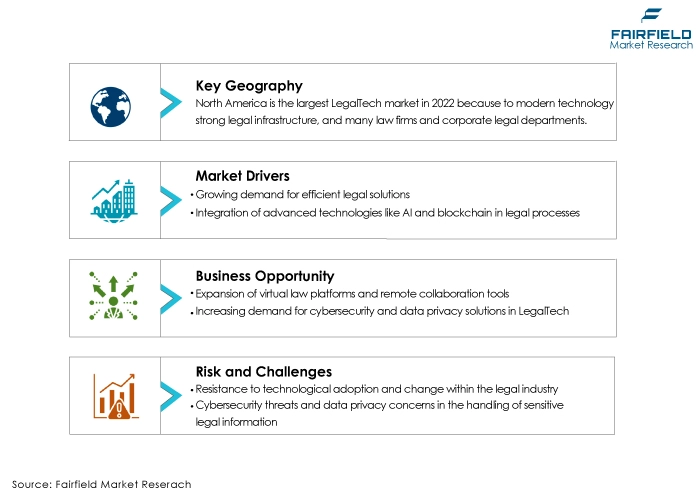
The reluctance of the legaltech industry to technological adoption and change is a significant restraint on the LegalTech market. The legal field, renowned for its time-honored methodologies, encounters obstacles when it comes to adopting and adjusting to emerging technologies.
Due to skepticism regarding the dependability of automated systems, concerns regarding job displacement, and the learning curve that accompanies new technologies, some legal professionals may be reluctant to adopt LegalTech solutions. The aforementioned opposition hinders the smooth incorporation of sophisticated technologies into legal processes, thereby decelerating the expansion of the LegalTech industry as a whole.
- Privacy and Data Security Concerns
Concerns regarding data privacy and security are a significant barrier to the widespread adoption of LegalTech solutions. Due to the management of sensitive and confidential information during legal proceedings, security is of the utmost importance. The incorporation of cloud-based solutions, although providing advantages in terms of accessibility and collaboration, gives rise to concerns regarding unauthorised access and data intrusions.
Legal organisations and specialists are vigilant in their efforts to protect client information and adhere to data protection regulations. It is crucial to address these concerns by implementing strong cybersecurity measures and assuring adherence to privacy laws. Doing so will enable us to overcome this limitation and promote increased trust in the implementation of LegalTech solutions.
Key Trends and Opportunities to Look at
Significantly influencing the LegalTech industry is the incorporation of Artificial Intelligence (AI), and sophisticated analytics. The efficacy of legal research, document analysis, and contract management is substantially enhanced by the use of AI-powered tools. Predictive analytics are made possible by machine learning algorithms, providing legal professionals with invaluable information to inform case strategy and decision-making.
This phenomenon not only optimises repetitive duties but also provides legal practitioners with intelligence derived from data, thereby revolutionising the manner in which legal services are rendered. Prospects exist in the advancement of progressively more intricate AI applications customised to distinct legal sectors, thereby affording vendors a competitive advantage and satisfying the ever-changing requirements of the legal industry.
- Cybersecurity and Data Privacy Solutions
- Popularity of Remote Collaboration Tools, and Virtual Law Platforms
The proliferation of digitalisation in legal processes has led to the emergence of cybersecurity, and data privacy solutions as pivotal developments within the LegalTech industry. Given that legal specialists are entrusted with vast quantities of sensitive and confidential data, data protection is of the utmost importance. Secure cloud-based platform development, encryption technology, and comprehensive cybersecurity protocols comprise the trend.
LegalTech vendors are presented with numerous prospects to offer all-encompassing solutions that guarantee the safeguarding of client information, adherence to data protection regulations, and preemptive measures against unauthorised access. The segment is expected to experience significant growth in demand for sophisticated solutions due to the increasing prominence of cybersecurity concerns.
The increasing prevalence of remote work has expedited the integration of virtual law platforms and tools for collaboration, thereby establishing a noteworthy trend and opportunity within the LegalTech industry. Legal professionals are progressively utilising virtual platforms for case management, document collaboration, and client meetings. This phenomenon creates opportunities for the creation of integrated, secure, and user-friendly virtual law platforms that promote smooth collaboration and communication.
The potential is in the development of solutions that provide a virtual setting that emulates the experience of face-to-face collaboration, all the while catering to the distinct requirements and security apprehensions of the legal sector. As more attorneys adopt remote work, it is anticipated that the market for innovative virtual law instruments will experience growth.
How Does the Regulatory Scenario Shape this Industry?
Strict regulatory standards govern the operation of the LegalTech market in order to guarantee the ethical application of technology in the legal sphere. Ensuring adherence to legal and data protection regulations is of the utmost importance when implementing advanced technologies, as it addresses concerns pertaining to client confidentiality, privacy, and ethical considerations.
Regulatory entities that establish guidelines are of the utmost importance, including regional legal authorities and the International Organisation for Standardisation (ISO). LegalTech vendors must adhere to these standards in order to establish credibility with legal professionals, safeguard data integrity, and promote responsible innovation in the ever-changing realm of legal technology.
Fairfield’s Ranking Board
Top Segments
In 2022, LegalTech software emerged as the prevailing market segment, propelled by its capacity for significant change. The incorporation of artificial intelligence, automation, and analytics into legal procedures improves decision-making and efficiency. Legal departments of corporations and law firms are investing more in software solutions that facilitate contract analysis, research, and case management. The demand for adaptable, technology-driven instruments establishes LegalTech Software as the market's principal catalyst.
The services sector exhibits the most rapid expansion within the LegalTech industry. Succeeding legal practitioners require specialised knowledge and assistance with the integration, education, and management of ever-changing legal technologies. Industry recognition of the necessity for comprehensive support is reflected in the increase in demand for consulting, training, and managed services.
The services segment flourishes in tandem with the expansion of LegalTech adoption, serving as a critical component in supporting organisations to optimise the advantages of technology integration and remain updated on developments in the industry.
- CLM Will Surge Ahead of Other LegalTech Type Segments
- Law Firms Remain the Most Prominent End Users
In 2022, contract lifecycle management's (CLM) dominant position in the LegalTech industry is due to the contract-centric nature of legal operations. By streamlining the contract creation, negotiation, and management processes, CLM solutions reduce risks and ensure compliance. As the complexity of business agreements rises, so does the need for effective CLM instruments; consequently, this sector dominates the LegalTech industry.
The rapid expansion of the Document Management sector within the LegalTech industry can be attributed to the industry's shift towards electronic documentation. Advance document management solutions are adopted due to the necessity for the secure and structured storage, retrieval, and sharing of legal documents.
With the increasing emphasis on efficiency among legal professionals in managing large quantities of information, the Document Management sector is experiencing substantial expansion. In response to the changing demands of the industry, this sector introduces cutting-edge functionalities and improved collaboration instruments.
Law firms will emerge as the main end users in the LegalTech sector in 2022, fuelled by an increasing emphasis on efficiency, productivity, and data-driven decision-making within legal practices. In order to streamline workflows and accommodate the intricacy of cases, law firms make substantial investments in LegalTech solutions. By utilising sophisticated software for case management, legal research, and document automation, law firms establish themselves as the market leaders in the adoption of LegalTech.
The corporate legal department sector is distinguished as the LegalTech industry's most rapidly expanding division. LegalTech is widely acknowledged by the corporate sector for its ability to effectively administer a wide range of legal functions, including contract management and compliance.
The growing quantity and intricacy of legal obligations performed by businesses stimulates the need for specialised LegalTech solutions. The rapid growth of LegalTech solution adoption by corporate legal departments, driven by the objective of improving operational efficiency and cost reduction, positions this segment as the most rapidly expanding in the market.
Regional Frontrunners
North America to be the Prime Regional Market
The legalTech market size will most notably be concentrated in North America in 2022, a region characterised by substantial investments, mature legal ecosystems, and early technology adoption. Legal professionals in the region enthusiastically adopt cutting-edge technologies to manage cases, conduct e-discovery, and analyse contracts, thereby making substantial contributions to the expansion of the market.
Due to a culture of innovation and high demand from law firms and corporate legal departments, North America is the dominant region in the global LegalTech market. Constant technological progress, and collaborative efforts serve to reinforce the region's pre-eminent position in influencing the course of the LegalTech sector.
Asia Pacific Likely to Benefit from a Surging Tide of Digital Transformation
Asia Pacific arises as the region with the most rapid growth in the legal tech industry during the coming years due to the convergence of a number of factors. A surge in digital transformation is observed in the region as both governments and enterprises make substantial investments in technology.
A growing awareness of the advantages of LegalTech, the emergence of new entrants, and legal reforms all contribute to the market's explosive growth. By virtue of its varied legal environment and rising need for streamlined legal solutions, Asia Pacific is a significant contributor to the expansion of the LegalTech industry as a whole.
Fairfield’s Competitive Landscape Analysis
In the dynamic LegalTech market, competition is fierce, and a multitude of vendors present an array of solutions. Prominent entities are consistently engaging in innovative practices to satisfy the ever-changing demands of corporate legal departments and law firms. The environment is distinguished by a combination of well-established industry frontrunners and budding businesses, which promotes rivalry and propels technological progress.
Who are the Leaders in Global LegalTech Space?
- Icertis, Inc.
- Filevine Inc.
- DocuSign, Inc.
- Casetext Inc.
- ProfitSolv, LLC
- Knovos, LLC
- Mystacks, Inc.
Segmentation:
By Solution
- Software
- Services
By Type
- E-discovery
- Legal Research
- Practice Management
- Analytics
- Compliance
- Document Management
By End Use
- Law Firms
- Corporate Legal Departments
- Government & Public Sector
- Others
By Region
- North America
- Europe
- Asia Pacific
- Latin America
- Middle East & Africa
- Executive Summary
- Global LegalTech Market Snapshot
- Future Projections
- Key Market Trends
- Regional Snapshot, by Value, 2026
- Analyst Recommendations
- Market Overview
- Market Definitions and Segmentations
- Market Dynamics
- Drivers
- Restraints
- Market Opportunities
- Value Chain Analysis
- COVID-19 Impact Analysis
- Porter's Five Forces Analysis
- Impact of Russia-Ukraine Conflict
- PESTLE Analysis
- Regulatory Analysis
- Price Trend Analysis
- Current Prices and Future Projections, 2025-2033
- Price Impact Factors
- Global LegalTech Market Outlook, 2020 - 2033
- Global LegalTech Market Outlook, by Solution, Value (US$ Bn), 2020-2033
- Software
- Services
- Global LegalTech Market Outlook, by Type, Value (US$ Bn), 2020-2033
- E-discovery
- Legal Research
- Practice Management
- Analytics
- Compliance
- Document Management
- Global LegalTech Market Outlook, by End Use, Value (US$ Bn), 2020-2033
- Law Firms
- Corporate Legal Departments
- Government & Public Sector
- Others
- Global LegalTech Market Outlook, by Region, Value (US$ Bn), 2020-2033
- North America
- Europe
- Asia Pacific
- Latin America
- Middle East & Africa
- Global LegalTech Market Outlook, by Solution, Value (US$ Bn), 2020-2033
- North America LegalTech Market Outlook, 2020 - 2033
- North America LegalTech Market Outlook, by Solution, Value (US$ Bn), 2020-2033
- Software
- Services
- North America LegalTech Market Outlook, by Type, Value (US$ Bn), 2020-2033
- E-discovery
- Legal Research
- Practice Management
- Analytics
- Compliance
- Document Management
- North America LegalTech Market Outlook, by End Use, Value (US$ Bn), 2020-2033
- Law Firms
- Corporate Legal Departments
- Government & Public Sector
- Others
- North America LegalTech Market Outlook, by Country, Value (US$ Bn), 2020-2033
- U.S. LegalTech Market Outlook, by Solution, 2020-2033
- U.S. LegalTech Market Outlook, by Type, 2020-2033
- U.S. LegalTech Market Outlook, by End Use, 2020-2033
- Canada LegalTech Market Outlook, by Solution, 2020-2033
- Canada LegalTech Market Outlook, by Type, 2020-2033
- Canada LegalTech Market Outlook, by End Use, 2020-2033
- BPS Analysis/Market Attractiveness Analysis
- North America LegalTech Market Outlook, by Solution, Value (US$ Bn), 2020-2033
- Europe LegalTech Market Outlook, 2020 - 2033
- Europe LegalTech Market Outlook, by Solution, Value (US$ Bn), 2020-2033
- Software
- Services
- Europe LegalTech Market Outlook, by Type, Value (US$ Bn), 2020-2033
- E-discovery
- Legal Research
- Practice Management
- Analytics
- Compliance
- Document Management
- Europe LegalTech Market Outlook, by End Use, Value (US$ Bn), 2020-2033
- Law Firms
- Corporate Legal Departments
- Government & Public Sector
- Others
- Europe LegalTech Market Outlook, by Country, Value (US$ Bn), 2020-2033
- Germany LegalTech Market Outlook, by Solution, 2020-2033
- Germany LegalTech Market Outlook, by Type, 2020-2033
- Germany LegalTech Market Outlook, by End Use, 2020-2033
- Italy LegalTech Market Outlook, by Solution, 2020-2033
- Italy LegalTech Market Outlook, by Type, 2020-2033
- Italy LegalTech Market Outlook, by End Use, 2020-2033
- France LegalTech Market Outlook, by Solution, 2020-2033
- France LegalTech Market Outlook, by Type, 2020-2033
- France LegalTech Market Outlook, by End Use, 2020-2033
- U.K. LegalTech Market Outlook, by Solution, 2020-2033
- U.K. LegalTech Market Outlook, by Type, 2020-2033
- U.K. LegalTech Market Outlook, by End Use, 2020-2033
- Spain LegalTech Market Outlook, by Solution, 2020-2033
- Spain LegalTech Market Outlook, by Type, 2020-2033
- Spain LegalTech Market Outlook, by End Use, 2020-2033
- Russia LegalTech Market Outlook, by Solution, 2020-2033
- Russia LegalTech Market Outlook, by Type, 2020-2033
- Russia LegalTech Market Outlook, by End Use, 2020-2033
- Rest of Europe LegalTech Market Outlook, by Solution, 2020-2033
- Rest of Europe LegalTech Market Outlook, by Type, 2020-2033
- Rest of Europe LegalTech Market Outlook, by End Use, 2020-2033
- BPS Analysis/Market Attractiveness Analysis
- Europe LegalTech Market Outlook, by Solution, Value (US$ Bn), 2020-2033
- Asia Pacific LegalTech Market Outlook, 2020 - 2033
- Asia Pacific LegalTech Market Outlook, by Solution, Value (US$ Bn), 2020-2033
- Software
- Services
- Asia Pacific LegalTech Market Outlook, by Type, Value (US$ Bn), 2020-2033
- E-discovery
- Legal Research
- Practice Management
- Analytics
- Compliance
- Document Management
- Asia Pacific LegalTech Market Outlook, by End Use, Value (US$ Bn), 2020-2033
- Law Firms
- Corporate Legal Departments
- Government & Public Sector
- Others
- Asia Pacific LegalTech Market Outlook, by Country, Value (US$ Bn), 2020-2033
- China LegalTech Market Outlook, by Solution, 2020-2033
- China LegalTech Market Outlook, by Type, 2020-2033
- China LegalTech Market Outlook, by End Use, 2020-2033
- Japan LegalTech Market Outlook, by Solution, 2020-2033
- Japan LegalTech Market Outlook, by Type, 2020-2033
- Japan LegalTech Market Outlook, by End Use, 2020-2033
- South Korea LegalTech Market Outlook, by Solution, 2020-2033
- South Korea LegalTech Market Outlook, by Type, 2020-2033
- South Korea LegalTech Market Outlook, by End Use, 2020-2033
- India LegalTech Market Outlook, by Solution, 2020-2033
- India LegalTech Market Outlook, by Type, 2020-2033
- India LegalTech Market Outlook, by End Use, 2020-2033
- Southeast Asia LegalTech Market Outlook, by Solution, 2020-2033
- Southeast Asia LegalTech Market Outlook, by Type, 2020-2033
- Southeast Asia LegalTech Market Outlook, by End Use, 2020-2033
- Rest of SAO LegalTech Market Outlook, by Solution, 2020-2033
- Rest of SAO LegalTech Market Outlook, by Type, 2020-2033
- Rest of SAO LegalTech Market Outlook, by End Use, 2020-2033
- BPS Analysis/Market Attractiveness Analysis
- Asia Pacific LegalTech Market Outlook, by Solution, Value (US$ Bn), 2020-2033
- Latin America LegalTech Market Outlook, 2020 - 2033
- Latin America LegalTech Market Outlook, by Solution, Value (US$ Bn), 2020-2033
- Software
- Services
- Latin America LegalTech Market Outlook, by Type, Value (US$ Bn), 2020-2033
- E-discovery
- Legal Research
- Practice Management
- Analytics
- Compliance
- Document Management
- Latin America LegalTech Market Outlook, by End Use, Value (US$ Bn), 2020-2033
- Law Firms
- Corporate Legal Departments
- Government & Public Sector
- Others
- Latin America LegalTech Market Outlook, by Country, Value (US$ Bn), 2020-2033
- Brazil LegalTech Market Outlook, by Solution, 2020-2033
- Brazil LegalTech Market Outlook, by Type, 2020-2033
- Brazil LegalTech Market Outlook, by End Use, 2020-2033
- Mexico LegalTech Market Outlook, by Solution, 2020-2033
- Mexico LegalTech Market Outlook, by Type, 2020-2033
- Mexico LegalTech Market Outlook, by End Use, 2020-2033
- Argentina LegalTech Market Outlook, by Solution, 2020-2033
- Argentina LegalTech Market Outlook, by Type, 2020-2033
- Argentina LegalTech Market Outlook, by End Use, 2020-2033
- Rest of LATAM LegalTech Market Outlook, by Solution, 2020-2033
- Rest of LATAM LegalTech Market Outlook, by Type, 2020-2033
- Rest of LATAM LegalTech Market Outlook, by End Use, 2020-2033
- BPS Analysis/Market Attractiveness Analysis
- Latin America LegalTech Market Outlook, by Solution, Value (US$ Bn), 2020-2033
- Middle East & Africa LegalTech Market Outlook, 2020 - 2033
- Middle East & Africa LegalTech Market Outlook, by Solution, Value (US$ Bn), 2020-2033
- Software
- Services
- Middle East & Africa LegalTech Market Outlook, by Type, Value (US$ Bn), 2020-2033
- E-discovery
- Legal Research
- Practice Management
- Analytics
- Compliance
- Document Management
- Middle East & Africa LegalTech Market Outlook, by End Use, Value (US$ Bn), 2020-2033
- Law Firms
- Corporate Legal Departments
- Government & Public Sector
- Others
- Middle East & Africa LegalTech Market Outlook, by Country, Value (US$ Bn), 2020-2033
- GCC LegalTech Market Outlook, by Solution, 2020-2033
- GCC LegalTech Market Outlook, by Type, 2020-2033
- GCC LegalTech Market Outlook, by End Use, 2020-2033
- South Africa LegalTech Market Outlook, by Solution, 2020-2033
- South Africa LegalTech Market Outlook, by Type, 2020-2033
- South Africa LegalTech Market Outlook, by End Use, 2020-2033
- Egypt LegalTech Market Outlook, by Solution, 2020-2033
- Egypt LegalTech Market Outlook, by Type, 2020-2033
- Egypt LegalTech Market Outlook, by End Use, 2020-2033
- Nigeria LegalTech Market Outlook, by Solution, 2020-2033
- Nigeria LegalTech Market Outlook, by Type, 2020-2033
- Nigeria LegalTech Market Outlook, by End Use, 2020-2033
- Rest of Middle East LegalTech Market Outlook, by Solution, 2020-2033
- Rest of Middle East LegalTech Market Outlook, by Type, 2020-2033
- Rest of Middle East LegalTech Market Outlook, by End Use, 2020-2033
- BPS Analysis/Market Attractiveness Analysis
- Middle East & Africa LegalTech Market Outlook, by Solution, Value (US$ Bn), 2020-2033
- Competitive Landscape
- Company Vs Segment Heatmap
- Company Market Share Analysis, 2025
- Competitive Dashboard
- Company Profiles
- Icertis, Inc.
- Company Overview
- Product Portfolio
- Financial Overview
- Business Strategies and Developments
- Filevine Inc.
- DocuSign, Inc.
- Casetext Inc.
- ProfitSolv, LLC
- Knovos, LLC
- Mystacks, Inc.
- Icertis, Inc.
- Appendix
- Research Methodology
- Report Assumptions
- Acronyms and Abbreviations
|
BASE YEAR |
HISTORICAL DATA |
FORECAST PERIOD |
UNITS |
|||
 |
2025 |
 |
2020 - 2025 |
 |
2026 - 2033 |
Value: US$ Million |
Our Research Methodology
Considering the volatility of business today, traditional approaches to strategizing a game plan can be unfruitful if not detrimental. True ambiguity is no way to determine a forecast. A myriad of predetermined factors must be accounted for such as the degree of risk involved, the magnitude of circumstances, as well as conditions or consequences that are not known or unpredictable. To circumvent binary views that cast uncertainty, the application of market research intelligence to strategically posture, move, and enable actionable outcomes is necessary.
View Methodology
Quality Assured
Rigorous Validation Process

Confidentiality Assured
End-to-end Data Security

Custom Research Services
Tailored To Your Objectives
FAQs
The LegalTech market size is USD 32.5 billion in 2026.
The LegalTech market is projected to grow at a CAGR of 9.5% by 2033.
The LegalTech market growth is driven by increasing adoption of AI-powered legal solutions, growing demand for legal process automation, and rising regulatory compliance requirements.
North America is the dominant region in the LegalTech market.
Icertis, Inc., Filevine Inc., DocuSign, Inc., Casetext Inc., and ProfitSolv, LLC are some of the leading industry players in the LegalTech market.
Related Reports
Global AR Glasses Industry Analysis, Size, Share, Growth, Trends, Regional Outlook, and Forecast 2021-2025 - (By Type Coverage, By Industry Coverage, By Geography, By Company)
AR Glasses Market to grow from USD 2.4 Bn in 2026 to USD 38.2 Bn by 2033, registering a remarkable CAGR of 48.5% during the forecast period
Mentoring Software Market Insights, Competitive Landscape, and Market Forecast - 2033
Mentoring Software Market to grow from USD 981.3 Mn in 2026 to USD 2,790.1 Mn by 2033, registering a strong CAGR of 16.1%.
Micro-Fulfillment Market Insights, Competitive Landscape, and Market Forecast - 2033
The micro-fulfillment market to grow from USD 9.3 Bn in 2026 to USD 67.7 Bn by 2033, registering a robust CAGR of 32.8%
Electrical Control Panel Market Insights, Competitive Landscape, and Market Forecast - 2033
Electrical Control Panel Market to grow from USD 7.4 Bn in 2026 to USD 11.3 Bn by 2033, registering a CAGR of 6.2% during the forecast period
Blockchain in Insurance Market Insights, Competitive Landscape, and Market Forecast - 2033
Blockchain in Insurance Market to grow from USD 2.8 Bn in 2026 to USD 22.5 Bn by 2033, registering a robust CAGR of 34.7% during the forecast period
Video Conferencing Market Insights, Competitive Landscape, and Market Forecast - 2033
Video Conferencing Market to grow from USD 13.9 Bn in 2026 to USD 22.8 Bn by 2033, registering a 7.3% CAGR during the 2026–2033 forecast period.