



Catheter Market
Catheter Market Insights, Competitive Landscape, and Market Forecast - 2033
Global Catheter Market Forecast
- Global catheter market size poised to reach USD 93.2 Bn in 2033, up from USD 56.1 Bn attained in 2026.
- Catheter market revenue likely to expand at a CAGR of 8% between 2026 and 2033.
Major Report Findings - Fairfield's Perspective
Key Growth Determinants
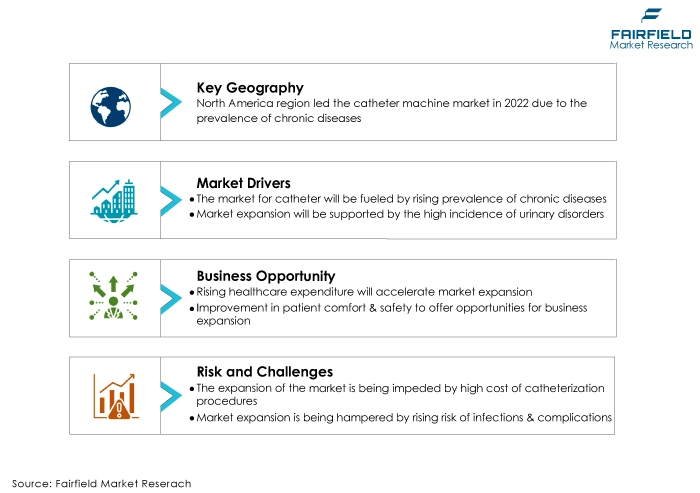
- Rising Prevalence of Chronic Diseases
Chronic diseases like cardiovascular diseases, diabetes, and urinary tract disorders have become increasingly common worldwide. Catheters play a crucial role in the diagnosis, treatment, and management of these conditions. The growing ageing population and unhealthy lifestyles contribute to the higher incidence of chronic diseases, necessitating a greater demand for catheters.
Moreover, advancements in catheter technology, including the development of minimally invasive procedures, have made catheterisation safer and more effective, further boosting their usage in chronic disease management.
As the global population continues to age and the prevalence of chronic diseases continues to rise, the demand for catheters is expected to remain strong, driving the growth of the global catheter market.
- Continuous Innovations in Catheter Materials and Procedures
The innovations are driven by a growth in demand for minimally invasive procedures and the need for safer and more efficient catheterisation techniques.
Advancements in materials have led to the development of catheters with improved biocompatibility, flexibility, and durability. These materials reduce the risk of infection and consequences while also improving patient comfort. These advancements have expanded the range of medical applications for catheters, including cardiology, urology, and gastroenterology, driving market growth.
Moreover, ongoing research and development efforts continue to refine catheter technologies, promising even more breakthroughs in the future, which will further boost market expansion.
- High Incidence of Urinary Disorders
Urinary disorders, such as urinary incontinence, urinary retention, and urinary tract infections, are prevalent worldwide, affecting billions of individuals across various age groups.
Factors like ageing, chronic diseases, neurological disorders, and post-surgical complications can cause these conditions. With growth in the aged population and the rising prevalence of chronic diseases, the share of catheters is expected to rise.
Furthermore, the creation of more efficient and pleasant catheter designs has been made possible by technical developments, improving patient comfort and lowering problems. Catheters play a major role in the management and treatment of these urinary disorders.
Major Growth Barriers
- High Cost of Catheterisation Procedures
The expenses encompass healthcare services, such as medical personnel, facility charges, and diagnostic tests. For patients and healthcare systems, the financial burden can be substantial, limiting access to catheterisation procedures and potentially delaying necessary medical interventions.
The cost barrier restricts market growth by reducing patient demand and hindering healthcare providers' ability to invest in advanced catheter technologies, ultimately impeding the market's expansion.
- Potential Risk of Infections, and Complications
Healthcare providers and manufacturers are continually striving to develop infection-resistant catheter materials and improved insertion techniques to mitigate the risks and enhance patient safety in catheterisation procedures.
Prolonged catheterisation can lead to urinary tract infections, bloodstream infections, and other complications, posing a serious threat to patient health. These complications not only result in increased healthcare costs but also diminish the overall effectiveness of catheter-based treatments.
Key Trends and Opportunities to Look at
As countries allocate more resources to their healthcare systems, there is a growth in demand for advanced medical devices like catheters, which are essential for various diagnostic and therapeutic procedures. Higher healthcare spending enables hospitals and healthcare facilities to invest in cutting-edge catheter technologies, improving patient care and outcomes.
- Industry’s Emphasis on Improved Patient Comfort and Safety
- Sophistication of Healthcare Infrastructure
Advancements in catheter design and materials have led to smoother insertion processes, reduced discomfort, and minimised tissue damage during placement. These developments not only improve the overall patient experience but also contribute to better healthcare outcomes, making catheters a vital tool in modern medical practice and driving their widespread adoption.
As healthcare systems expand and improve, there is an increasing demand for medical devices like catheters. These essential tools are crucial for various diagnostic and therapeutic procedures, making them indispensable in modern healthcare settings. The growing healthcare infrastructure fosters accessibility to advanced medical services, which, in turn, drives the adoption of catheters, contributing to market growth.
How Does the Regulatory Scenario Shape this Industry?
Over the last three years, the regulatory landscape in the catheter industry has aimed to strike a balance between innovation and patient safety, assuring healthcare providers and patients alike that these critical medical devices meet rigorous standards before entering the market.
One of the most influential regulatory bodies is the US FDA, which sets rigorous standards for catheter safety, efficacy, and quality, ensuring that these medical devices meet stringent requirements before they are approved for market entry. This stringent oversight helps enhance patient safety and confidence in catheter-related procedures.
The European Union Medical Device Regulation introduced stricter regulations and increased transparency in the approval process for medical devices, including catheters, within the European Union. It has led to a higher level of scrutiny and standardised evaluation criteria for catheters, fostering innovation and product quality. Complying with these regulations is paramount for catheter manufacturers to succeed in this dynamic and highly regulated industry.
Fairfield’s Ranking Borad
Top Segments
The cardiovascular segment dominated the market in 2022. They are specifically designed for procedures related to the heart, and blood vessels. Catheters play a major role in the entire process of diagnosing and treating various cardiovascular conditions.
This category includes a wide range of catheters, such as angioplasty catheters, guiding catheters, electrophysiology catheters, and intravascular ultrasound catheters. These catheters are vital tools in interventions like angiography, angioplasty, and stent placement.
Furthermore, the specialty category is projected to experience the fastest market growth. It covers a diverse range of catheters designed for specific medical applications beyond cardiovascular procedures. This category includes catheters like urinary catheters, neurovascular catheters, and intrathecal catheters. These specialty catheters cater to a wide array of medical needs across various disciplines.
- Hospital Stores Account for Higher Revenue Generation
In 2022, the hospital's stores category dominated the industry. They are the primary source of catheter procurement, as they require a steady supply for various medical procedures and patient care. Catheters are utilised in a wide range of medical settings within hospitals, including surgery, critical care units, and general patient wards. Hospitals often establish long-term contracts with catheter suppliers to ensure reliable supply of these essential medical devices.
The retail stores category is anticipated to grow substantially throughout the projected period. These stores typically cater to individuals who require catheters for personal use at home. Retail outlets offer convenience and accessibility for patients and caregivers, allowing them to purchase catheters over the counter without the need for a prescription in some regions. Retail stores may carry a variety of catheter types and sizes, making them a convenient option for those seeking catheters for intermittent self-catheterisation or other medical needs.
Regional Frontrunners
North America’s Leadership Sustains
In the medical devices industry, catheter adoption is anticipated to dominate in the North American region. The advanced healthcare infrastructure, high healthcare expenditure, prevalence of chronic diseases, ageing population, and robust healthcare system helped drive market expansion in the area.
The US is a dominant market within North America, driven by technological advancements, a growing geriatric population, and a high demand for minimally invasive procedures. Additionally, Canada also contributes to the regional market with its increasing healthcare investments. Overall, North America is expected to continue witnessing steady growth in the catheter market due to these factors.
Major Gains for Asia Pacific from an Expanding Ageing Population
The increase in healthcare infrastructure, rapid economic growth, and an ageing population are driving expansion in the Asia Pacific catheter market. Countries like China, India, and Japan are witnessing substantial growth in the catheter market due to rising chronic diseases and surgical procedures.
Furthermore, favourable government initiatives, and increasing awareness about minimally invasive procedures are driving the adoption of catheters. Asia Pacific is expected to continue its robust growth trajectory in the catheter market, with increasing investments in healthcare, and ongoing technological advancements.
As healthcare standards improve and healthcare expenditure rises, the region is likely to play an increasingly significant role in the global catheter market's expansion.
Fairfield’s Competitive Landscape Analysis
The global catheter market is a consolidated market with fewer major players present across the globe. The key players focus on product innovation, strategic mergers, and geographical spreading to gain a competitive edge. The market also witnesses the emergence of smaller players offering specialised catheter solutions. Regulatory compliance, product quality, and cost-effective manufacturing processes are critical factors influencing competitiveness in this dynamic market.
Who are the Leaders in the Global Catheter Space?
- Medtronic
- Edwards Lifesciences Corporation
- Teleflex Incorporated
- Abbott
- Braun Melsungen AG
- Becton, Dickinson and Company
- Boston Scientific Corporation
- ConvaTec Group
- Coloplast
- Johnson & Johnson Services
- Terumo Corporation
- Hollister Incorporated
- Stryker
- Cook Medical
- Merit Medical Systems
- amg International GmbH
- Simeks Tibbi Ürünler
- Alvimedica
- Medinol
- Amsino International
An Expert’s Eye
Demand and Future Growth
The increasing demand for minimally invasive medical procedures, a growing ageing population, and rising prevalence of chronic diseases are driving the market. Additionally, emerging markets and expanding applications in various medical fields, including cardiology, urology, and neurology are likely to fuel future growth. With the continuous evolution of healthcare practices, the global catheter market is anticipated to experience robust expansion in the foreseeable future.
Supply Side of the Market
According to our analysis, the US is the major manufacturer and adopter of catheter due to technological advancements, growing geriatric population and high demand for minimally invasive procedures. For instance, in April 2021, the Emprint ablation catheter kit achieved "Breakthrough Device Designation" status from the US FDA. It is an innovative device that has not been authorised in the US. The catheter is intended for use with the Emprint microwave generator and the Medtronic lung navigation platform to offer minimally invasive, localised treatment of malignant lung lesions. It can also be used in combination with standard care therapy.
Canada also contributes to the market by making more healthcare investments. Countries such as China, India, and Japan are also the major manufacturers in the catheter market due to the growth in chronic diseases and surgical procedures, increasing investments in healthcare and ongoing technological advancements. As healthcare standards improve and healthcare expenditure rises, the market for catheters also increases globally.
The Global Catheter Market is Segmented as Below:
By Product Type:
- Cardiovascular
- Urology
- Intravenous
- Neurovascular
- Specialty Catheters
By Distribution Channel:
- Hospitals Stores
- Retail Stores
- Others
By Geographic Coverage:
- North America
- Europe
- Asia Pacific
- Latin America
- Middle East & Africa
- Executive Summary
- Global Catheter Market Snapshot
- Future Projections
- Key Market Trends
- Regional Snapshot, by Value, 2026
- Analyst Recommendations
- Market Overview
- Market Definitions and Segmentations
- Market Dynamics
- Drivers
- Restraints
- Market Opportunities
- Value Chain Analysis
- COVID-19 Impact Analysis
- Porter's Five Forces Analysis
- Impact of Russia-Ukraine Conflict
- PESTLE Analysis
- Regulatory Analysis
- Price Trend Analysis
- Current Prices and Future Projections, 2025-2033
- Price Impact Factors
- Global Catheter Market Outlook, 2020 - 2033
- Global Catheter Market Outlook, by Product Type, Value (US$ Mn), 2020-2033
- Cardiovascular
- Urology
- Intravenous
- Neurovascular
- Specialty Catheters
- Global Catheter Market Outlook, by Distribution Channel, Value (US$ Mn), 2020-2033
- Hospitals Stores
- Retail Stores
- Others
- Global Catheter Market Outlook, by Region, Value (US$ Mn), 2020-2033
- North America
- Europe
- Asia Pacific
- Latin America
- Middle East & Africa
- Global Catheter Market Outlook, by Product Type, Value (US$ Mn), 2020-2033
- North America Catheter Market Outlook, 2020 - 2033
- North America Catheter Market Outlook, by Product Type, Value (US$ Mn), 2020-2033
- Cardiovascular
- Urology
- Intravenous
- Neurovascular
- Specialty Catheters
- North America Catheter Market Outlook, by Distribution Channel, Value (US$ Mn), 2020-2033
- Hospitals Stores
- Retail Stores
- Others
- North America Catheter Market Outlook, by Country, Value (US$ Mn), 2020-2033
- S. Catheter Market Outlook, by Product Type, 2020-2033
- S. Catheter Market Outlook, by Distribution Channel, 2020-2033
- Canada Catheter Market Outlook, by Product Type, 2020-2033
- Canada Catheter Market Outlook, by Distribution Channel, 2020-2033
- BPS Analysis/Market Attractiveness Analysis
- North America Catheter Market Outlook, by Product Type, Value (US$ Mn), 2020-2033
- Europe Catheter Market Outlook, 2020 - 2033
- Europe Catheter Market Outlook, by Product Type, Value (US$ Mn), 2020-2033
- Cardiovascular
- Urology
- Intravenous
- Neurovascular
- Specialty Catheters
- Europe Catheter Market Outlook, by Distribution Channel, Value (US$ Mn), 2020-2033
- Hospitals Stores
- Retail Stores
- Others
- Europe Catheter Market Outlook, by Country, Value (US$ Mn), 2020-2033
- Germany Catheter Market Outlook, by Product Type, 2020-2033
- Germany Catheter Market Outlook, by Distribution Channel, 2020-2033
- Italy Catheter Market Outlook, by Product Type, 2020-2033
- Italy Catheter Market Outlook, by Distribution Channel, 2020-2033
- France Catheter Market Outlook, by Product Type, 2020-2033
- France Catheter Market Outlook, by Distribution Channel, 2020-2033
- K. Catheter Market Outlook, by Product Type, 2020-2033
- K. Catheter Market Outlook, by Distribution Channel, 2020-2033
- Spain Catheter Market Outlook, by Product Type, 2020-2033
- Spain Catheter Market Outlook, by Distribution Channel, 2020-2033
- Russia Catheter Market Outlook, by Product Type, 2020-2033
- Russia Catheter Market Outlook, by Distribution Channel, 2020-2033
- Rest of Europe Catheter Market Outlook, by Product Type, 2020-2033
- Rest of Europe Catheter Market Outlook, by Distribution Channel, 2020-2033
- BPS Analysis/Market Attractiveness Analysis
- Europe Catheter Market Outlook, by Product Type, Value (US$ Mn), 2020-2033
- Asia Pacific Catheter Market Outlook, 2020 - 2033
- Asia Pacific Catheter Market Outlook, by Product Type, Value (US$ Mn), 2020-2033
- Cardiovascular
- Urology
- Intravenous
- Neurovascular
- Specialty Catheters
- Asia Pacific Catheter Market Outlook, by Distribution Channel, Value (US$ Mn), 2020-2033
- Hospitals Stores
- Retail Stores
- Others
- Asia Pacific Catheter Market Outlook, by Country, Value (US$ Mn), 2020-2033
- China Catheter Market Outlook, by Product Type, 2020-2033
- China Catheter Market Outlook, by Distribution Channel, 2020-2033
- Japan Catheter Market Outlook, by Product Type, 2020-2033
- Japan Catheter Market Outlook, by Distribution Channel, 2020-2033
- South Korea Catheter Market Outlook, by Product Type, 2020-2033
- South Korea Catheter Market Outlook, by Distribution Channel, 2020-2033
- India Catheter Market Outlook, by Product Type, 2020-2033
- India Catheter Market Outlook, by Distribution Channel, 2020-2033
- Southeast Asia Catheter Market Outlook, by Product Type, 2020-2033
- Southeast Asia Catheter Market Outlook, by Distribution Channel, 2020-2033
- Rest of SAO Catheter Market Outlook, by Product Type, 2020-2033
- Rest of SAO Catheter Market Outlook, by Distribution Channel, 2020-2033
- BPS Analysis/Market Attractiveness Analysis
- Asia Pacific Catheter Market Outlook, by Product Type, Value (US$ Mn), 2020-2033
- Latin America Catheter Market Outlook, 2020 - 2033
- Latin America Catheter Market Outlook, by Product Type, Value (US$ Mn), 2020-2033
- Cardiovascular
- Urology
- Intravenous
- Neurovascular
- Specialty Catheters
- Latin America Catheter Market Outlook, by Distribution Channel, Value (US$ Mn), 2020-2033
- Hospitals Stores
- Retail Stores
- Others
- Latin America Catheter Market Outlook, by Country, Value (US$ Mn), 2020-2033
- Brazil Catheter Market Outlook, by Product Type, 2020-2033
- Brazil Catheter Market Outlook, by Distribution Channel, 2020-2033
- Mexico Catheter Market Outlook, by Product Type, 2020-2033
- Mexico Catheter Market Outlook, by Distribution Channel, 2020-2033
- Argentina Catheter Market Outlook, by Product Type, 2020-2033
- Argentina Catheter Market Outlook, by Distribution Channel, 2020-2033
- Rest of LATAM Catheter Market Outlook, by Product Type, 2020-2033
- Rest of LATAM Catheter Market Outlook, by Distribution Channel, 2020-2033
- BPS Analysis/Market Attractiveness Analysis
- Latin America Catheter Market Outlook, by Product Type, Value (US$ Mn), 2020-2033
- Middle East & Africa Catheter Market Outlook, 2020 - 2033
- Middle East & Africa Catheter Market Outlook, by Product Type, Value (US$ Mn), 2020-2033
- Cardiovascular
- Urology
- Intravenous
- Neurovascular
- Specialty Catheters
- Middle East & Africa Catheter Market Outlook, by Distribution Channel, Value (US$ Mn), 2020-2033
- Hospitals Stores
- Retail Stores
- Others
- Middle East & Africa Catheter Market Outlook, by Country, Value (US$ Mn), 2020-2033
- GCC Catheter Market Outlook, by Product Type, 2020-2033
- GCC Catheter Market Outlook, by Distribution Channel, 2020-2033
- South Africa Catheter Market Outlook, by Product Type, 2020-2033
- South Africa Catheter Market Outlook, by Distribution Channel, 2020-2033
- Egypt Catheter Market Outlook, by Product Type, 2020-2033
- Egypt Catheter Market Outlook, by Distribution Channel, 2020-2033
- Nigeria Catheter Market Outlook, by Product Type, 2020-2033
- Nigeria Catheter Market Outlook, by Distribution Channel, 2020-2033
- Rest of Middle East Catheter Market Outlook, by Product Type, 2020-2033
- Rest of Middle East Catheter Market Outlook, by Distribution Channel, 2020-2033
- BPS Analysis/Market Attractiveness Analysis
- Middle East & Africa Catheter Market Outlook, by Product Type, Value (US$ Mn), 2020-2033
- Competitive Landscape
- Company Vs Segment Heatmap
- Company Market Share Analysis, 2025
- Competitive Dashboard
- Company Profiles
- Medtronic
- Company Overview
- Product Portfolio
- Financial Overview
- Business Strategies and Developments
- Edwards Lifesciences Corporation
- Teleflex Incorporated
- Abbott
- Braun Melsungen AG
- Becton, Dickinson and Company
- Boston Scientific Corporation
- ConvaTec Group
- Coloplast
- Johnson & Johnson Services
- Medtronic
- Appendix
- Research Methodology
- Report Assumptions
- Acronyms and Abbreviations
|
BASE YEAR |
HISTORICAL DATA |
FORECAST PERIOD |
UNITS |
|||
 |
2025 |
 |
2019 - 2024 |
 |
2026 - 2033 |
Value: US$ Billion |
|
REPORT FEATURES |
DETAILS |
|
Product Coverage |
|
|
Distribution Channel Coverage |
|
|
Geographical Coverage |
|
|
Leading Companies |
|
|
Report Highlights |
Key Market Indicators, Macro-micro economic impact analysis, Technological Roadmap, Key Trends, Driver, Restraints, and Future Opportunities & Revenue Pockets, Porter’s 5 Forces Analysis, Historical Trend (2019-2021), Market Estimates and Forecast, Market Dynamics, Industry Trends, Competition Landscape, Category, Region, Country-wise Trends & Analysis, COVID-19 Impact Analysis (Demand and Supply Chain) |
Our Research Methodology
Considering the volatility of business today, traditional approaches to strategizing a game plan can be unfruitful if not detrimental. True ambiguity is no way to determine a forecast. A myriad of predetermined factors must be accounted for such as the degree of risk involved, the magnitude of circumstances, as well as conditions or consequences that are not known or unpredictable. To circumvent binary views that cast uncertainty, the application of market research intelligence to strategically posture, move, and enable actionable outcomes is necessary.
View Methodology
Quality Assured
Rigorous Validation Process

Confidentiality Assured
End-to-end Data Security

Custom Research Services
Tailored To Your Objectives
FAQs
The catheter market is driven by an aging population, increasing prevalence of chronic diseases, and technological advancements in catheter design, enhancing patient comfort and safety.
The growing preference for minimally invasive surgeries propels the demand for catheters as essential tools, contributing to the expansion of the catheter market globally.
The catheter market faces challenges related to stringent regulatory requirements, necessitating manufacturers to adhere to rigorous standards for product safety and efficacy.
Innovations in materials, such as biocompatible polymers and antimicrobial coatings, are enhancing catheter performance, reducing infection risks, and fostering technological evolution within the market.
The catheter market exhibits regional variations influenced by healthcare infrastructure development, economic factors, and the prevalence of specific medical conditions, with North America, and Asia Pacific emerging as key growth regions.
Related Reports
Fructosamine Test Market Insights, Competitive Landscape, and Market Forecast - 2033
The Fructosamine Test Market is projected to grow from USD 382.2 Million in 2026 to USD 545 Million by 2033, at a CAGR of 5.2%
Urothelial Carcinoma Diagnostics Market Insights, Competitive Landscape, and Market Forecast - 2033
The Urothelial Carcinoma Diagnostics Market is expected to grow from USD 2.1 Billion in 2026 to USD 4 Billion by 2033, registering a CAGR of 9.8%
Prefilled Syringes Market Insights, Competitive Landscape, and Market Forecast - 2033
The Prefilled Syringes Market is expected to grow from USD 2.8 Billion in 2026 to USD 5.1 Billion by 2033, registering a CAGR of 8.8%
Biofilm Treatment Market Insights, Competitive Landscape, and Market Forecast - 2033
The Biofilm Treatment Market is expected to grow from USD 2.5 Billion in 2026 to USD 4.4 Billion by 2033, registering a CAGR of 8.5%
Elastomeric Infusion Pumps Market Insights, Competitive Landscape, and Market Forecast - 2033
The Elastomeric Infusion Pumps Market is expected to grow from USD 1.3 Billion in 2026 to USD 2.1 Billion by 2033, registering a CAGR of 7.3%
Peripheral Stent Implants Market Insights, Competitive Landscape, and Market Forecast - 2033
The Peripheral Stent Implants Market is expected to grow from USD 4.2 Billion in 2026 to USD 6.6 Billion by 2033, registering a CAGR of 6.7%