



Dental Implants Market
Dental Implants Market Insights, Competitive Landscape, and Market Forecast - 2033
Global Dental Implants Market Forecast
The Dental Implants Market is expected to grow from USD 8.4 Billion in 2026 to USD 13.8 Billion by 2033, reflecting strong industry expansion and registering a CAGR of 7.4% during the forecast period from 2026 to 2033.
Global Dental Implants Market Insights
A Look Back and a Look Forward - Comparative Analysis
The dental implants market has shown consistent growth, fueled by rising demand for tooth replacement solutions, particularly among aging populations globally. Innovations in implant technology, such as titanium alloys and enhanced surgical techniques, have increased the preference for implants over traditional dentures.
Increasing awareness of oral health and the growing popularity of cosmetic dentistry have also significantly contributed to market expansion. However, high costs, limited accessibility in developing regions, and the complexity of implant procedures remain barriers to widespread adoption.
The market is poised for significant growth, driven by the rising prevalence of tooth loss due to aging, poor oral hygiene, and heightened interest in dental aesthetics. The adoption of digital dentistry, including 3D imaging and AI-assisted techniques, is expected to transform the industry by enhancing precision and shortening recovery times.
The shift toward minimally invasive procedures and the availability of more affordable implant options are anticipated to make implants accessible to a broad population. Additionally, the increased use of implants for full-mouth rehabilitation and advancements in biomaterials will further propel market expansion. Technological advancements and improved accessibility are expected to drive robust growth in the market.
Key Growth Determinants
- Increasing Prevalence of Dental Disorders
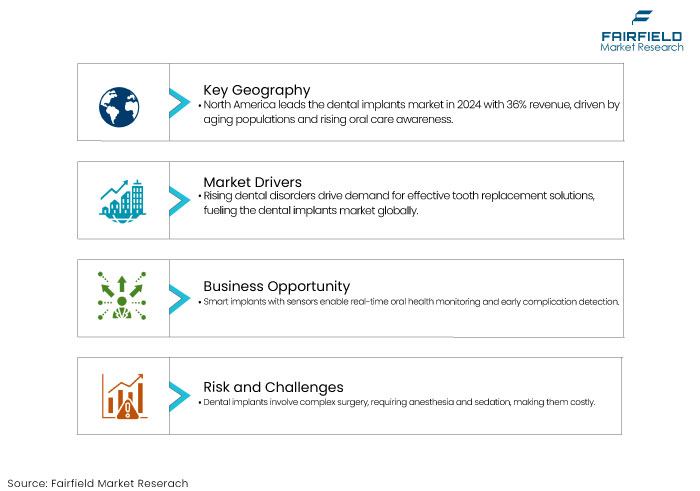
The prevalence of dental disorders, including tooth decay, periodontal disease, and trauma, underscores the significant need for effective tooth replacement solutions to restore oral health and function. It is one of the key drivers for the dental implants market. Dental issues are pervasive worldwide, affecting individuals of all ages and demographics and impacting their quality of life in various ways.
The WHO Global Oral Health Status Report (2022) estimated that oral diseases affect close to 3.5 billion people worldwide, with 3 out of 4 people affected living in middle-income countries. Globally, an estimated 2 billion people suffer from caries of permanent teeth and 514 million children suffer from caries of primary teeth.
Prevalence of the oral diseases continues to increase globally with growing urbanization and changes in living conditions. This is primarily due to inadequate exposure to fluoride (in the water supply and oral hygiene products such as toothpaste), availability and affordability of food with high sugar content, and poor access to oral health care services in the community. Marketing of food and beverages high in sugar, as well as tobacco and alcohol, has led to a growing consumption of products that contribute to oral health conditions and other NCDs.
In response to the prevalence of dental disorders and the resulting need for tooth replacement solutions, dental implants have emerged as a leading choice for restoring oral health and function. Unlike traditional tooth replacement options such as dentures or bridges, dental implants offer a permanent and durable solution that closely resembles natural teeth in both appearance and function.
By surgically placing titanium implants into the jawbone and attaching prosthetic crowns or bridges, dental implants provide stable and long-lasting support for replacement teeth. They integrate with the surrounding bone through a process called osseointegration, ensuring optimal stability and preventing bone loss.
- Growing Focus on Research and Development
Growing focus on research and development for introducing novel technologically advanced implantation devices remains a key driver for the dental implants market growth.
The growing prevalence of tooth-related disorders, both existing and new cases, has led to a significant surge in demand for dental devices. This rise in demand has prompted key industry players to intensify their research and development efforts. Technological innovations, coupled with a strong emphasis on boosting production capacities, are expected to drive substantial market growth in the years to come.
Key Growth Market Barriers
- High Cost of Premium Dental Implants
Dental implants require a surgical procedure. Dental implant surgery is far more complex than other restorations like dental fillings. For the most part, patients will require local anesthesia and a form of dental sedation, thus dental implants are a costly procedure.
High-quality implant materials and specialized types of implants are usually more expensive. Most dental implant procedures take multiple visits and several steps to complete. The prices of dental implants vary depending upon the case, individual, treatment duration, and lack of dental coverage. It is likely to lead to high treatment costs due to the need for routine checkups. This can hamper the dental implants market growth.
The typical prices of zirconia dental implants are usually higher than those of regular titanium dental implants. Also, treatment with zirconia dental implants can be expansive for patients who do not have dental insurance coverage, and this is among the key factors restraining the market growth.
- Risks and Complications of Dental Implants Impede Market Growth
Although dental implantation offers numerous benefits, it also comes with certain risks and safety concerns. These include the potential for infections at the implant site, injury to nearby structures, and nerve damage, which can lead to pain, numbness, or tingling sensations. Such complications are likely to restrict the widespread adoption of dental implants, thereby hindering dental implants market growth throughout the forecast period.
Dental Implants Market Trends and Opportunities
- Incorporating Sensors or Other Technologies into Implants
Incorporating sensors or other technologies into implants can enable real-time monitoring of oral health and early detection of complications. Smart implants can monitor factors such as temperature, pH levels, and pressure within the oral cavity. For example,
- Sensors embedded in the implant can detect subtle changes in temperature or pH that may indicate inflammation, infection, or other issues affecting implant health. This real-time data can alert both patients and healthcare providers to potential problems at their earliest stages, allowing for prompt intervention and treatment.
According to Medical Expo in 2023, Scientists have developed a smart dental implant that resists bacterial growth and generates its electricity through chewing and brushing to power a tissue-rejuvenating light.
Smart implants can also, track key indicators of implant stability and osseointegration, providing valuable feedback on the success of the implantation procedure. By continuously monitoring factors like bone density and implant mobility, these implants can help predict and prevent complications. These complications are implant failure or peri-implantitis, a common inflammatory condition around dental implants.
The data collected by smart implants can be transmitted wirelessly to a mobile device or a cloud-based platform, allowing for remote monitoring and analysis by dental professionals. This enables proactive, personalized care tailored to each patient's unique oral health needs.
The longitudinal data generated by smart implants can contribute to ongoing research and development efforts, further advancing our understanding of dental implantology and improving treatment outcomes over time.
- Digital Dentistry Transforming the Dental Implants Market
One of the key trends in the dental implants market is the integration of digital dentistry technologies, such as CAD/CAM systems, 3D imaging, and AI-guided procedures. These advancements are enhancing the precision of implant placement, reducing procedure times, and improving patient outcomes. 3D printing is also playing a vital role by enabling customized implants tailored to individual patient anatomies.
Digital workflows streamline communication between clinicians and laboratories, ensuring efficient and accurate treatment planning. This trend is further supported by the growing demand for minimally invasive techniques, as digital tools make implant procedures less invasive and more accessible, driving market growth globally.
Segments Covered in the Report
- Titanium Dental Implants Remain the Top Product Type
The market is segmented into titanium and zirconium dental implants, with titanium implants dominating the dental implants market due to their widespread use. Titanium's exceptional biocompatibility with bone, versatility across numerous treatments, and hypoallergenic properties contribute significantly to its market leadership. Its superior success rates and cost-effectiveness compared to other materials further boost its adoption in dental procedures, driving market growth during the forecast period.
Titanium implants are available in both one-piece and two-piece designs, unlike zirconium implants, which are limited to one-piece systems. Two-piece titanium implants offer advanced features, such as supporting overdentures, enhancing their functionality. Additionally, implants come in various dimensions to accommodate patients’ bone sizes, offering greater flexibility in treatment planning.
- Dental Clinics Remain the Dominant End User
The market is segmented by end user into hospitals, ambulatory clinics, and dental clinics, with dental clinics leading the dental implants market. Dental clinics are often the first choice for patients seeking tooth replacement options like dental implants. They offer direct access without requiring hospital referrals, more flexible scheduling, and shorter wait times compared to hospitals.
Handling implant procedures also provides clinics with significant revenue opportunities. Many clinics have invested in advanced on-site capabilities, such as radiography, 3D imaging, and fully equipped surgical facilities, allowing them to independently perform routine implant procedures. Their local accessibility and lower treatment costs make them a preferred choice for patients.
Since implant treatments are typically outpatient procedures that don't require hospitalization, dental clinics provide a convenient and cost-effective alternative, establishing themselves globally as the key driver for implant procedures.
Regional Analysis
- North America Dental Implants Market Surpasses 1/3market Share
North America dominates the dental implants market, accounting for approximately 36% of total revenue in 2024. This growth is driven by an aging population with high dental issue prevalence and increased awareness of oral preventive and restorative treatments.
According to the American Academy of Implant Dentistry, over 3 million people in the region have dental implants, a figure significantly higher than in developing countries. This high figure record is due to great resource availability, higher per capita income, and growing concerns about aesthetics and oral health awareness.
Strict quality standards ensure the safety and reliability of dental implants, boosting patient confidence in implantology as a trusted treatment option. With a rising emphasis on dental aesthetics, North America leads the premium segment, with patients opting for high-quality materials like titanium implants. Additionally, the region's substantial elderly population, along with the growing incidence of tooth decay and periodontal diseases, continues to drive market expansion.
Prominent Players in Global Dental Implants Market
• Osstem Implant Co Ltd
• Straumann Holding AG
• Dentsply Sirona Inc
• Nobel Biocare Services AG
• KYOCERA Medical Corp
• Zimmer Biomet Holdings Inc
• AB Dental Devices
• Alpha-Bio Tec Ltd
• Dentis Co., Ltd.
• Dentium Co Ltd
The Global Dental Implants Market is Segmented as Below
By Product
• Titanium Dental Implants
• External Connectors
• Internal Connectors
• Zirconium Dental Implants
By Procedure
• Root-form Dental Implants
• Plate-form Dental Implants
By End-user
• Hospitals
• Ambulatory Surgical Centers
• Dental Clinics
By Region
• North America
• Europe
• Asia Pacific
• Latin America
• Middle East & Africa
- Executive Summary
- Global Dental Implants Market Snapshot
- Future Projections
- Key Market Trends
- Regional Snapshot, by Value, 2026
- Analyst Recommendations
- Market Overview
- Market Definitions and Segmentations
- Market Dynamics
- Drivers
- Restraints
- Market Opportunities
- Value Chain Analysis
- COVID-19 Impact Analysis
- Porter's Five Forces Analysis
- Impact of Russia-Ukraine Conflict
- PESTLE Analysis
- Regulatory Analysis
- Price Trend Analysis
- Current Prices and Future Projections, 2025-2033
- Price Impact Factors
- Global Dental Implants Market Outlook, 2020 - 2033
- Global Dental Implants Market Outlook, by By Product, Value (US$ Bn), 2020-2033
- Titanium Dental Implants
- External Connectors
- Internal Connectors
- Zirconium Dental Implants
- Global Dental Implants Market Outlook, by By Procedure, Value (US$ Bn), 2020-2033
- Root-form Dental Implants
- Plate-form Dental Implants
- Global Dental Implants Market Outlook, by By End-user, Value (US$ Bn), 2020-2033
- Hospitals
- Ambulatory Surgical Centers
- Dental Clinics
- Global Dental Implants Market Outlook, by Region, Value (US$ Bn), 2020-2033
- North America
- Europe
- Asia Pacific
- Latin America
- Middle East & Africa
- Global Dental Implants Market Outlook, by By Product, Value (US$ Bn), 2020-2033
- North America Dental Implants Market Outlook, 2020 - 2033
- North America Dental Implants Market Outlook, by By Product, Value (US$ Bn), 2020-2033
- Titanium Dental Implants
- External Connectors
- Internal Connectors
- Zirconium Dental Implants
- North America Dental Implants Market Outlook, by By Procedure, Value (US$ Bn), 2020-2033
- Root-form Dental Implants
- Plate-form Dental Implants
- North America Dental Implants Market Outlook, by By End-user, Value (US$ Bn), 2020-2033
- Hospitals
- Ambulatory Surgical Centers
- Dental Clinics
- North America Dental Implants Market Outlook, by Country, Value (US$ Bn), 2020-2033
- U.S. Dental Implants Market Outlook, by By Product, 2020-2033
- U.S. Dental Implants Market Outlook, by By Procedure, 2020-2033
- U.S. Dental Implants Market Outlook, by By End-user, 2020-2033
- Canada Dental Implants Market Outlook, by By Product, 2020-2033
- Canada Dental Implants Market Outlook, by By Procedure, 2020-2033
- Canada Dental Implants Market Outlook, by By End-user, 2020-2033
- BPS Analysis/Market Attractiveness Analysis
- North America Dental Implants Market Outlook, by By Product, Value (US$ Bn), 2020-2033
- Europe Dental Implants Market Outlook, 2020 - 2033
- Europe Dental Implants Market Outlook, by By Product, Value (US$ Bn), 2020-2033
- Titanium Dental Implants
- External Connectors
- Internal Connectors
- Zirconium Dental Implants
- Europe Dental Implants Market Outlook, by By Procedure, Value (US$ Bn), 2020-2033
- Root-form Dental Implants
- Plate-form Dental Implants
- Europe Dental Implants Market Outlook, by By End-user, Value (US$ Bn), 2020-2033
- Hospitals
- Ambulatory Surgical Centers
- Dental Clinics
- Europe Dental Implants Market Outlook, by Country, Value (US$ Bn), 2020-2033
- Germany Dental Implants Market Outlook, by By Product, 2020-2033
- Germany Dental Implants Market Outlook, by By Procedure, 2020-2033
- Germany Dental Implants Market Outlook, by By End-user, 2020-2033
- Italy Dental Implants Market Outlook, by By Product, 2020-2033
- Italy Dental Implants Market Outlook, by By Procedure, 2020-2033
- Italy Dental Implants Market Outlook, by By End-user, 2020-2033
- France Dental Implants Market Outlook, by By Product, 2020-2033
- France Dental Implants Market Outlook, by By Procedure, 2020-2033
- France Dental Implants Market Outlook, by By End-user, 2020-2033
- U.K. Dental Implants Market Outlook, by By Product, 2020-2033
- U.K. Dental Implants Market Outlook, by By Procedure, 2020-2033
- U.K. Dental Implants Market Outlook, by By End-user, 2020-2033
- Spain Dental Implants Market Outlook, by By Product, 2020-2033
- Spain Dental Implants Market Outlook, by By Procedure, 2020-2033
- Spain Dental Implants Market Outlook, by By End-user, 2020-2033
- Russia Dental Implants Market Outlook, by By Product, 2020-2033
- Russia Dental Implants Market Outlook, by By Procedure, 2020-2033
- Russia Dental Implants Market Outlook, by By End-user, 2020-2033
- Rest of Europe Dental Implants Market Outlook, by By Product, 2020-2033
- Rest of Europe Dental Implants Market Outlook, by By Procedure, 2020-2033
- Rest of Europe Dental Implants Market Outlook, by By End-user, 2020-2033
- BPS Analysis/Market Attractiveness Analysis
- Europe Dental Implants Market Outlook, by By Product, Value (US$ Bn), 2020-2033
- Asia Pacific Dental Implants Market Outlook, 2020 - 2033
- Asia Pacific Dental Implants Market Outlook, by By Product, Value (US$ Bn), 2020-2033
- Titanium Dental Implants
- External Connectors
- Internal Connectors
- Zirconium Dental Implants
- Asia Pacific Dental Implants Market Outlook, by By Procedure, Value (US$ Bn), 2020-2033
- Root-form Dental Implants
- Plate-form Dental Implants
- Asia Pacific Dental Implants Market Outlook, by By End-user, Value (US$ Bn), 2020-2033
- Hospitals
- Ambulatory Surgical Centers
- Dental Clinics
- Asia Pacific Dental Implants Market Outlook, by Country, Value (US$ Bn), 2020-2033
- China Dental Implants Market Outlook, by By Product, 2020-2033
- China Dental Implants Market Outlook, by By Procedure, 2020-2033
- China Dental Implants Market Outlook, by By End-user, 2020-2033
- Japan Dental Implants Market Outlook, by By Product, 2020-2033
- Japan Dental Implants Market Outlook, by By Procedure, 2020-2033
- Japan Dental Implants Market Outlook, by By End-user, 2020-2033
- South Korea Dental Implants Market Outlook, by By Product, 2020-2033
- South Korea Dental Implants Market Outlook, by By Procedure, 2020-2033
- South Korea Dental Implants Market Outlook, by By End-user, 2020-2033
- India Dental Implants Market Outlook, by By Product, 2020-2033
- India Dental Implants Market Outlook, by By Procedure, 2020-2033
- India Dental Implants Market Outlook, by By End-user, 2020-2033
- Southeast Asia Dental Implants Market Outlook, by By Product, 2020-2033
- Southeast Asia Dental Implants Market Outlook, by By Procedure, 2020-2033
- Southeast Asia Dental Implants Market Outlook, by By End-user, 2020-2033
- Rest of SAO Dental Implants Market Outlook, by By Product, 2020-2033
- Rest of SAO Dental Implants Market Outlook, by By Procedure, 2020-2033
- Rest of SAO Dental Implants Market Outlook, by By End-user, 2020-2033
- BPS Analysis/Market Attractiveness Analysis
- Asia Pacific Dental Implants Market Outlook, by By Product, Value (US$ Bn), 2020-2033
- Latin America Dental Implants Market Outlook, 2020 - 2033
- Latin America Dental Implants Market Outlook, by By Product, Value (US$ Bn), 2020-2033
- Titanium Dental Implants
- External Connectors
- Internal Connectors
- Zirconium Dental Implants
- Latin America Dental Implants Market Outlook, by By Procedure, Value (US$ Bn), 2020-2033
- Root-form Dental Implants
- Plate-form Dental Implants
- Latin America Dental Implants Market Outlook, by By End-user, Value (US$ Bn), 2020-2033
- Hospitals
- Ambulatory Surgical Centers
- Dental Clinics
- Latin America Dental Implants Market Outlook, by Country, Value (US$ Bn), 2020-2033
- Brazil Dental Implants Market Outlook, by By Product, 2020-2033
- Brazil Dental Implants Market Outlook, by By Procedure, 2020-2033
- Brazil Dental Implants Market Outlook, by By End-user, 2020-2033
- Mexico Dental Implants Market Outlook, by By Product, 2020-2033
- Mexico Dental Implants Market Outlook, by By Procedure, 2020-2033
- Mexico Dental Implants Market Outlook, by By End-user, 2020-2033
- Argentina Dental Implants Market Outlook, by By Product, 2020-2033
- Argentina Dental Implants Market Outlook, by By Procedure, 2020-2033
- Argentina Dental Implants Market Outlook, by By End-user, 2020-2033
- Rest of LATAM Dental Implants Market Outlook, by By Product, 2020-2033
- Rest of LATAM Dental Implants Market Outlook, by By Procedure, 2020-2033
- Rest of LATAM Dental Implants Market Outlook, by By End-user, 2020-2033
- BPS Analysis/Market Attractiveness Analysis
- Latin America Dental Implants Market Outlook, by By Product, Value (US$ Bn), 2020-2033
- Middle East & Africa Dental Implants Market Outlook, 2020 - 2033
- Middle East & Africa Dental Implants Market Outlook, by By Product, Value (US$ Bn), 2020-2033
- Titanium Dental Implants
- External Connectors
- Internal Connectors
- Zirconium Dental Implants
- Middle East & Africa Dental Implants Market Outlook, by By Procedure, Value (US$ Bn), 2020-2033
- Root-form Dental Implants
- Plate-form Dental Implants
- Middle East & Africa Dental Implants Market Outlook, by By End-user, Value (US$ Bn), 2020-2033
- Hospitals
- Ambulatory Surgical Centers
- Dental Clinics
- Middle East & Africa Dental Implants Market Outlook, by Country, Value (US$ Bn), 2020-2033
- GCC Dental Implants Market Outlook, by By Product, 2020-2033
- GCC Dental Implants Market Outlook, by By Procedure, 2020-2033
- GCC Dental Implants Market Outlook, by By End-user, 2020-2033
- South Africa Dental Implants Market Outlook, by By Product, 2020-2033
- South Africa Dental Implants Market Outlook, by By Procedure, 2020-2033
- South Africa Dental Implants Market Outlook, by By End-user, 2020-2033
- Egypt Dental Implants Market Outlook, by By Product, 2020-2033
- Egypt Dental Implants Market Outlook, by By Procedure, 2020-2033
- Egypt Dental Implants Market Outlook, by By End-user, 2020-2033
- Nigeria Dental Implants Market Outlook, by By Product, 2020-2033
- Nigeria Dental Implants Market Outlook, by By Procedure, 2020-2033
- Nigeria Dental Implants Market Outlook, by By End-user, 2020-2033
- Rest of Middle East Dental Implants Market Outlook, by By Product, 2020-2033
- Rest of Middle East Dental Implants Market Outlook, by By Procedure, 2020-2033
- Rest of Middle East Dental Implants Market Outlook, by By End-user, 2020-2033
- BPS Analysis/Market Attractiveness Analysis
- Middle East & Africa Dental Implants Market Outlook, by By Product, Value (US$ Bn), 2020-2033
- Competitive Landscape
- Company Vs Segment Heatmap
- Company Market Share Analysis, 2025
- Competitive Dashboard
- Company Profiles
- Osstem Implant Co Ltd
- Company Overview
- Product Portfolio
- Financial Overview
- Business Strategies and Developments
- Straumann Holding AG
- Dentsply Sirona Inc
- Nobel Biocare Services AG
- KYOCERA Medical Corp
- Zimmer Biomet Holdings Inc
- AB Dental Devices
- Alpha-Bio Tec Ltd
- Dentis Co., Ltd.
- Dentium Co Ltd
- Osstem Implant Co Ltd
- Appendix
- Research Methodology
- Report Assumptions
- Acronyms and Abbreviations
|
BASE YEAR |
HISTORICAL DATA |
FORECAST PERIOD |
UNITS |
|||
 |
2025 |
 |
2020 - 2025 |
 |
2026 - 2033 |
Value: US$ Million |
Our Research Methodology
Considering the volatility of business today, traditional approaches to strategizing a game plan can be unfruitful if not detrimental. True ambiguity is no way to determine a forecast. A myriad of predetermined factors must be accounted for such as the degree of risk involved, the magnitude of circumstances, as well as conditions or consequences that are not known or unpredictable. To circumvent binary views that cast uncertainty, the application of market research intelligence to strategically posture, move, and enable actionable outcomes is necessary.
View Methodology
Quality Assured
Rigorous Validation Process

Confidentiality Assured
End-to-end Data Security

Custom Research Services
Tailored To Your Objectives
FAQs
The Dental Implants market size is USD 8.4 Billion in 2026.
The Dental Implants market is projected to grow at a 7.4% CAGR by 2033.
The Dental Implants market growth drivers include the rising prevalence of dental disorders, increasing focus on research and development, and growing demand for dental aesthetics.
North America is the dominating region for the Dental Implants market.
Straumann Holding AG, Dentsply Sirona Inc, Nobel Biocare Services AG, Zimmer Biomet Holdings Inc, and Osstem Implant Co Ltd are some leading industry players in the Dental Implants market.
Related Reports
Fructosamine Test Market Insights, Competitive Landscape, and Market Forecast - 2033
The Fructosamine Test Market is projected to grow from USD 382.2 Million in 2026 to USD 545 Million by 2033, at a CAGR of 5.2%
Urothelial Carcinoma Diagnostics Market Insights, Competitive Landscape, and Market Forecast - 2033
The Urothelial Carcinoma Diagnostics Market is expected to grow from USD 2.1 Billion in 2026 to USD 4 Billion by 2033, registering a CAGR of 9.8%
Prefilled Syringes Market Insights, Competitive Landscape, and Market Forecast - 2033
The Prefilled Syringes Market is expected to grow from USD 2.8 Billion in 2026 to USD 5.1 Billion by 2033, registering a CAGR of 8.8%
Biofilm Treatment Market Insights, Competitive Landscape, and Market Forecast - 2033
The Biofilm Treatment Market is expected to grow from USD 2.5 Billion in 2026 to USD 4.4 Billion by 2033, registering a CAGR of 8.5%
Elastomeric Infusion Pumps Market Insights, Competitive Landscape, and Market Forecast - 2033
The Elastomeric Infusion Pumps Market is expected to grow from USD 1.3 Billion in 2026 to USD 2.1 Billion by 2033, registering a CAGR of 7.3%
Peripheral Stent Implants Market Insights, Competitive Landscape, and Market Forecast - 2033
The Peripheral Stent Implants Market is expected to grow from USD 4.2 Billion in 2026 to USD 6.6 Billion by 2033, registering a CAGR of 6.7%