



Fertility Testing Devices Market
Fertility Testing Devices Market Insights, Competitive Landscape, and Market Forecast - 2033
Global Fertility Testing Devices Market Forecast
The Fertility Testing Devices Market is expected to grow from USD 2.6 Billion in 2026 to USD 4.1 Billion by 2033, reflecting strong industry expansion and registering a CAGR of 6.8% during the forecast period from 2026 to 2033.
Fertility Testing Devices Market: Key Insights & Trends
- Ovulation kits lead with 55% share, reflecting strong consumer trust and affordability.
- Fertility monitors gain momentum as AI and digital tools enhance accuracy.
- Female testing dominates demand, while male kits expand with growing acceptance.
- Pharmacies hold 45% share, but online channels rapidly accelerate with e-commerce growth.
- Rising infertility from lifestyle and demographic shifts fuels adoption of home-use devices.
- Emerging economies and AI-enabled telemedicine create major opportunities in connected solutions.
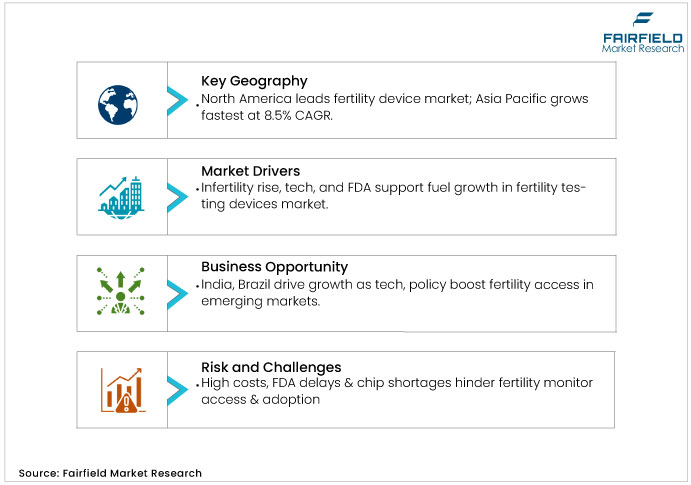
- North America leads with 35% share, followed by Europe at 28%, while Asia Pacific surges on urbanization.
- Key players drive innovation through digital monitors, online retail, and AI-powered diagnostics.
Key Growth Drivers
- Increasing Prevalence of Infertility Due to Lifestyle and Demographic Shifts
Infertility affects 1 in 6 people globally, with U.S. rates rising among women aged 15–49 due to delayed childbearing, obesity, and stress. The average maternal age at first birth continues to climb, creating greater demand for early, accurate testing solutions. These shifts are driving adoption of accessible, non-invasive products, positioning the fertility testing devices market for steady expansion. Home-use kits are increasingly popular, supported by AI-enabled applications that enhance accuracy and reduce misdiagnosis, improving user confidence. Regulatory backing also plays a role, with the FDA approving dozens of new devices since 2020, lowering entry barriers and broadening consumer access. Collectively, these factors point to sustained revenue growth, underscoring the segment’s resilience even in the face of macroeconomic pressures such as inflation and shifting healthcare spending priorities worldwide.
- Advancements in Home-Based and Digital Fertility Testing Technologies
Digital fertility monitors using biosensor technology have gained strong traction, with adoption surging since 2022 as real-time hormone tracking now reaches near-lab accuracy. Regulatory momentum supports this shift, with the U.S. FDA granting multiple new clearances for connected devices in 2024. Demographic change also plays a role, as more women over 35 seek fertility guidance, creating sustained demand. Within the fertility testing devices market, innovations are lowering barriers through scalable manufacturing that steadily reduces costs, making products more accessible. International regulators such as the European Medicines Agency are aligning standards, promoting cross-border trade and enhancing global availability. Post-pandemic recovery has further boosted R&D, encouraging hybrid models that blend wearable devices with telemedicine. These dynamics are positioning digital fertility solutions as a fast-growing sub-segment, reshaping consumer health management worldwide.
- Rising Awareness Through Public Health Campaigns and Digital Media
Public health campaigns by organizations such as the CDC have boosted infertility awareness, reaching millions in 2024 and driving a notable rise in testing kit purchases. Globally, WHO’s reproductive health guidelines have shaped policies across multiple countries, increasing screening participation. Social media further amplifies visibility, with platforms driving a large share of inquiries in the fertility testing devices market, especially among millennials delaying parenthood. This growing awareness reduces stigma, as more people now view testing as routine. Regulatory measures, such as EU labeling mandates, strengthen trust, while urbanization and shifting lifestyles heighten demand. Combined with subsidies in national programs, these factors are expected to expand market penetration significantly in emerging urban centers by 2027.
Key Restraints
- Affordability challenges and reimbursement gaps restrict wider fertility testing adoption
Premium fertility monitors priced at USD 150–300 remain out of reach for many, with affordability issues deterring low-income users. Lengthy FDA approval timelines increase development costs, while semiconductor shortages drive production expenses higher. These combined pressures limit accessibility and slow overall adoption, especially in price-sensitive segments where affordability and timely availability are critical concerns.
- Device accuracy issues and recalls undermine consumer confidence and market growth
Over-the-counter kits show variability, with false positives up to 20% in humid climates, per a 2024 Journal of Clinical Endocrinology study. Regulatory scrutiny from EMA has led to recalls of 8 devices in 2024, eroding consumer confidence. Competitors face threats from unverified imports, while supply chain issues delay quality controls, limiting growth to 5% in affected regions.
Fertility Testing Devices Market Trends and Opportunities
- Emerging regions drive fertility testing growth through subsidies and digital access
Emerging regions such as India and Brazil represent a significant growth opportunity, supported by rising infertility prevalence and large unmet demand among women of reproductive age. Policies such as India’s Ayushman Bharat subsidies improve affordability, while new biosensor-based strips integrated with mobile platforms expand rural access. These drivers are expected to accelerate adoption and deliver strong double-digit growth potential through 2030 across developing markets.
- AI and telemedicine enhance personalized fertility solutions with connected technology
AI-enhanced apps could add USD 800 million to the fertility testing devices market by 2028, with telemedicine adoption rising 40% post-pandemic. Policy changes, such as U.S. HIPAA expansions, enable data sharing, while subsidies in the EU support 15% cost reductions. Unmet needs for personalized tracking in 25% of users drive innovation, with market sizing estimating 18% growth in connected devices.
Segment-wise Trends & Analysis
Ovulation kits dominate fertility testing while monitors gain momentum with technology
Ovulation testing kits lead the fertility testing devices market with a 55% share in 2025, valued at USD 1.49 billion, due to their affordability and ease of use. Fertility monitors emerge as the fastest-growing segment at a 9.2% CAGR, propelled by digital features appealing to tech-savvy consumers. This dominance reflects consumer preference for quick diagnostics, while growth in monitors stems from accuracy improvements.
- Ovulation kits face competition from apps, challenging 10% market share.
- Monitors offer opportunities in AI integration for predictive analytics.
- Supply chain efficiencies could reduce kit costs by 15%.
- Regulatory approvals accelerate monitor adoption in Asia.
Female testing leads global demand while male segment adoption expands steadily
The female segment accounts for the majority share in 2025, supported by high global PCOS prevalence and strong demand for diagnostic solutions. Male testing, though smaller, is expanding rapidly as stigma declines and home sperm analysis kits gain acceptance, addressing previously underserved needs in reproductive health.
- Female kits dominate retail channels with 60% penetration.
- Male segment challenges include privacy concerns in testing.
- Opportunities arise from bundled gender-neutral devices.
- Trends show 20% rise in male inquiries via online platforms.
Pharmacies maintain strong presence while online sales accelerate with e-commerce
Retail pharmacies command 45% share in the fertility testing devices market for 2025, valued at USD 1.22 billion, owing to widespread availability. Online channels grow at 10.1% CAGR, fueled by e-commerce convenience. Pharmacies ensure trust, while online expands reach to remote areas.
- Retail faces inventory bottlenecks during peaks.
- Online trends include subscription models for recurring tests.
- Challenges involve counterfeit risks in digital sales.
- Opportunities in partnerships with telehealth platforms.
Regional Insights
North America leads fertility testing with awareness, technology adoption, and policy support
North America leads the fertility testing devices market with 35% global share, driven by high awareness and tech adoption; Europe follows at 28%, emphasizing regulatory compliance; Asia Pacific grows fastest at 8.5% CAGR due to population density and urbanization.
U.S. Fertility Testing Devices Market – 2025 Snapshot & Outlook
High infertility prevalence continues to drive demand for ovulation kits, supported by FDA approvals that improve accuracy. Online retail channels, led by Amazon, are expanding sales significantly. Policy incentives such as IRS medical expense deductions and Affordable Care Act coverage improve affordability and access. Consumer adoption of wearables is rising, while post-pandemic recovery boosts R&D investments, reinforcing steady growth momentum and shaping a positive long-term outlook for fertility solutions.
- Delayed childbearing trend: Average age 27.3 years boosts kit demand.
- Digital health surge: 30% growth in app-linked devices.
- Policy impact: ACA reimbursements enhance affordability by 15%.
Europe strengthens fertility testing through regulation, subsidies, and digital integration
Germany and the U.K. anchor Europe's market, with combined 60% regional share; trends include stringent EMA regulations and rising IVF linkages.
Germany Fertility Testing Devices Market – 2025 Snapshot & Outlook
Advanced healthcare systems support steady growth, with female testing dominating due to high infertility prevalence. Government subsidies improve affordability, while EU surveys show rising use of home kits before IVF. Pharmacies remain key retail channels, sustaining strong sales. Aging demographics further amplify demand as more women over 35 seek early and accessible reproductive health solutions.
- Regulatory harmony: EMA standards reduce approval times by 20%.
- Subsidized access: GKV policies lower barriers for 30% users.
- Urban demand: Berlin trials boost online penetration 25%.
NHS integrations drive market growth, with ovulation kits holding the largest share amid rising infertility rates. Tax incentives and policy reforms expand affordability and free screenings. Consumer preference increasingly favors digital monitors, while e-commerce accelerates post-Brexit, strengthening access and adoption across the UK fertility landscape through supportive healthcare initiatives.
- NHS linkages: Free consults drive 18% testing uptake.
- Digital trends: App usage up 35% among millennials.
- Cost efficiencies: Tax reliefs cut expenses by 15%.
Asia Pacific demand rises with low fertility rates and urbanization trends
Japan, South Korea, and China drive Asia Pacific’s market, together holding a 45% share. Low fertility rates averaging 1.2–1.6 births per woman, coupled with rapid urbanization, remain the primary forces shaping demand, according to the UN Population Division (2024).
Japan Fertility Testing Devices Market – 2025 Snapshot & Outlook
Aging demographics sustain growth, with fertility monitors holding a strong share amid rising infertility rates. Government subsidies reduce costs and enhance margins, while surveys show widespread use among urban women. Retail pharmacies dominate distribution, and persistently low birth rates intensify demand for early testing solutions to address reproductive health challenges.
- Demographic pressure: Over-35 segment grows 20%.
- Tech adoption: Wearables penetrate 40% households.
- Policy support: Subsidies enhance affordability 12%.
India Fertility Testing Devices Market – 2025 Snapshot & Outlook
Rapid urbanization drives strong growth, with the female segment holding the majority share amid rising infertility. Ayushman Bharat reimbursements improve affordability, while ICMR reports highlight sharp increases in app-based testing adoption. Expanding online channels and a growing middle-class population further accelerate demand, positioning India for robust market expansion through 2032.
- Awareness campaigns: Government drives 25% uptake.
- E-commerce boom: Flipkart sales up 35%.
- Rural expansion: Mobile units reach 15% more users.
Prominent Players in Global Fertility Testing Devices Market
• HILIN LIFE PRODUCTS
• Church & Dwight Co., Inc.
• Abbott
• Prestige Consumer Healthcare, Inc.
• TaiDoc Technology Corporation
• bioZhena Corporation
• Quidel Corporation
The Global Fertility Testing Devices Market is Segmented as Below
By Product
• Ovulation Testing Kit
• Fertility Monitors
By Gender
• Male
• Female
By Distribution Channel
• Hospital Pharmacy
• Retail Pharmacy
• Online Pharmacy
By Region
• North America
• Europe
• Asia Pacific
• Latin America
• Middle East & Africa
- Executive Summary
- Global Fertility Testing Devices Market Snapshot
- Future Projections
- Key Market Trends
- Regional Snapshot, by Value, 2026
- Analyst Recommendations
- Market Overview
- Market Definitions and Segmentations
- Market Dynamics
- Drivers
- Restraints
- Market Opportunities
- Value Chain Analysis
- COVID-19 Impact Analysis
- Porter's Five Forces Analysis
- Impact of Russia-Ukraine Conflict
- PESTLE Analysis
- Regulatory Analysis
- Price Trend Analysis
- Current Prices and Future Projections, 2025-2033
- Price Impact Factors
- Global Fertility Testing Devices Market Outlook, 2020 - 2033
- Global Fertility Testing Devices Market Outlook, by By Product, Value (US$ Bn), 2020-2033
- Ovulation Testing Kit
- Fertility Monitors
- Global Fertility Testing Devices Market Outlook, by By Gender, Value (US$ Bn), 2020-2033
- Male
- Female
- Global Fertility Testing Devices Market Outlook, by By Distribution Channel, Value (US$ Bn), 2020-2033
- Hospital Pharmacy
- Retail Pharmacy
- Online Pharmacy
- Global Fertility Testing Devices Market Outlook, by Region, Value (US$ Bn), 2020-2033
- North America
- Europe
- Asia Pacific
- Latin America
- Middle East & Africa
- Global Fertility Testing Devices Market Outlook, by By Product, Value (US$ Bn), 2020-2033
- North America Fertility Testing Devices Market Outlook, 2020 - 2033
- North America Fertility Testing Devices Market Outlook, by By Product, Value (US$ Bn), 2020-2033
- Ovulation Testing Kit
- Fertility Monitors
- North America Fertility Testing Devices Market Outlook, by By Gender, Value (US$ Bn), 2020-2033
- Male
- Female
- North America Fertility Testing Devices Market Outlook, by By Distribution Channel, Value (US$ Bn), 2020-2033
- Hospital Pharmacy
- Retail Pharmacy
- Online Pharmacy
- North America Fertility Testing Devices Market Outlook, by Country, Value (US$ Bn), 2020-2033
- U.S. Fertility Testing Devices Market Outlook, by By Product, 2020-2033
- U.S. Fertility Testing Devices Market Outlook, by By Gender, 2020-2033
- U.S. Fertility Testing Devices Market Outlook, by By Distribution Channel, 2020-2033
- Canada Fertility Testing Devices Market Outlook, by By Product, 2020-2033
- Canada Fertility Testing Devices Market Outlook, by By Gender, 2020-2033
- Canada Fertility Testing Devices Market Outlook, by By Distribution Channel, 2020-2033
- BPS Analysis/Market Attractiveness Analysis
- North America Fertility Testing Devices Market Outlook, by By Product, Value (US$ Bn), 2020-2033
- Europe Fertility Testing Devices Market Outlook, 2020 - 2033
- Europe Fertility Testing Devices Market Outlook, by By Product, Value (US$ Bn), 2020-2033
- Ovulation Testing Kit
- Fertility Monitors
- Europe Fertility Testing Devices Market Outlook, by By Gender, Value (US$ Bn), 2020-2033
- Male
- Female
- Europe Fertility Testing Devices Market Outlook, by By Distribution Channel, Value (US$ Bn), 2020-2033
- Hospital Pharmacy
- Retail Pharmacy
- Online Pharmacy
- Europe Fertility Testing Devices Market Outlook, by Country, Value (US$ Bn), 2020-2033
- Germany Fertility Testing Devices Market Outlook, by By Product, 2020-2033
- Germany Fertility Testing Devices Market Outlook, by By Gender, 2020-2033
- Germany Fertility Testing Devices Market Outlook, by By Distribution Channel, 2020-2033
- Italy Fertility Testing Devices Market Outlook, by By Product, 2020-2033
- Italy Fertility Testing Devices Market Outlook, by By Gender, 2020-2033
- Italy Fertility Testing Devices Market Outlook, by By Distribution Channel, 2020-2033
- France Fertility Testing Devices Market Outlook, by By Product, 2020-2033
- France Fertility Testing Devices Market Outlook, by By Gender, 2020-2033
- France Fertility Testing Devices Market Outlook, by By Distribution Channel, 2020-2033
- U.K. Fertility Testing Devices Market Outlook, by By Product, 2020-2033
- U.K. Fertility Testing Devices Market Outlook, by By Gender, 2020-2033
- U.K. Fertility Testing Devices Market Outlook, by By Distribution Channel, 2020-2033
- Spain Fertility Testing Devices Market Outlook, by By Product, 2020-2033
- Spain Fertility Testing Devices Market Outlook, by By Gender, 2020-2033
- Spain Fertility Testing Devices Market Outlook, by By Distribution Channel, 2020-2033
- Russia Fertility Testing Devices Market Outlook, by By Product, 2020-2033
- Russia Fertility Testing Devices Market Outlook, by By Gender, 2020-2033
- Russia Fertility Testing Devices Market Outlook, by By Distribution Channel, 2020-2033
- Rest of Europe Fertility Testing Devices Market Outlook, by By Product, 2020-2033
- Rest of Europe Fertility Testing Devices Market Outlook, by By Gender, 2020-2033
- Rest of Europe Fertility Testing Devices Market Outlook, by By Distribution Channel, 2020-2033
- BPS Analysis/Market Attractiveness Analysis
- Europe Fertility Testing Devices Market Outlook, by By Product, Value (US$ Bn), 2020-2033
- Asia Pacific Fertility Testing Devices Market Outlook, 2020 - 2033
- Asia Pacific Fertility Testing Devices Market Outlook, by By Product, Value (US$ Bn), 2020-2033
- Ovulation Testing Kit
- Fertility Monitors
- Asia Pacific Fertility Testing Devices Market Outlook, by By Gender, Value (US$ Bn), 2020-2033
- Male
- Female
- Asia Pacific Fertility Testing Devices Market Outlook, by By Distribution Channel, Value (US$ Bn), 2020-2033
- Hospital Pharmacy
- Retail Pharmacy
- Online Pharmacy
- Asia Pacific Fertility Testing Devices Market Outlook, by Country, Value (US$ Bn), 2020-2033
- China Fertility Testing Devices Market Outlook, by By Product, 2020-2033
- China Fertility Testing Devices Market Outlook, by By Gender, 2020-2033
- China Fertility Testing Devices Market Outlook, by By Distribution Channel, 2020-2033
- Japan Fertility Testing Devices Market Outlook, by By Product, 2020-2033
- Japan Fertility Testing Devices Market Outlook, by By Gender, 2020-2033
- Japan Fertility Testing Devices Market Outlook, by By Distribution Channel, 2020-2033
- South Korea Fertility Testing Devices Market Outlook, by By Product, 2020-2033
- South Korea Fertility Testing Devices Market Outlook, by By Gender, 2020-2033
- South Korea Fertility Testing Devices Market Outlook, by By Distribution Channel, 2020-2033
- India Fertility Testing Devices Market Outlook, by By Product, 2020-2033
- India Fertility Testing Devices Market Outlook, by By Gender, 2020-2033
- India Fertility Testing Devices Market Outlook, by By Distribution Channel, 2020-2033
- Southeast Asia Fertility Testing Devices Market Outlook, by By Product, 2020-2033
- Southeast Asia Fertility Testing Devices Market Outlook, by By Gender, 2020-2033
- Southeast Asia Fertility Testing Devices Market Outlook, by By Distribution Channel, 2020-2033
- Rest of SAO Fertility Testing Devices Market Outlook, by By Product, 2020-2033
- Rest of SAO Fertility Testing Devices Market Outlook, by By Gender, 2020-2033
- Rest of SAO Fertility Testing Devices Market Outlook, by By Distribution Channel, 2020-2033
- BPS Analysis/Market Attractiveness Analysis
- Asia Pacific Fertility Testing Devices Market Outlook, by By Product, Value (US$ Bn), 2020-2033
- Latin America Fertility Testing Devices Market Outlook, 2020 - 2033
- Latin America Fertility Testing Devices Market Outlook, by By Product, Value (US$ Bn), 2020-2033
- Ovulation Testing Kit
- Fertility Monitors
- Latin America Fertility Testing Devices Market Outlook, by By Gender, Value (US$ Bn), 2020-2033
- Male
- Female
- Latin America Fertility Testing Devices Market Outlook, by By Distribution Channel, Value (US$ Bn), 2020-2033
- Hospital Pharmacy
- Retail Pharmacy
- Online Pharmacy
- Latin America Fertility Testing Devices Market Outlook, by Country, Value (US$ Bn), 2020-2033
- Brazil Fertility Testing Devices Market Outlook, by By Product, 2020-2033
- Brazil Fertility Testing Devices Market Outlook, by By Gender, 2020-2033
- Brazil Fertility Testing Devices Market Outlook, by By Distribution Channel, 2020-2033
- Mexico Fertility Testing Devices Market Outlook, by By Product, 2020-2033
- Mexico Fertility Testing Devices Market Outlook, by By Gender, 2020-2033
- Mexico Fertility Testing Devices Market Outlook, by By Distribution Channel, 2020-2033
- Argentina Fertility Testing Devices Market Outlook, by By Product, 2020-2033
- Argentina Fertility Testing Devices Market Outlook, by By Gender, 2020-2033
- Argentina Fertility Testing Devices Market Outlook, by By Distribution Channel, 2020-2033
- Rest of LATAM Fertility Testing Devices Market Outlook, by By Product, 2020-2033
- Rest of LATAM Fertility Testing Devices Market Outlook, by By Gender, 2020-2033
- Rest of LATAM Fertility Testing Devices Market Outlook, by By Distribution Channel, 2020-2033
- BPS Analysis/Market Attractiveness Analysis
- Latin America Fertility Testing Devices Market Outlook, by By Product, Value (US$ Bn), 2020-2033
- Middle East & Africa Fertility Testing Devices Market Outlook, 2020 - 2033
- Middle East & Africa Fertility Testing Devices Market Outlook, by By Product, Value (US$ Bn), 2020-2033
- Ovulation Testing Kit
- Fertility Monitors
- Middle East & Africa Fertility Testing Devices Market Outlook, by By Gender, Value (US$ Bn), 2020-2033
- Male
- Female
- Middle East & Africa Fertility Testing Devices Market Outlook, by By Distribution Channel, Value (US$ Bn), 2020-2033
- Hospital Pharmacy
- Retail Pharmacy
- Online Pharmacy
- Middle East & Africa Fertility Testing Devices Market Outlook, by Country, Value (US$ Bn), 2020-2033
- GCC Fertility Testing Devices Market Outlook, by By Product, 2020-2033
- GCC Fertility Testing Devices Market Outlook, by By Gender, 2020-2033
- GCC Fertility Testing Devices Market Outlook, by By Distribution Channel, 2020-2033
- South Africa Fertility Testing Devices Market Outlook, by By Product, 2020-2033
- South Africa Fertility Testing Devices Market Outlook, by By Gender, 2020-2033
- South Africa Fertility Testing Devices Market Outlook, by By Distribution Channel, 2020-2033
- Egypt Fertility Testing Devices Market Outlook, by By Product, 2020-2033
- Egypt Fertility Testing Devices Market Outlook, by By Gender, 2020-2033
- Egypt Fertility Testing Devices Market Outlook, by By Distribution Channel, 2020-2033
- Nigeria Fertility Testing Devices Market Outlook, by By Product, 2020-2033
- Nigeria Fertility Testing Devices Market Outlook, by By Gender, 2020-2033
- Nigeria Fertility Testing Devices Market Outlook, by By Distribution Channel, 2020-2033
- Rest of Middle East Fertility Testing Devices Market Outlook, by By Product, 2020-2033
- Rest of Middle East Fertility Testing Devices Market Outlook, by By Gender, 2020-2033
- Rest of Middle East Fertility Testing Devices Market Outlook, by By Distribution Channel, 2020-2033
- BPS Analysis/Market Attractiveness Analysis
- Middle East & Africa Fertility Testing Devices Market Outlook, by By Product, Value (US$ Bn), 2020-2033
- Competitive Landscape
- Company Vs Segment Heatmap
- Company Market Share Analysis, 2025
- Competitive Dashboard
- Company Profiles
- HILIN LIFE PRODUCTS
- Company Overview
- Product Portfolio
- Financial Overview
- Business Strategies and Developments
- Church & Dwight Co., Inc.
- Abbott
- Prestige Consumer Healthcare, Inc.
- TaiDoc Technology Corporation
- bioZhena Corporation
- Quidel Corporation
- HILIN LIFE PRODUCTS
- Appendix
- Research Methodology
- Report Assumptions
- Acronyms and Abbreviations
|
BASE YEAR |
HISTORICAL DATA |
FORECAST PERIOD |
UNITS |
|||
 |
2025 |
 |
2020 - 2025 |
 |
2026 - 2033 |
Value: US$ Million |
Our Research Methodology
Considering the volatility of business today, traditional approaches to strategizing a game plan can be unfruitful if not detrimental. True ambiguity is no way to determine a forecast. A myriad of predetermined factors must be accounted for such as the degree of risk involved, the magnitude of circumstances, as well as conditions or consequences that are not known or unpredictable. To circumvent binary views that cast uncertainty, the application of market research intelligence to strategically posture, move, and enable actionable outcomes is necessary.
View Methodology
Quality Assured
Rigorous Validation Process

Confidentiality Assured
End-to-end Data Security

Custom Research Services
Tailored To Your Objectives
FAQs
The Fertility Testing Devices market size is USD 2.6 Billion in 2026.
The Fertility Testing Devices market is projected to grow at a 6.8% CAGR by 2033.
The Fertility Testing Devices market growth drivers include rising infertility rates, advancements in home-based and digital fertility testing technologies, and increasing awareness through public health campaigns and digital media.
North America is the dominating region for the Fertility Testing Devices market.
Abbott, Church & Dwight Co., Inc., Prestige Consumer Healthcare, Inc., Quidel Corporation, and TaiDoc Technology Corporation are some leading industry players in the Fertility Testing Devices market.
Related Reports
Fructosamine Test Market Insights, Competitive Landscape, and Market Forecast - 2033
The Fructosamine Test Market is projected to grow from USD 382.2 Million in 2026 to USD 545 Million by 2033, at a CAGR of 5.2%
Urothelial Carcinoma Diagnostics Market Insights, Competitive Landscape, and Market Forecast - 2033
The Urothelial Carcinoma Diagnostics Market is expected to grow from USD 2.1 Billion in 2026 to USD 4 Billion by 2033, registering a CAGR of 9.8%
Prefilled Syringes Market Insights, Competitive Landscape, and Market Forecast - 2033
The Prefilled Syringes Market is expected to grow from USD 2.8 Billion in 2026 to USD 5.1 Billion by 2033, registering a CAGR of 8.8%
Biofilm Treatment Market Insights, Competitive Landscape, and Market Forecast - 2033
The Biofilm Treatment Market is expected to grow from USD 2.5 Billion in 2026 to USD 4.4 Billion by 2033, registering a CAGR of 8.5%
Elastomeric Infusion Pumps Market Insights, Competitive Landscape, and Market Forecast - 2033
The Elastomeric Infusion Pumps Market is expected to grow from USD 1.3 Billion in 2026 to USD 2.1 Billion by 2033, registering a CAGR of 7.3%
Peripheral Stent Implants Market Insights, Competitive Landscape, and Market Forecast - 2033
The Peripheral Stent Implants Market is expected to grow from USD 4.2 Billion in 2026 to USD 6.6 Billion by 2033, registering a CAGR of 6.7%